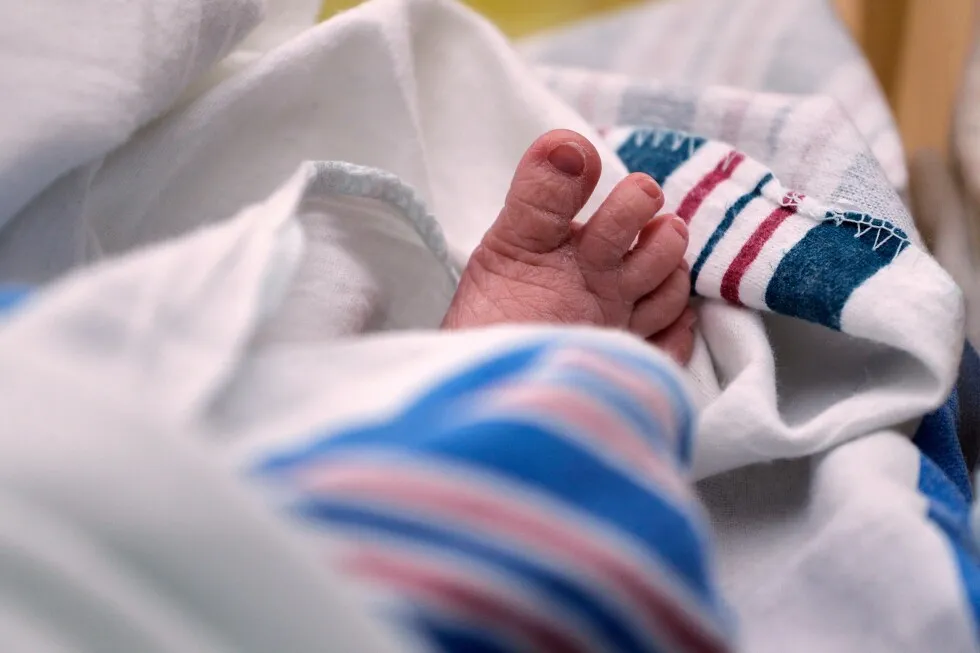
The toes of a baby are seen at a hospital in McAllen, Texas, on Wednesday, July 29, 2020. (AP Photo/Eric Gay, File) Updated [hour]:[minute] [AMPM] [timezone], [monthFull] [day], [year] NEW YORK (AP) — U.S. births fell a little in 2025, according to newly posted provisional data.Slightly over 3.6 million births have been reported through birth certificates, or about 24,000 fewer than in 2024. The decline seems to confirm predictions by some experts, who doubted a slight increase in births in 2024 marked the start of an upward trend.The Centers for Disease Control and Prevention updated its provisional birth data late last week, filling in two months of missing data and offering the first good look at last year’s tally.The posted numbers account for nearly all of the babies born in 2025, according to the CDC. Data is still being compiled and analyzed, but the final tally might only add “a few thousand additional births,” said Robert Anderson, who oversees birth and death tracking at the CDC’s National Center for Health Statistics. Experts say people are marrying later and also worry about their ability to have the money, health insurance and other resources needed to raise children in a stable environment.Last year, the Trump administration took steps to encourage more births, like issuing an executive order meant to expand access to and reduce costs of in vitro fertilization and backing the idea of “baby bonuses” that might encourage more couples to have kids. So far, only the number of births are available — and not birth rates and other information that can give insights into who is having babies. For example, although births increased in 2024 over the year before, the fertility rate actually fell, noted Karen Guzzo, a family demographer at the University of North Carolina.The fertility rate is a statistic describing whether each generation has enough children to replace itself — about 2.1 kids per woman. It has been sliding in America for close to two decades as more women wait longer to have children or don’t have kids at all. For 2025, “I wouldn’t expect birth or fertility rates to have risen; I would expect them to fall because childbearing is highly related to economic conditions and uncertainty,” Guzzo said in an email.Also, most of the births in 2025 would have been children conceived in 2024, when people were worried about affordability and political polarization, she added.As a general trend, U.S. births and birth rates have been falling for years. They dropped in 2020, then rose for two straight years after that, an increase experts partly attributed to pregnancies put off amid the COVID-19 pandemic.A 2% drop in 2023 put U.S. births at fewer than 3.6 million, the lowest one-year tally since 1979.___The Associated Press Health and Science Department receives support from the Howard Hughes Medical Institute’s Department of Science Education and the Robert Wood Johnson Foundation. The AP is solely responsible for all content. Stobbe mainly covers public health for The Associated Press.
SRCAssociated Press (AP)
LANGEN
LEANCenter
WORDS496
ENT6
FRI · 2026-02-06 · 17:23 GMTBRIEF NSR-2026-0206-14021
NSR-2026-0206-14021News Report·EN·Economic Impact
US births dropped last year, suggesting the 2024 uptick was short-lived
U.S. births decreased slightly in 2025, with just over 3.6 million births reported, according to provisional data from the CDC.
By
MIKE STOBBEAssociated Press (AP)Filed 2026-02-06 · 17:23 GMTLean · CenterRead · 2 min
Associated Press (AP)FIG 01
Reading time
2min
Word count
496words
Sources cited
2cited
Entities identified
6entities
Quality score
100%
§ 01
Briefing Summary
AI-generatedNEWSAR · AI
U.S. births decreased slightly in 2025, with just over 3.6 million births reported, according to provisional data from the CDC. This decline of approximately 24,000 births compared to 2024 suggests the previous year's increase was not the start of an upward trend. Experts attribute the falling birth rate to factors such as people marrying later and concerns about the financial and resource requirements of raising children. The fertility rate, which has been declining for two decades, is expected to have also fallen in 2025 due to economic uncertainty and political polarization. While the Trump administration took steps to encourage births, only the total number of births is currently available, with further analysis needed to understand birth rates and demographic details.
Confidence 0.90Sources 2Claims 5Entities 6
§ 02
Article analysis
Model · rule-basedFraming
Economic Impact
Public Health
Tone
Measured
AI-assessed
CalmNeutralAlarmist
Factuality
0.80 / 1.00
Factual
LowHigh
Sources cited
2
Limited
FewMany
§ 03
Key claims
5 extracted01
The posted numbers account for nearly all of the babies born in 2025, according to the CDC.
factualCDC
Confidence
1.00
02
Slightly over 3.6 million births have been reported through birth certificates in 2025.
statisticAP
Confidence
1.00
03
U.S. births fell a little in 2025, according to newly posted provisional data.
factualAP
Confidence
1.00
04
The fertility rate has been sliding in America for close to two decades.
factualKaren Guzzo, University of North Carolina
Confidence
0.90
05
Data is still being compiled and analyzed, but the final tally might only add “a few thousand additional births”.
quoteRobert Anderson, CDC
Confidence
0.90
§ 04
Full report
2 min read · 496 words§ 05
Entities
6 identifiedKey playerOppositionContextPositiveNeutralNegative
People1
Organizations3
§ 06
Keywords & salience
9 termsus births
1.00
birth rate
0.80
fertility rate
0.70
birth decline
0.70
cdc
0.60
economic conditions
0.60
childbearing
0.50
political polarization
0.40
in vitro fertilization
0.40
§ 07
Topic connections
Interactive graph Network visualization showing 51 related topics
View Full Graph Person Organization Location Event|Click node to navigate|Edge numbers = shared articles