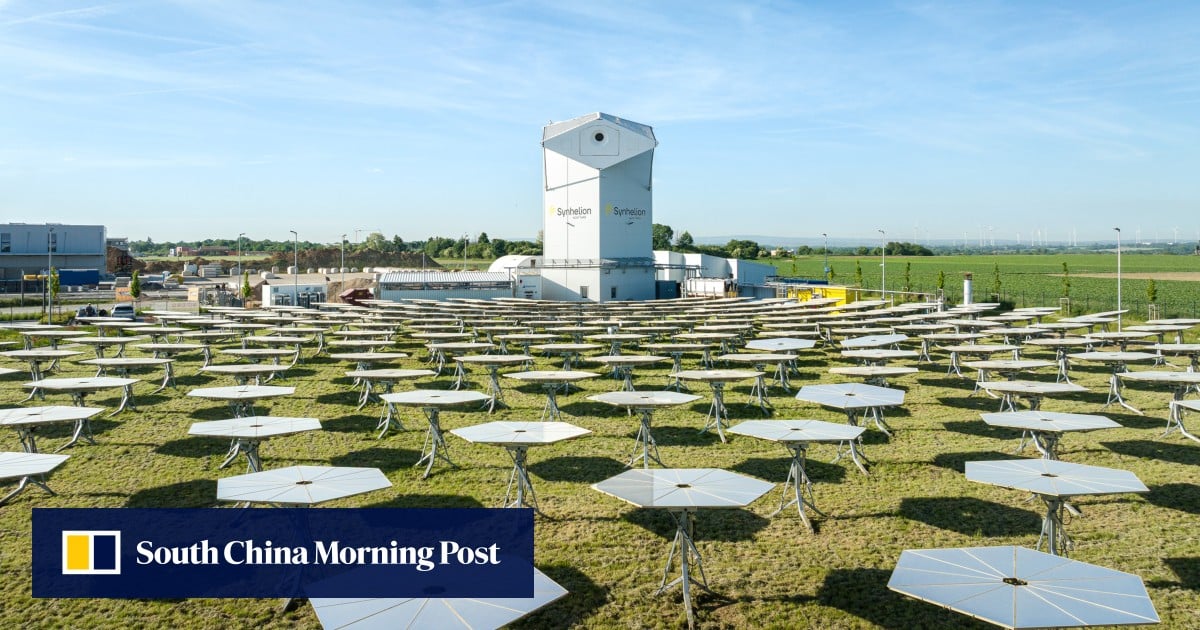
Chinese scientists have developed a plant-inspired method to convert carbon dioxide and water into valuable chemicals, such as the building blocks for petrol, by using solar energy.The process – inspired by photosynthesis, where plants harness sunlight, carbon dioxide and water to generate energy – could help produce a sustainable source of fuel, the researchers said.The team, from the Chinese Academy of Sciences and the Hong Kong University of Science and Technology, said they had developed a material able to store small amounts of electrical energy to help efficiently drive chemical reactions.When paired with catalysts that converted carbon dioxide into various chemicals, it enabled the solar-driven production of carbon monoxide.This could be further converted into fuel, offering a possible alternative for hard-to-electrify sectors such as aviation and shipping.“This work establishes a bioinspired charge reservoir strategy for efficient carbon dioxide photoreduction, providing a universal approach to solar fuel production,” the team wrote in a paper published in the peer-reviewed journal Nature Communications last week.
SRCSouth China Morning Post
LANGEN
LEANCenter-Right
WORDS162
ENT4
SAT · 2026-02-07 · 10:00 GMTBRIEF NSR-2026-0207-14175
NSR-2026-0207-14175News Report·EN·Environmental
How Chinese scientists made petrol building blocks with CO2, water and sunlight
Chinese scientists from the Chinese Academy of Sciences and the Hong Kong University of Science and Technology have developed a new method to convert carbon dioxide and water into valuable chemicals using solar energy. Inspired by photosynthesis, the process uses a newly developed material that stores small amounts of electrical energy to efficiently drive chemical reactions.
Victoria BelaSouth China Morning PostFiled 2026-02-07 · 10:00 GMTLean · Center-RightRead · 1 min
South China Morning PostFIG 01
Reading time
1min
Word count
162words
Sources cited
1cited
Entities identified
4entities
Quality score
100%
§ 01
Briefing Summary
AI-generatedNEWSAR · AI
Chinese scientists from the Chinese Academy of Sciences and the Hong Kong University of Science and Technology have developed a new method to convert carbon dioxide and water into valuable chemicals using solar energy. Inspired by photosynthesis, the process uses a newly developed material that stores small amounts of electrical energy to efficiently drive chemical reactions. This material is paired with catalysts to convert carbon dioxide into carbon monoxide, a key building block for fuels. The resulting carbon monoxide can then be further processed into fuel, offering a sustainable alternative for sectors like aviation and shipping. The research, published in Nature Communications, presents a bioinspired strategy for efficient carbon dioxide photoreduction, potentially leading to sustainable fuel production.
Confidence 0.90Sources 1Claims 5Entities 4
§ 02
Article analysis
Model · rule-basedFraming
Environmental
Technology
Tone
Measured
AI-assessed
CalmNeutralAlarmist
Factuality
0.80 / 1.00
Factual
LowHigh
Sources cited
1
Limited
FewMany
§ 03
Key claims
5 extracted01
This work establishes a bioinspired charge reservoir strategy for efficient carbon dioxide photoreduction.
quotethe team
Confidence
1.00
02
The team developed a material able to store small amounts of electrical energy.
factual
Confidence
1.00
03
The process is inspired by photosynthesis.
factual
Confidence
1.00
04
Chinese scientists have developed a method to convert carbon dioxide and water into valuable chemicals using solar energy.
factual
Confidence
1.00
05
The process could help produce a sustainable source of fuel.
predictionthe researchers
Confidence
0.70
§ 04
Full report
1 min read · 162 words§ 05
Entities
4 identifiedKey playerOppositionContextPositiveNeutralNegative
Organizations3
Locations1
§ 06
Keywords & salience
9 termscarbon dioxide
1.00
solar energy
0.90
fuel production
0.80
photosynthesis
0.70
sustainable fuel
0.70
carbon monoxide
0.60
chemical reactions
0.50
bioinspired
0.40
catalysts
0.40
§ 07
Topic connections
Interactive graph Network visualization showing 9 related topics
View Full Graph Person Organization Location Event|Click node to navigate|Edge numbers = shared articles