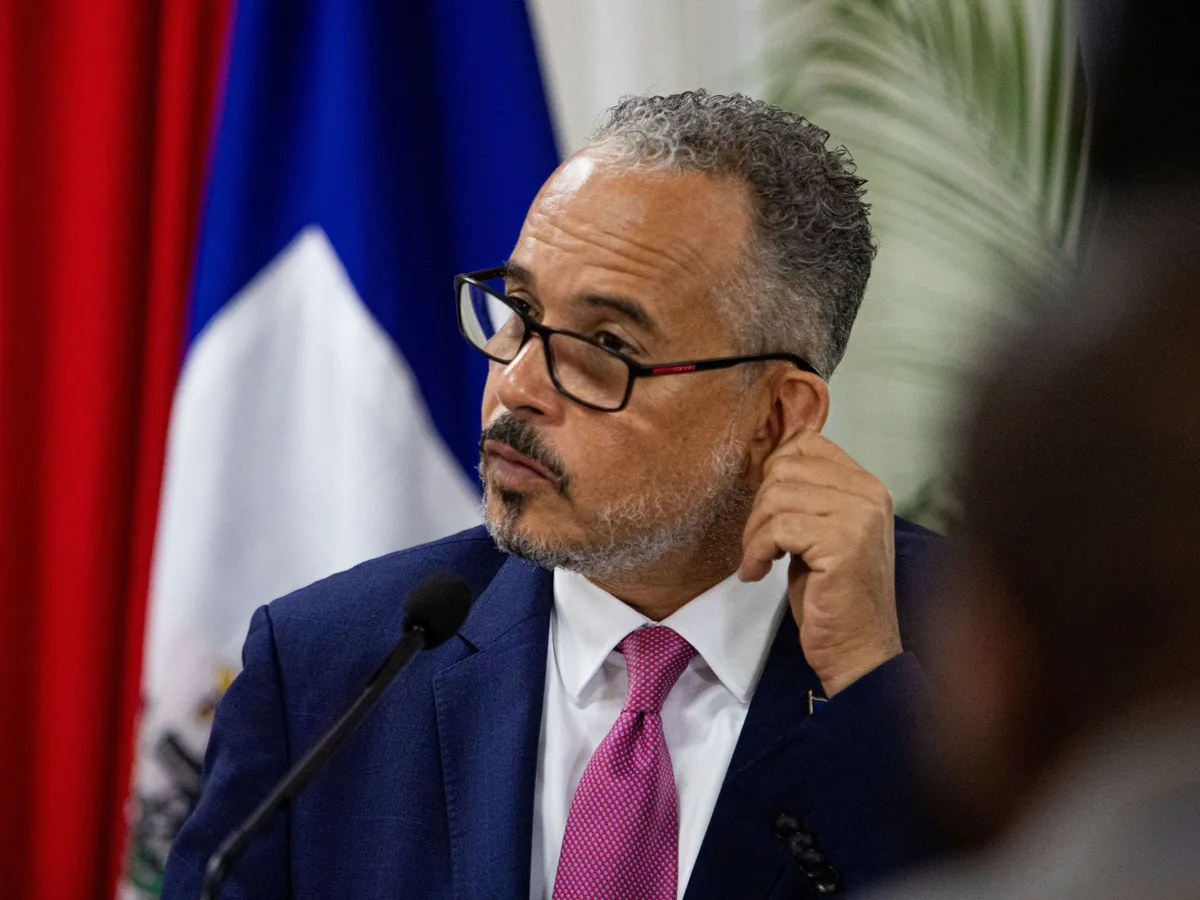
Move comes after council tried to oust PM Fils-Aime and the US recently deployed warship to waters near Haiti’s capital.Published On 7 Feb 2026Haiti’s Transitional Presidential Council has handed power to US-backed Prime Minister Alix Didier Fils-Aime after almost two years of tumultuous governance marked by rampant gang violence that has left thousands dead.The transfer of power between the nine-member transitional council and 54-year-old businessman Fils-Aime took place on Saturday under tight security, given Haiti’s unstable political climate.Recommended Stories list of 2 itemslist 1 of 2Haiti officials announce plan to oust prime minister, deepening US standofflist 2 of 2‘Will act accordingly’: US threatens action against Haitian councilend of list“Mr Prime Minister, in this historic moment, I know that you are gauging the depth of the responsibility you are taking on for the country,” council President Laurent Saint-Cyr told Fils-Aime, who is now the country’s only politician with executive power.In late January, several members of the council said they were seeking to remove Fils-Aime, leading the United States to announce visa revocations for four unidentified council members and a cabinet minister.Days before the council was dissolved, the US deployed a warship and two US coastguard boats to waters near Haiti’s capital, Port-au-Prince, where gangs control 90 percent of the territory.US Secretary of State Marco Rubio stressed “the importance” of Fils-Aime’s continued tenure “to combat terrorist gangs and stabilise the island”.The council’s plan to oust Fils-Aime for reasons not made public appeared to fall to the wayside as it stepped down in an official ceremony on Saturday.Fils-Aime now faces the daunting task of organising the first general elections in a decade.Election this year unlikelyThe Transitional Presidential Council was established in 2024 as the country’s top executive body, a response to a political crisis stretching back to the 2021 assassination of President Jovenel Moise.
SRCAl Jazeera
LANGEN
LEANCenter
WORDS301
ENT8
SAT · 2026-02-07 · 23:08 GMTBRIEF NSR-2026-0208-14309
NSR-2026-0208-14309News Report·EN·Political Strategy
Haiti’s transitional council hands power to US-backed prime minister
In Haiti, the Transitional Presidential Council transferred power to US-backed Prime Minister Alix Didier Fils-Aime on Saturday, ending its nearly two-year governance. The move follows a period of political instability marked by gang violence and a recent attempt by council members to remove Fils-Aime from power.
Al Jazeera StaffAl JazeeraFiled 2026-02-07 · 23:08 GMTLean · CenterRead · 2 min
Al JazeeraFIG 01
Reading time
2min
Word count
301words
Sources cited
2cited
Entities identified
8entities
Quality score
100%
§ 01
Briefing Summary
AI-generatedNEWSAR · AI
In Haiti, the Transitional Presidential Council transferred power to US-backed Prime Minister Alix Didier Fils-Aime on Saturday, ending its nearly two-year governance. The move follows a period of political instability marked by gang violence and a recent attempt by council members to remove Fils-Aime from power. The United States responded to the attempted ousting by announcing visa revocations and deploying a warship near Port-au-Prince. US Secretary of State Marco Rubio emphasized the importance of Fils-Aime's continued leadership for combating gangs and stabilizing Haiti. The council, formed in 2024 after the assassination of President Jovenel Moise, dissolved after the transfer. Fils-Aime now faces the challenge of organizing the first general elections in a decade.
Confidence 0.90Sources 2Claims 5Entities 8
§ 02
Article analysis
Model · rule-basedFraming
Political Strategy
National Security
Tone
Measured
AI-assessed
CalmNeutralAlarmist
Factuality
0.80 / 1.00
Factual
LowHigh
Sources cited
2
Limited
FewMany
§ 03
Key claims
5 extracted01
The Transitional Presidential Council was established in 2024 as the country’s top executive body.
factualArticle
Confidence
1.00
02
US Secretary of State Marco Rubio stressed “the importance” of Fils-Aime’s continued tenure.
quoteMarco Rubio
Confidence
1.00
03
The US deployed a warship and two US coastguard boats to waters near Haiti’s capital.
factualArticle
Confidence
1.00
04
Haiti’s Transitional Presidential Council has handed power to US-backed Prime Minister Alix Didier Fils-Aime.
factualArticle
Confidence
1.00
05
Gangs control 90 percent of the territory near Haiti's capital, Port-au-Prince.
factualArticle
Confidence
0.90
§ 04
Full report
2 min read · 301 words§ 05
Entities
8 identifiedKey playerOppositionContextPositiveNeutralNegative
People4
§ 06
Keywords & salience
10 termshaiti
1.00
us-backed prime minister
0.90
transitional council
0.90
alix didier fils-aime
0.80
political crisis
0.70
gang violence
0.70
us intervention
0.60
transfer of power
0.60
general elections
0.50
political instability
0.50
§ 07
Topic connections
Interactive graph Network visualization showing 39 related topics
View Full Graph Person Organization Location Event|Click node to navigate|Edge numbers = shared articles