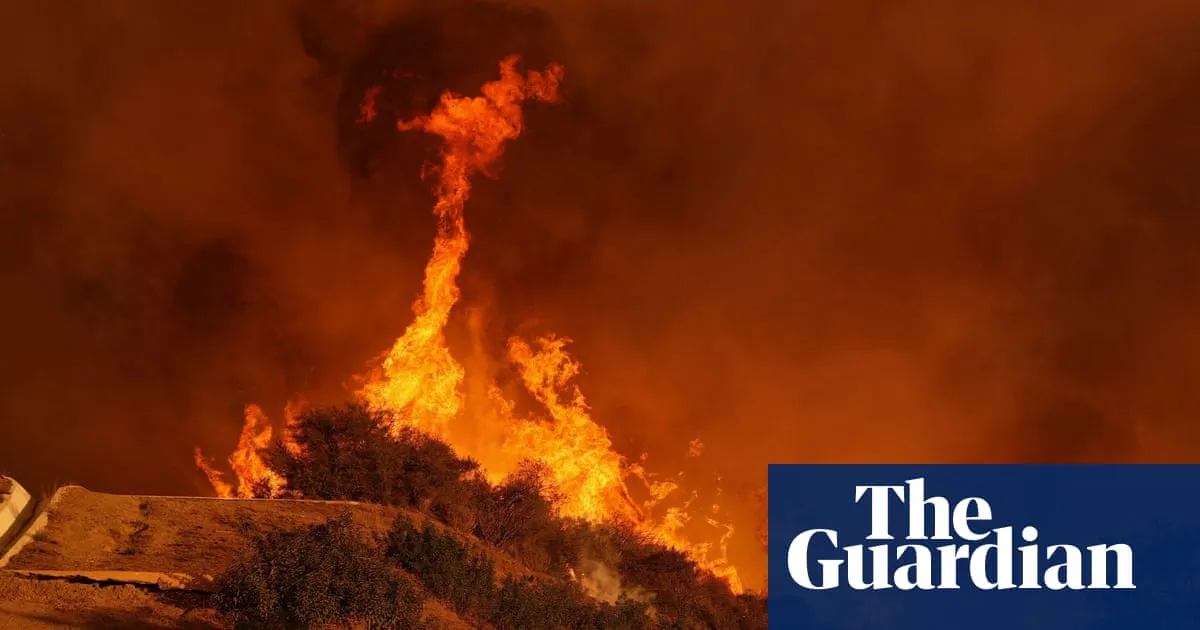
As climate disasters drive up the price of home insurance, three US states are considering empowering their state prosecutors to sue major polluters for their role in those rising costs.Lawmakers in California, Hawaii and New York have introduced measures which would authorize their attorneys general to sue fossil fuel companies on behalf of residents whose insurance premiums have soared amid climate disasters.“The cost of home insurance in California is an absolute crisis,” said state senator Scott Wiener, lead author of his state’s bill, speaking at a press conference announcing the measure on Thursday. “We know that the years ahead are going to be dramatically more dangerous, tragically, when it comes to climate disasters, and we can’t allow Californians, our residents, our small businesses, to be left holding the bag.”The proposals aim to hold the fossil fuel industry, the top contributor to global warming, accountable for soaring insurance rates driven by climate-fueled extreme weather.In California, after the deadly 2025 Los Angeles-area wildfires, which destroyed more than 18,000 homes and properties, residents faced massive insurance premium increases, as well as widespread non-renewals of insurance and thousands of delayed or denied claims.“We became refugees overnight,” Rasheed Ali, who lost his Altadena, California, home in the Eaton fire last January, said at the Thursday press conference announcing Wiener’s initiative. “We had insurance, but insurance didn’t mean we were protected. Our policy was bought decades ago, never adjusted to reflect the real value of our home, which leaves a massive financial gap that we are struggling to fill.”In New York, where state senator Brian Kavanagh introduced a bill in November 2025, insurance premiums have also steadily risen amid increasingly extreme weather, with rates up 19% statewide since 2018. Some regions have seen even greater increases: multifamily homes in Brooklyn have seen insurance premiums more than double from 2020 to 2023, according to figures from real estate data company Yardi Matrix.An aerial image shows destroyed homes and vehicles in the aftermath of the Maui wildfires in Lahaina, Hawaii, on 17 August 2023. Photograph: Patrick T Fallon/AFP via Getty ImagesHawaii, too, has seen an insurance crisis sparked by devastating floods, hurricanes and fires. The Maui blazes of 2023 alone catalyzed over $2.3bn in claims. Since those fires, premiums have also shot up by as much as 50% year over year, with far greater increases for condominium dwellers. Even more concerning, said Hawaii state senator Jarrett Keohokalole, who introduced the measure in his state last month, is that some insurers have dropped policyholders and fled the state over cost concerns.“They just packed up and left,” Keohokalole told the Guardian.Hawaiians have been forced to grapple with those crises, said Keohokalole, but big polluters should be footing the bill.“Without a doubt, the increasing incidence of really devastating natural disaster events is what’s driving the insurance crisis,” he said. “Whose fault is that? We know.”Only fossil fuel firms worth at least $500m which do business within state bounds can be held liable in each measure. In all three, funds recovered in court could be used to cover residents’ rising insurance rates. Each state’s Fair Access to Insurance Requirements (Fair) plan, which provides insurance to those who cannot obtain coverage through the private market and are funded collectively by private insurers, would also be eligible for compensation by funds acquired in court.In California, reliance on the Fair plan has grown 500% in less than 10 years as major insurance companies have dropped policyholders, raising concerns that it could become too overextended to afford to cover losses. The program expects to pay $4bn in losses from the deadly January 2025 Los Angeles wildfires. To cover those losses, the state asked the insurers who fund it for $1bn; half of those costs may be covered by rate increases.“The reality is that Fair plan premiums keep going up, and for many families it’s the only option left after private insurers have pulled out and left people behind,” Sierra Kos, founder of the disaster survivor network Extreme Weather Survivors, told the Guardian. “Survivors should not be the ones forced to carry the financial burden of disasters that fossil fuel companies knowingly helped create.”In the California bill, funds could also be used to fund a program to fire-proof low- and middle-income homes. Unlike in that measure, the Hawaii and New York would also provide a new legal right to insurers to sue the fossil fuel industry after a climate disaster.The bills are facing opposition from oil industry trade groups, including the American Petroleum Institute (API), the nation’s largest fossil fuel lobbying organization.“These proposed bills are part of a coordinated campaign against an industry that powers everyday life, drives America’s economy, and is actively reducing emissions. Retroactively penalizing companies for meeting consumer demand for affordable, reliable energy would set a dangerous precedent of state overreach,” Rolf Hanson, API’s senior vice-president for state government relations and public affairs, told the Guardian.The oil trade group Western States Petroleum Association (WSPA) is also opposing the California bill. In a statement to the Guardian, WSPA spokesperson Jim Stanley said its sponsors are “pursuing headlines for their campaigns”, and that the bill would “kill jobs and make life less affordable”.Dolores Huerta, the veteran worker justice organizer, addressed the industry’s resistance at Thursday’s California press conference.“There’s going to be a lot of pushback. We know that the oil companies have tons and tons of money, and they are going to put a lot of pressure on our legislators and policymakers not to pass this legislation,” she said. “So that means that we now have a big job to do. We have got to get out there. We’ve got to organize.”The bills come as the Trump administration is gutting funding and staffing for disaster response programs, Iyla Shornstein, political director at the non-profit Center for Climate Integrity, which is backing the bills, told the Guardian.“States need every tool available to protect their residents, she said, “including the ability to make the big oil corporations most responsible for this mess pay their fair share of the rising costs.”Concerns about climate-fueled insurance crises are growing across the country. Rhode Island senator Sheldon Whitehouse, a climate hawk, travelled to Louisiana on Friday in the latest of a series of visits to meet those affected by the issue.In December, two homeowners in Washington facing steep increases in home insurance premiums filed a first-of-its-kind lawsuit against oil majors to hold them accountable for the price spikes.States have made other attempts to hold the fossil fuel industry liable for climate damages. Seventy states and local governments across the US have sued big oil for allegedly deceiving the public about the climate crisis. Vermont and New York in recent years also passed “climate superfund” bills, requiring the largest oil companies to help pay for efforts to adapt to the climate crisis. Similar measures have been proposed in California, New Jersey and other states.Amid mounting proof that fossil fuel companies were aware of the dangers of the climate crisis but perpetuated it anyway, there is “no wonder” that people are becoming interested in holding the sector accountable for climate harms, said Hawaii state senator Keohokalole.“Residents shouldn’t have to pay for the risk mitigation of private entities, full stop,” he said. “It’s time for a comeuppance.”
SRCThe Guardian - World News
LANGEN
LEANCenter-Left
WORDS1 202
ENT8
SUN · 2026-02-08 · 14:00 GMTBRIEF NSR-2026-0208-14462
NSR-2026-0208-14462News Report·EN·Economic Impact
These US states want polluters to pay for the rising insurance costs of climate disasters
California, Hawaii, and New York are considering legislation to allow their attorneys general to sue major polluters for the rising costs of home insurance due to climate disasters. The proposed measures aim to hold fossil fuel companies accountable for extreme weather events that have driven up insurance premiums.
Dharna NoorThe Guardian - World NewsFiled 2026-02-08 · 14:00 GMTLean · Center-LeftRead · 5 min
The Guardian - World NewsFIG 01
Reading time
5min
Word count
1 202words
Sources cited
6cited
Entities identified
8entities
Quality score
100%
§ 01
Briefing Summary
AI-generatedNEWSAR · AI
California, Hawaii, and New York are considering legislation to allow their attorneys general to sue major polluters for the rising costs of home insurance due to climate disasters. The proposed measures aim to hold fossil fuel companies accountable for extreme weather events that have driven up insurance premiums. California residents, for example, have faced significant premium increases and non-renewals after devastating wildfires. Similarly, New York has seen a statewide increase in insurance rates, with some areas experiencing even greater surges. Hawaii has also experienced an insurance crisis due to floods, hurricanes, and fires, including the devastating Maui blazes of 2023.
Confidence 0.90Sources 6Claims 5Entities 8
§ 02
Article analysis
Model · rule-basedFraming
Economic Impact
Environmental
Tone
Measured
AI-assessed
CalmNeutralAlarmist
Factuality
0.70 / 1.00
Factual
LowHigh
Sources cited
6
Well sourced
FewMany
§ 03
Key claims
5 extracted01
The cost of home insurance in California is an absolute crisis.
quotestate senator Scott Wiener
Confidence
1.00
02
Some insurers have dropped policyholders and fled Hawaii over cost concerns.
factualHawaii state senator Jarrett Keohokalole
Confidence
1.00
03
Maui blazes of 2023 alone catalyzed over $2.3bn in claims.
statistic
Confidence
1.00
04
Insurance premiums in New York have risen 19% statewide since 2018.
statistic
Confidence
1.00
05
Lawmakers in California, Hawaii and New York have introduced measures which would authorize their attorneys general to sue fossil fuel companies.
factual
Confidence
1.00
§ 04
Full report
5 min read · 1 202 words§ 05
Entities
8 identifiedKey playerOppositionContextPositiveNeutralNegative
§ 06
Keywords & salience
10 termsinsurance costs
0.90
climate disasters
0.90
fossil fuel companies
0.80
insurance premiums
0.70
polluters
0.70
climate change
0.60
extreme weather
0.60
wildfires
0.50
home insurance
0.50
lawsuits
0.50
§ 07
Topic connections
Interactive graph Network visualization showing 51 related topics
View Full Graph Person Organization Location Event|Click node to navigate|Edge numbers = shared articles