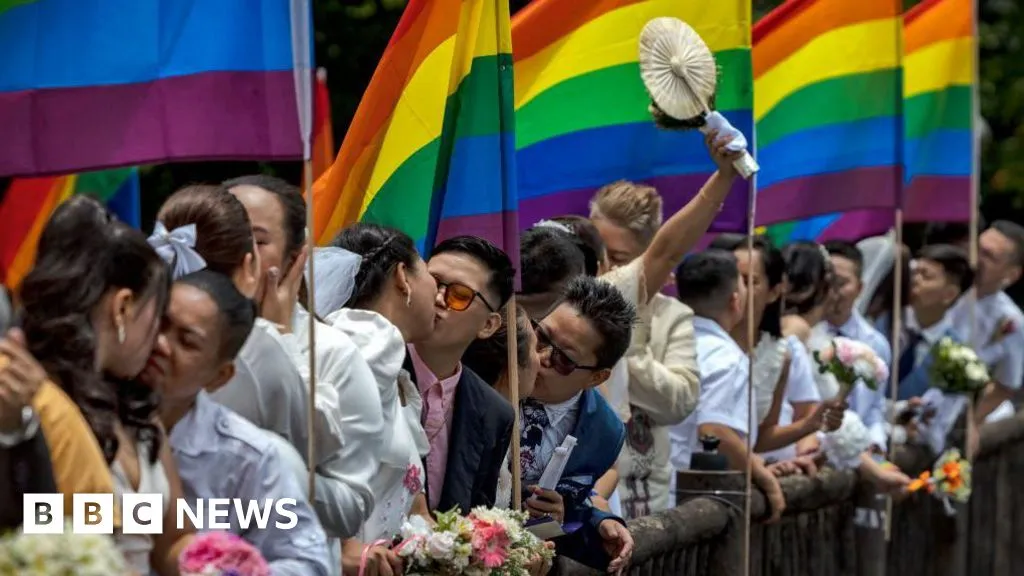
44 minutes agoJoel GuintoandVirma SimonetteGetty ImagesThe Philippine Supreme Court in a landmark decision has ruled that same-sex couples can be considered co-owners of property.Applying a provision of the country's Family Code for the first time, the court said same-sex couples can be recognised as co-owners if it is proven that both parties contributed to acquiring a property.Same-sex unions are outlawed in conservative Catholic Philippines and it is the only country in the world, outside of the Vatican, that does not allow divorce.This has left LGBT couples without legal protections when it comes to property, finance and healthcare.The Supreme Court ruling, which was made public on Tuesday, involved a former couple - two women - who had feuded over plans to sell their house and lot in suburban Manila.One of the women refused to sell their house after initially agreeing to do so, leading the other to file a claim before a lower court asking to divide their property. The lower court denied the claim, which was affirmed by the Court of Appeals.But the Supreme Court on 5 February reversed the lower court rulings. It cited a document made by one partner - and acknowledged by the other - that she paid 50% of the purchase and renovation costs.The property was registered under the name of only one of the partners to make the paperwork during the acquisition faster, since they were not married or related by blood.While the Family Code defines marriage as a bond between a man and a woman, the court said Article 148 - which governs "property relations of people who live together but cannot legally marry" - does not discriminate based on gender and "applies to all forms of co-habitation".Article 148 applies to same-sex couples, "otherwise, we render legally invisible some forms of legitimate intimate relationships", said Associate Justice Marvic Leonen.Associate Justice Amy Lazaro Javier further noted that Article 148 must not be limited to heterosexual couples "given the prevailing values in modern society as well as the glaring yet unjustified difference in the treatment of heterosexual couples vis-à-vis their homosexual counterparts".A spokesperson for the Supreme Court, Camille Ting, confirmed to the BBC that it is the first time Article 148 of the Family Code has been used to decide on a case regarding property rights of a same-sex couple.The court in its decision also called on government and lawmakers to address the needs of same-sex couples."With the political, moral, and cultural questions that surround the issue concerning the rights of same-sex couples, political departments especially the Congress must be involved to quest for solutions," the court said.
SRCBBC News - World
LANGEN
LEANCenter
WORDS432
ENT4
TUE · 2026-02-10 · 06:31 GMTBRIEF NSR-2026-0210-14915
NSR-2026-0210-14915News Report·EN·Legal & Judicial
Philippine top court says same-sex couples can co-own property
The Philippine Supreme Court ruled that same-sex couples can be recognized as co-owners of property if both parties contributed to its acquisition. The ruling, made public on Tuesday, involved a dispute between two women over a house in suburban Manila.
BBC News - WorldFiled 2026-02-10 · 06:31 GMTLean · CenterRead · 2 min
BBC News - WorldFIG 01
Reading time
2min
Word count
432words
Sources cited
2cited
Entities identified
4entities
Quality score
100%
§ 01
Briefing Summary
AI-generatedNEWSAR · AI
The Philippine Supreme Court ruled that same-sex couples can be recognized as co-owners of property if both parties contributed to its acquisition. The ruling, made public on Tuesday, involved a dispute between two women over a house in suburban Manila. The court applied Article 148 of the Family Code, which governs property relations of unmarried cohabitants, stating it does not discriminate based on gender. This is the first time Article 148 has been used to decide a case regarding property rights of a same-sex couple in the Philippines, where same-sex unions are outlawed. The court reversed lower court rulings that denied the property claim, citing evidence that one partner paid 50% of the costs. The Supreme Court also called on the government and lawmakers to address the needs of same-sex couples.
Confidence 0.90Sources 2Claims 5Entities 4
§ 02
Article analysis
Model · rule-basedFraming
Legal & Judicial
Human Rights
Tone
Measured
AI-assessed
CalmNeutralAlarmist
Factuality
0.80 / 1.00
Factual
LowHigh
Sources cited
2
Limited
FewMany
§ 03
Key claims
5 extracted01
The Supreme Court called on government and lawmakers to address the needs of same-sex couples.
factual
Confidence
1.00
02
Article 148 applies to same-sex couples, otherwise, we render legally invisible some forms of legitimate intimate relationships.
quoteAssociate Justice Marvic Leonen
Confidence
1.00
03
The Supreme Court cited Article 148 of the Family Code in its decision.
factual
Confidence
1.00
04
Same-sex unions are outlawed in the conservative Catholic Philippines.
factual
Confidence
1.00
05
The Philippine Supreme Court ruled that same-sex couples can be considered co-owners of property.
factual
Confidence
1.00
§ 04
Full report
2 min read · 432 words§ 05
Entities
4 identifiedKey playerOppositionContextPositiveNeutralNegative
§ 06
Keywords & salience
9 termssame-sex couples
1.00
property rights
0.90
philippine supreme court
0.80
family code
0.70
co-ownership
0.70
article 148
0.60
legal protections
0.50
lgbt rights
0.50
philippines
0.40
§ 07
Topic connections
Interactive graph No topic relationship data available yet. This graph will appear once topic relationships have been computed.