Palestinians in Israel are reaching breaking point in the face of endemic crime and government neglect.Israel" class="entity-link entity-organization" data-entity-id="27909" data-entity-type="organization">Palestinian citizens of Israel protest, calling on the Israeli government to tackle a wave of crime and killings in their communities through effective law and order, in Sakhnin, northern Israel, January 22, 2026 [Ammar Awad/Reuters]Published On 10 Feb 2026Weighing up his options on a Monday morning in January, Ali Zbeedat, a longtime shopkeeper from Sakhnin, a small Palestinian-majority town in Israel’s north, decided he had had enough.Earlier that day, the widespread and organised criminality that plagues Sakhnin and countless other Palestinian towns and villages across Israel had come to his door.Recommended Stories list of 3 itemslist 1 of 3Here’s why Israel is allowing record murder rates in its Palestinian townslist 2 of 3Israel-Palestine head of Human Rights Watch quits over ‘blocked’ reportlist 3 of 3How Israel destroyed Gaza’s health system ‘deliberately and methodically’end of list“We know where you go and where you walk. We will kill you if you don’t finish what you’re supposed to,” a message sent to his phone read. Gunmen had already targeted Zbeedat’s family businesses on four separate occasions, the latest just the week before, when one of his stores had been hit by dozens of automatic rifle rounds.The message was the final straw. Zbeedat shuttered his businesses, with no plan to reopen them.His case has caught the attention of Israel" class="entity-link entity-organization" data-entity-id="27909" data-entity-type="organization">Palestinian citizens of Israel, as well as wider Israeli society.As word of Zbeedat’s action spread, more and more businesses in Sakhnin closed their doors, protesting against the organised crime that had become endemic to their community amid what appeared to be a deliberate policy of government neglect.What began as protests in Sakhnin quickly galvanised public opinion against criminal gangs to levels described by commentators as “historic”, with tens of thousands of people, both Palestinian and Jewish Israeli, taking to the streets of Tel Aviv and choking traffic in Jerusalem over the weekend to demonstrate against the organised crime that has been allowed to leach the lifeblood out of Israel’s remaining Palestinian communities.“In 2025, 252 Palestinians were murdered in Israel, but that doesn’t tell you everything,” Aida Touma-Suleiman, a Palestinian member of the Israeli parliament representing the left-wing Hadash-Ta’al faction, who has been one of the few prominent voices to constantly speak out on the violence, said.“It doesn’t tell you about the thousands of people unable to live a normal life, or forced to pay nearly all their income for protection.“The fear and the anger are growing, but it took one very courageous man in Sakhnin to light the spark. They asked him for protection; he said, no. They tried to shoot one of his sons, so he closed his shops and said they would remain closed,” she told Al Jazeera.Fertile groundPalestinian citizens of Israel make up approximately 21 percent of Israel’s overall population.They are the descendants of Palestinians who were not forced out in the Nakba of 1948, when 750,000 people fled following the establishment of the State of Israel.The Palestinians who remain in Israel largely live separate lives from the rest of the population in isolated towns and villages, suffering from a lack of government funding and living as de facto second-class citizens.To many that live in those communities, it is not that the state is actively working against them, rather it is entirely absent, observers, including Hassan Jabareen, the founder and general director of the Arab rights organisation Adalah, said.“It’s Hobbesian,” he said, drawing a parallel with how the English philosopher Thomas Hobbes described human conditions without the restraining power of the state, and life in one of Israel’s Palestinian communities, which he described as “nasty, brutish and short”, paraphrasing Hobbes.About 38 percent of Palestinian households fall below the poverty line in Israel, many well below it, according to Israel’s National Insurance Institute. The same report found that about half of all Palestinians say that whatever money they can make during the month is outstripped by what they have to spend.People hold placards and light their phone torches during a demonstration against rising crime rates against Israel" class="entity-link entity-organization" data-entity-id="27909" data-entity-type="organization">Palestinian citizens of Israel [Ahmad Gharabli/AFP]Unemployment is endemic, and made worse after access to the occupied West Bank, where Palestinians are controlled by Israel, but do not have Israeli citizenship, was restricted following the outbreak of Israel’s genocidal war on Gaza in 2023.According to 2024 figures, only 54 percent of Palestinian men and 36 percent of Palestinian women in Israel have jobs, after already low employment levels plummeted in tandem with the genocide in Gaza.It makes fertile ground for organised crime, Touma-Suleiman said.From the Nakba to the present, Palestinian towns and villages in Israel have lacked police stations, she told Al Jazeera, describing how Palestinians who had fled the poverty of their villages to work on the criminal peripheries of Israeli society would return, armed with the knowledge needed to build new criminal networks in their own communities, safe from the police’s prying eyes.“We also had a lot of Arab families from the territories occupied after 1967, who had collaborated with the Israeli government, relocated here following the second Intifada [in 2005],” Touma-Suleiman said, describing how this disrupted Palestinian communities in Israel.“A lot of those families are now running criminal organisations, even the police say those families are under the protection of the Shabak [Israel’s internal security agency, the Shin Bet], so they can’t really touch them.”Al Jazeera reached out to the Israeli prime minister’s office and the Shin Bet for comment, but has yet to receive a response.Poisoned harvestThe outcome has been organised crime on an industrial scale.Gangs, closer to the Italian mafia in scale and reach, control much of what little commercial life can flourish in Israel’s Palestinian towns and villages, confident their operations will not be interrupted by a police force headed by far-right and anti-Palestinian Minister of National Security Itamar Ben-Gvir, who himself has previously been prosecuted for supporting anti-Palestinian “terror” groups.Itamar Ben-Gvir is reported to be in charge of a task force investigating the problem [File: Abir Sultan/EPA]“There are hierarchies operating at a major, nationwide level,” Touma-Suleiman said, “The killings are just a symptom. They have their own banking systems and give out loans,” she said of a financial desert where only about 20 percent of Palestinians qualify for loans from Israeli banks.“They also deal in drugs and weapons: not just pistols, but missiles and explosives. They’re embedded in the state, as well, controlling contracting companies, which means other companies bidding for work have to go through them.”The outcome has been neighbourhoods unrecognisable to the Jewish Israelis who rarely venture into territory considered dangerous and unsafe.“They [Jewish Israelis] refer to the Palestinian nature or the Arab nature, and of course, not to the fact that the Israeli state stays at arm’s length from the [Palestinian] enclaves and they let the murders and crime just happen,” prominent Israeli sociologist Yehouda Shenhav-Shahrabani told Al Jazeera.Toxic cropAt one of the most recent protests against the violence, demonstrators walked through the streets of Tel Aviv, carrying banners and photos of relatives killed.Placards, reading “Enough violence and murder”, “No more silence”, and “Arab Lives Matter”, told of a tide of anger that even Israeli President Isaac Herzog, who had few qualms with the genocide of more than 70,000 Palestinians in Gaza, has accepted must be addressed.
SRCAl Jazeera
LANGEN
LEANCenter
WORDS1 213
ENT7
TUE · 2026-02-10 · 07:35 GMTBRIEF NSR-2026-0210-14922
NSR-2026-0210-14922News Report·EN·Social Justice
Palestinian citizens of Israel demand government do more to stop crime
Palestinian citizens of Israel are protesting against widespread crime and perceived government neglect in their communities. The protests began in Sakhnin after a shopkeeper, Ali Zbeedat, closed his businesses due to threats and repeated attacks.
Simon Speakman CordallAl JazeeraFiled 2026-02-10 · 07:35 GMTLean · CenterRead · 5 min
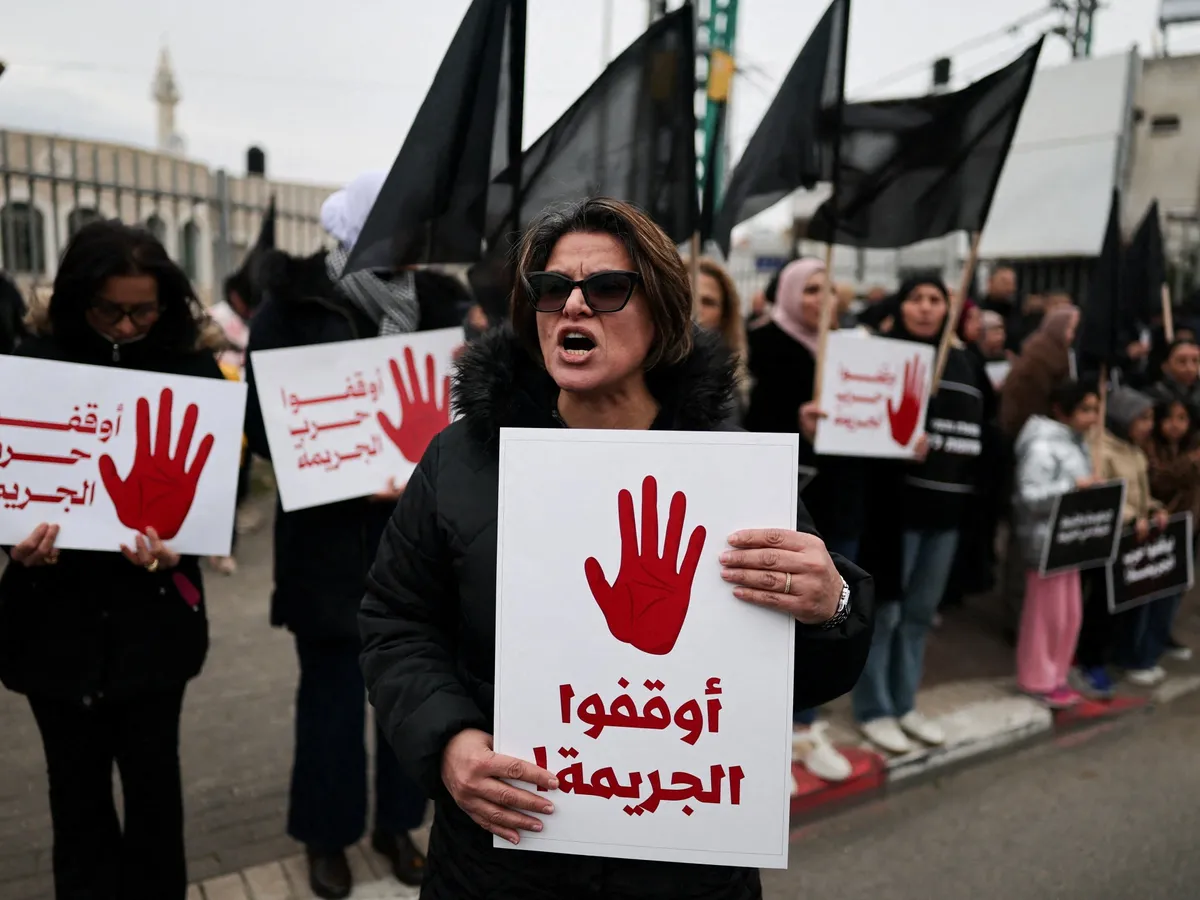
Al JazeeraFIG 01
Reading time
5min
Word count
1 213words
Sources cited
1cited
Entities identified
7entities
Quality score
100%
§ 01
Briefing Summary
AI-generatedNEWSAR · AI
Palestinian citizens of Israel are protesting against widespread crime and perceived government neglect in their communities. The protests began in Sakhnin after a shopkeeper, Ali Zbeedat, closed his businesses due to threats and repeated attacks. This action sparked wider demonstrations, with tens of thousands of Palestinians and Jewish Israelis protesting in Tel Aviv and Jerusalem. Protesters are demanding that the Israeli government take action to address the organized crime plaguing Palestinian towns and villages. In 2025, 252 Palestinians were murdered in Israel, highlighting the severity of the issue. The demonstrations reflect growing frustration over the lack of law and order in these communities.
Confidence 0.90Sources 1Claims 4Entities 7
§ 02
Article analysis
Model · rule-basedFraming
Social Justice
Human Rights
Tone
Mixed Tone
AI-assessed
CalmNeutralAlarmist
Factuality
0.70 / 1.00
Factual
LowHigh
Sources cited
1
Limited
FewMany
§ 03
Key claims
4 extracted01
Gunmen targeted Ali Zbeedat's family businesses on four separate occasions.
factualArticle
Confidence
1.00
02
In 2025, 252 Palestinians were murdered in Israel.
statisticAida Touma-Suleiman
Confidence
0.90
03
Palestinian citizens of Israel are protesting government neglect of crime in their communities.
factualArticle
Confidence
0.90
04
Palestinian citizens of Israel make up approximately 21 percent of Israel’s ov
statisticArticle
Confidence
0.80
§ 04
Full report
5 min read · 1 213 words§ 05
Entities
7 identifiedKey playerOppositionContextPositiveNeutralNegative
Organizations2
§ 06
Keywords & salience
8 termscrime
1.00
palestinian citizens of israel
0.90
government neglect
0.80
organized crime
0.80
protest
0.70
law and order
0.60
violence
0.50
murder rates
0.50
§ 07
Topic connections
Interactive graph Network visualization showing 51 related topics
View Full Graph Person Organization Location Event|Click node to navigate|Edge numbers = shared articles