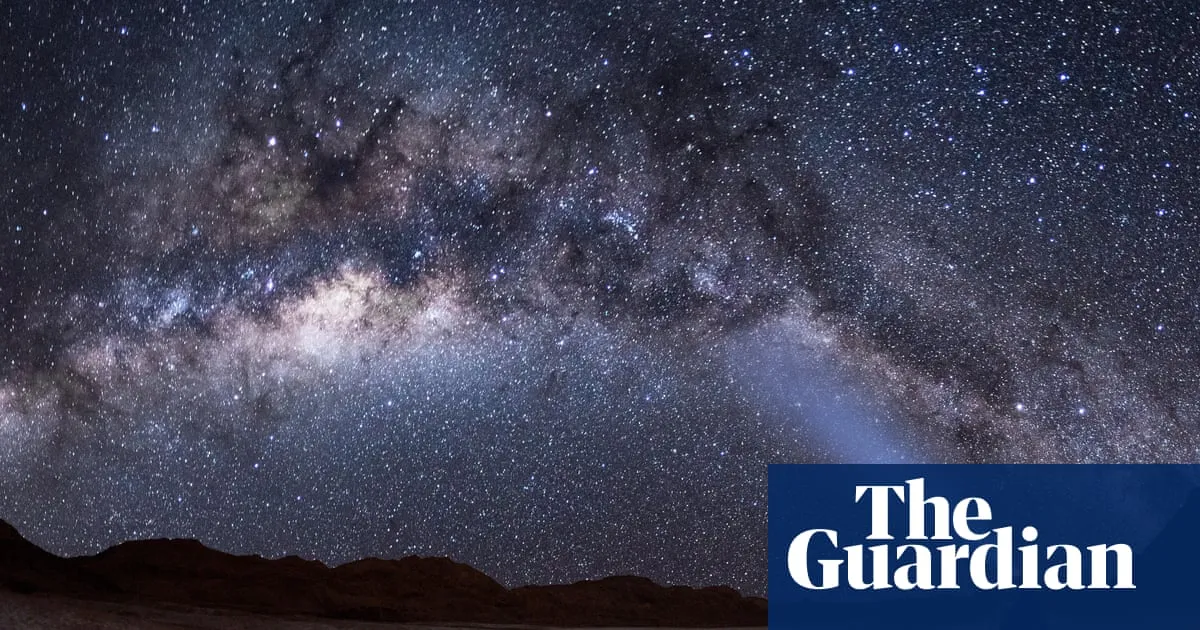
The scientific community is celebrating the cancellation of a project which would have threatened the clearest skies in the world in Chile’s Atacama Desert.The proposed $10bn, 3,000-hectare green hydrogen and ammonia production facility, known as INNA, included a port, transport links to the coast and three solar power plants, and had been under evaluation by Chile’s environmental regulator for almost a year.Astronomers had warned repeatedly that its proximity to some of the world’s most powerful telescopes would have irreparably damaged observation in the area, which is the best site in the world for ground-based astronomy.“This cancellation means that the INNA project will no longer have a negative impact on the Paranal Observatory,” said Itziar de Gregorio, the European Southern Observatory’s (ESO) representative in Chile, where it operates three telescope complexes.“However, what this megaproject has brought to the table is the urgent need for clear protection measures around the sites where professional astronomy is carried out in Chile. This cancellation does not mean that the work to protect the skies is over.”Chile’s environmental evaluation service confirmed that, following meetings last week with AES Andes – the company which had proposed the facility – the project has now been formally withdrawn.Scientists had warned that the INNA facility would affect readings by raising light pollution, causing tiny vibrations in the earth which would affect instruments, aerialise dust which could settle on the mirrors of its precision telescopes, and increase atmospheric turbulence.They argued that there was no need to place the facility so close to the observatories given the potentially disastrous consequences for astronomy.Aes Andes, a subsidiary of US company AES Corporation which generates energy in Chile, Colombia and Argentina, with coal, gas, hydroelectric, wind and solar plants, did not immediately respond to a request for comment.However, in a press release it said: “After detailed analysis of its portfolio of projects, [AES Andes] has decided to cease the execution of the INNA project,” although it added that it was “absolutely compatible” with other activities in the area.An open letter published in December, led by 2020 Nobel Prize winner Reinhard Genzel, had urged the Chilean government to kill the proposed project, as the facility would have been just 11.6km from Paranal, one of the world’s most important observatories.Its Very Large Telescope (VLT), built 2,600m above sea level, has taken the readings that have won three Nobel prizes. And on nearby Cerro Armazones, the Extremely Large Telescope (ELT) – will be the largest and most powerful telescope ever built – is under construction.It will allow astronomers to scour distant galaxies for Earth-like exoplanets that might support life.
SRCThe Guardian - World News
LANGEN
LEANCenter-Left
WORDS431
ENT5
TUE · 2026-02-10 · 12:48 GMTBRIEF NSR-2026-0210-15009
NSR-2026-0210-15009News Report·EN·Environmental
Astronomers celebrate cancellation of $10bn Chile project that threatened clearest skies in the world
Astronomers had warned that proximity of INNA facility to telescopes would have irreparably damaged observation The scientific community is celebrating the cancellation of a project which would have threatened the clearest skies in the world in Chile’s Atacama Desert . The proposed $10bn, 3,000-hect
John Bartlett in SantiagoThe Guardian - World NewsFiled 2026-02-10 · 12:48 GMTLean · Center-LeftRead · 2 min
The Guardian - World NewsFIG 01
Reading time
2min
Word count
431words
Sources cited
2cited
Entities identified
5entities
Quality score
50%
§ 02
Article analysis
Model · rule-basedFraming
Environmental
Technology
Tone
Measured
AI-assessed
CalmNeutralAlarmist
Factuality
0.80 / 1.00
Factual
LowHigh
Sources cited
2
Limited
FewMany
§ 03
Key claims
5 extracted01
After detailed analysis of its portfolio of projects, [AES Andes] has decided to cease the execution of the INNA project.
quoteAES Andes
Confidence
1.00
02
The INNA facility would have been just 11.6km from Paranal, one of the world’s most important observatories.
factualnull
Confidence
1.00
03
This cancellation means that the INNA project will no longer have a negative impact on the Paranal Observatory.
quoteItziar de Gregorio, the European Southern Observatory’s (ESO) representative in Chile
Confidence
1.00
04
Scientists had warned that the INNA facility would affect readings by raising light pollution.
factualScientists
Confidence
0.90
05
Astronomers had warned that its proximity to some of the world’s most powerful telescopes would have irreparably damaged observation in the area.
factualAstronomers
Confidence
0.90
§ 04
Full report
2 min read · 431 words§ 05
Entities
5 identifiedKey playerOppositionContextPositiveNeutralNegative