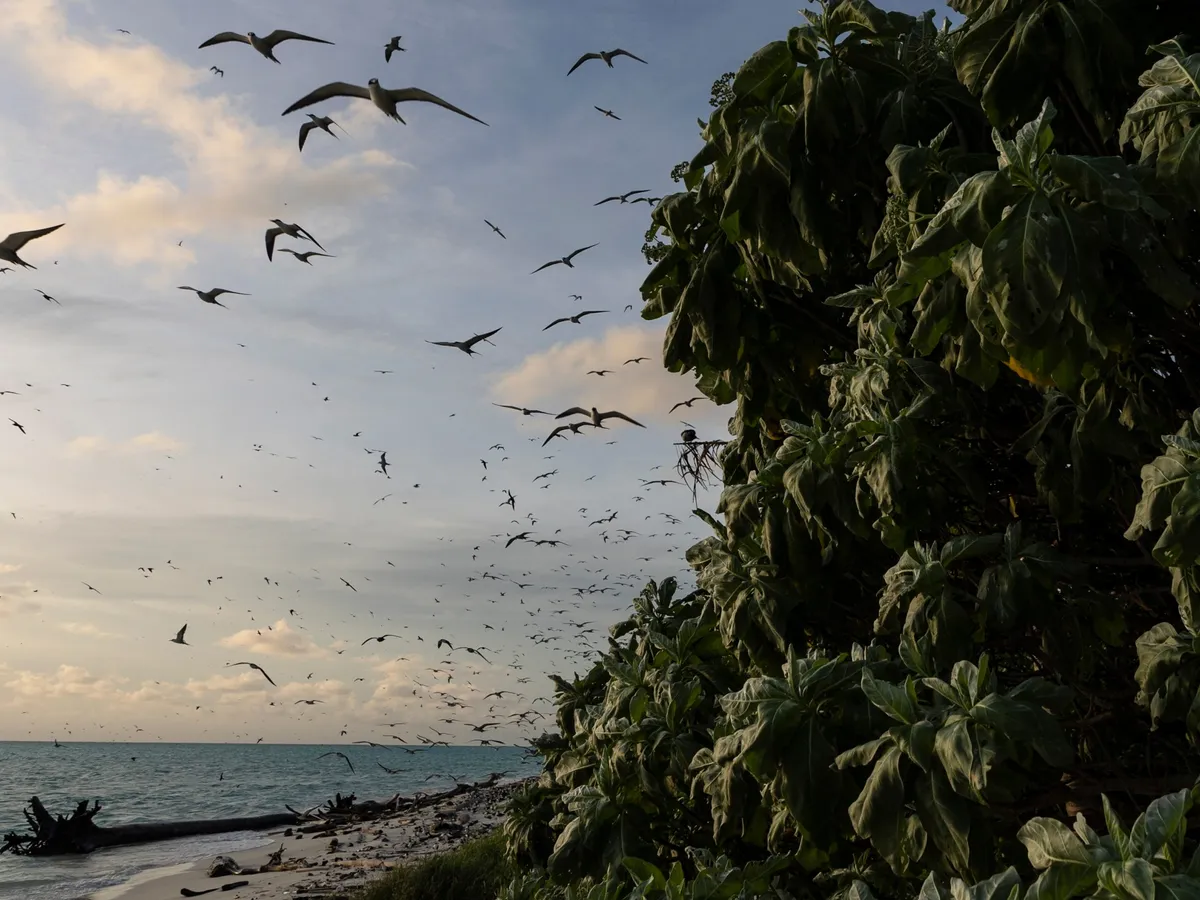
The Trump administration has accused Hokkons Baules of Palau and Anderson Jibas of the Marshall Islands of ‘significant corruption’.Bridled terns fly over Helen Island, Palau, on July 17, 2024 [Yannick Peterhans/AP Photo]Published On 11 Feb 2026The administration of United States President Donald Trump has sanctioned two leaders of Pacific island nations for alleged corruption, accusing them both of creating openings for China to increase its influence in the region.On Tuesday, the US Department of State issued a notice alleging that the president of Palau’s Senate, Hokkons Baules, and a former mayor in the Marshall Islands, Anderson Jibas, had engaged in “significant corruption”.Recommended Stories list of 3 itemslist 1 of 3Pacific Islands leaders meet with climate change, security on agendalist 2 of 3First treaty to protect marine life in high seas to take effect in Januarylist 3 of 3Nukedend of listNeither they nor their families will henceforth be allowed to enter the US, according to the statement.“The Trump Administration will not allow foreign public officials to steal from U.S. taxpayers or threaten U.S. interests,” State Department spokesperson Tommy Pigott wrote on social media.The State Department’s Bureau of International Narcotics and Law Enforcement (INL) also posted its support for the sanctions.“Corruption that hurts U.S. interests will be met with significant consequences,” it said.In both cases, the US credited the politicians’ actions with allowing the expansion of Chinese interests in the Pacific region.The State Department alleged that Baules took bribes in exchange for supporting Chinese interests in Palau, an island in Micronesia that is the 16th smallest country in the world.“His actions constituted significant corruption and adversely affected U.S. interests in Palau,” the US said in its statement.Jibas, meanwhile, stands accused of “orchestrating and financially benefitting from” schemes to misuse the Bikini Resettlement Trust, a US-backed fund designed to compensate those negatively affected by nuclear bomb testing on the Bikini Atoll, part of the Marshall Islands.The trust was worth nearly $59m in 2017, when the first Trump administration decided to hand control of the main resettlement fund to local authorities and relinquish its authority to audit.Since then, the fund has emptied precipitously. As of February 2023, the trust had plummeted to a mere $100,000, and payments to Bikini Atoll survivors and descendants have ceased.Critics have blamed Jibas, who was elected in 2016 to lead the Kili, Bikini and Ejit islands as mayor. He campaigned on having more local autonomy over the fund.But reports in The Wall Street Journal and other news outlets accused him of misappropriating the funds for purchases including vacations, travel and a new pick-up truck.In Tuesday’s announcement, the State Department connected Jibas’s alleged abuse to the spread of Chinese power in the Pacific and an increase in immigration to the US, two key issues in Trump’s platform.“The theft, misuse, and abuse of the U.S.-provided money for the fund wasted U.S. taxpayer money and contributed to a loss of jobs, food insecurity, migration to the United States,” the department wrote.“The lack of accountability for Jibas’ acts of corruption has eroded public trust in the government of the Marshall Islands, creating an opportunity for malign foreign influence from China and others.”Both Palau and the Marshall Islands were US territories, occupied during World War II and granted independence in the late 20th century.They both continue to be part of a Compact of Free Association with the US, which allows the North American superpower to continue military operations in the area and control the region’s defence.They are also part of a dwindling list of countries that maintain diplomatic relations with Taiwan’s government, much to the ire of the People’s Republic of China.Only about a dozen remain, and they are largely concentrated in Central America, the Caribbean or the Pacific islands.But China has sought to pressure those smaller countries into rupturing their ties with Taiwan and recognising its government in Beijing instead.The Asian superpower – often seen as a rival to the US – has also attempted to expand its sphere of influence to the southern Pacific, by building trade relations and countering US military authority in the area.Baules, for example, is among the local politicians who have advocated for recognising Beijing’s government over Taipei’s, and he is a vocal proponent for increased ties with China.Those shifting views have placed island nations like Palau and the Marshall Islands in the midst of a geopolitical tug-of-war, as the US struggles with China to maintain dominance in the region.In other parts of the world, the US has also used sanctions to dissuade local officials from seeking closer ties with China.Panamanian President Jose Raul Mulino, for instance, has accused the US embassy in his country of threatening to strip local officials of their visas, as the US and China jockey for influence over the Panama Canal.Similar reports have emerged in neighbouring Costa Rica, where officials like lawmaker Vanessa Castro and former President Oscar Arias have accused the US of revoking their visas over ties to China.But there have been other points of tension between the Pacific Islands and the US in recent years.The Trump administration has withdrawn from accords designed to limit climate change and quashed international efforts to reduce emissions, straining ties with the islands, which are vulnerable to rising sea levels.Still, the US State Department framed the sanctions on Tuesday as an effort to ensure local accountability and defend US interests in the region.“The United States will continue to promote accountability for those who abuse public power for personal gain and steal from our citizens to enrich themselves,” it said.“These designations reaffirm the United States’ commitment to countering global corruption affecting U.S. interests.”
SRCAl Jazeera
LANGEN
LEANCenter
WORDS927
ENT8
WED · 2026-02-11 · 02:32 GMTBRIEF NSR-2026-0211-15193
NSR-2026-0211-15193News Report·EN·National Security
US sanctions officials from Marshall Islands and Palau, citing China fears
In February 2026, the US government sanctioned Hokkons Baules, president of Palau's Senate, and Anderson Jibas, a former mayor in the Marshall Islands, for alleged corruption. The US State Department accused both men of "significant corruption" that allowed China to expand its influence in the Pacific region.
Al Jazeera StaffAl JazeeraFiled 2026-02-11 · 02:32 GMTLean · CenterRead · 4 min
Al JazeeraFIG 01
Reading time
4min
Word count
927words
Sources cited
2cited
Entities identified
8entities
Quality score
100%
§ 01
Briefing Summary
AI-generatedNEWSAR · AI
In February 2026, the US government sanctioned Hokkons Baules, president of Palau's Senate, and Anderson Jibas, a former mayor in the Marshall Islands, for alleged corruption. The US State Department accused both men of "significant corruption" that allowed China to expand its influence in the Pacific region. Baules allegedly accepted bribes to support Chinese interests in Palau, while Jibas is accused of misusing the Bikini Resettlement Trust, a US-backed fund for those affected by nuclear testing. As a result of the sanctions, Baules and Jibas, along with their families, are now barred from entering the United States. The US government stated it will not tolerate foreign officials stealing from US taxpayers or threatening US interests.
Confidence 0.90Sources 2Claims 5Entities 8
§ 02
Article analysis
Model · rule-basedFraming
National Security
Political Strategy
Tone
Measured
AI-assessed
CalmNeutralAlarmist
Factuality
0.80 / 1.00
Factual
LowHigh
Sources cited
2
Limited
FewMany
§ 03
Key claims
5 extracted01
Corruption that hurts U.S. interests will be met with significant consequences.
quoteState Department’s Bureau of International Narcotics and Law Enforcement (INL)
Confidence
1.00
02
The Bikini Resettlement Trust plummeted from nearly $59m in 2017 to $100,000 as of February 2023.
statisticArticle's own claim
Confidence
1.00
03
Jibas is accused of misusing the Bikini Resettlement Trust, a US-backed fund.
factualUS Department of State
Confidence
1.00
04
The US accuses Baules and Jibas of creating openings for China to increase its influence in the region.
factualUS Department of State
Confidence
1.00
05
US sanctioned Hokkons Baules of Palau and Anderson Jibas of the Marshall Islands for alleged corruption.
factualArticle's own claim
Confidence
1.00
§ 04
Full report
4 min read · 927 words§ 05
Entities
8 identifiedKey playerOppositionContextPositiveNeutralNegative
§ 06
Keywords & salience
9 termsus sanctions
0.90
corruption
0.80
china influence
0.70
pacific islands
0.70
bikini resettlement trust
0.60
bikini atoll
0.60
palau
0.50
marshall islands
0.50
us interests
0.50
§ 07
Topic connections
Interactive graph Network visualization showing 51 related topics
View Full Graph Person Organization Location Event|Click node to navigate|Edge numbers = shared articles