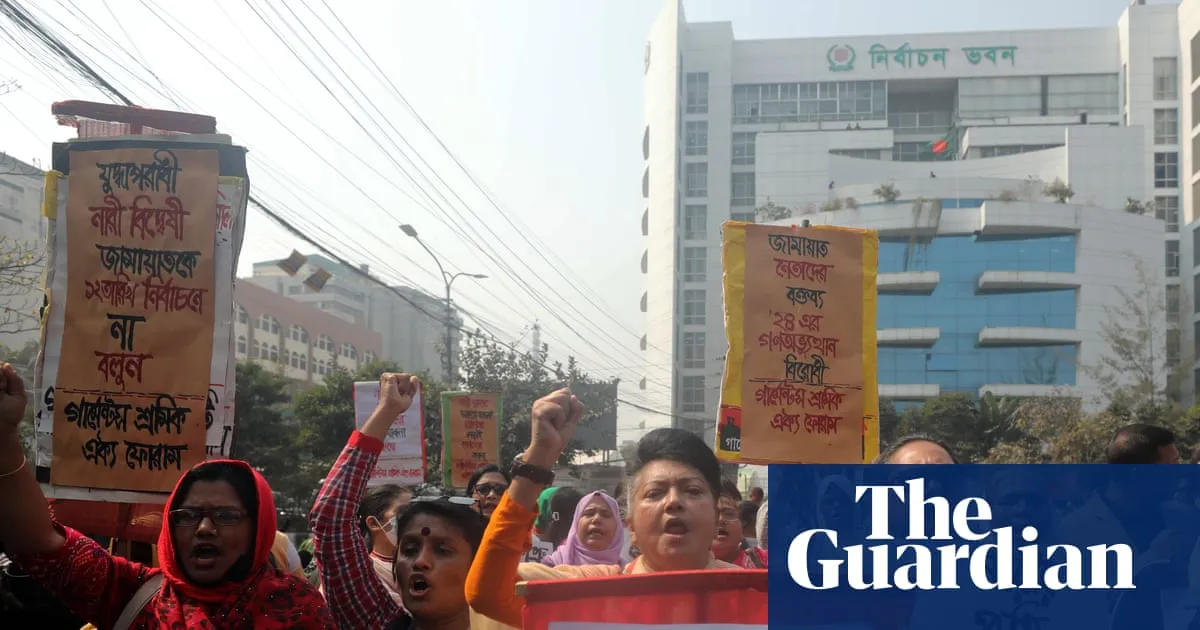
As the clock hit midnight, the women held their flame torches aloft and marched into the Dhaka night. “The people have given their blood, now we want equality,” they shouted above the roar of the traffic.For many in Bangladesh, the past few weeks have been a cause for jubilation. The first free and fair elections in 17 years have been promised for Thursday, after the toppling of the regime of Sheikh Hasina in a bloody student-led uprising in August 2024 in which more than 1,000 people died.Opposition figures long persecuted and jailed are now running as candidates, freely holding rallies for the first time in years. The former prime minister is languishing in exile in India and facing a death sentence for crimes against humanity in Bangladesh, and her Awami League party is banned from contesting the election.Women marched in Dhaka at midnightYet for swathes of women in the country, including those who were at the forefront of the revolution, the hope of the election has become tinged with disappointment and fear, amid a resurgence of regressive Islamist politics that it is feared will impinge upon women’s rights and a dearth of female candidates in the running.“This was meant to be an election representing change and reform. Instead, we are seeing women being systematically erased and their rights threatened,” said Sabiha Sharmin, 25, as she took part in the midnight march. “We worry this election will throw the country back 100 years.”Among the most oppressed political movements of the Hasina era, when elections were rigged and opponents persecuted, was Jamaat e-Islami, an Islamist party that believes in bringing sharia law to Bangladesh. It was banned and its leaders jailed, disappeared or sentenced to death.Since Hasina’s fall, Jamaat e-Islami has mobilised with unprecedented gusto, positioning itself as a rival to the veteran Bangladesh National party (BNP) that was previously expected to make a clean sweep of the elections.Limited polling still suggests BNP will win the election but it appears as if Jamaat e-Islami will earn an unprecedented share of the vote and be a significant force after the election. “Whether it’s as a sizeable opposition or a government in power, the future of Bangladesh’s politics looks like a heavily Islamist party will be at its centre,” said Thomas Kean, Crisis Group’s senior consultant on Bangladesh.People board an overcrowded train in Dhaka to travel home to vote in the national election. Photograph: Fatima Tuj Johora/ReutersCritics say the resurgence of conservative Islamist politics has already begun to seep into society. In rural areas, girls were prevented from playing football by religious leaders who termed it indecent, and women have reported mounting harassment if they do not cover their hair or dress modestly.While Jamaat e-Islami has put forward a manifesto focusing on reform, women’s safety from harassment and clean politics, the party is not running a single female candidate. Rhetoric from the party’s leader, Shafiqur Rahman, has had a chilling effect.In an incendiary interview with Al Jazeera, he said a woman could never lead the party as it was un-Islamic. Comments he made last year then resurfaced, denying the existence of marital rape and describing rape as “immoral women and men coming together outside marriage”.“These are the kinds of views and policies you hear in Iran and Afghanistan,” said Zayba Tahzeeb, 21, a physics student who attended the Dhaka midnight march. “Women’s sovereignty, our freedoms, our independence: all are at stake in this election.”Taslima Akhter (fourth from right) of the Ganosamhati Andolon party at a campaign rally in Dhaka. Photograph: Munir Uz Zaman/AFP/Getty ImagesAmong the policies proposed by the party is reducing women’s working hours from eight hours to five, with the government subsidising the lost income, so women can spend more time at home. Women make up 44% of the country’s workforce, according to the International Labour Organization, the highest proportion in south Asia, and paid work is a right fiercely guarded by women across economic strata.The sense of frustration grew after the National Citizen party (NCP), which was formed by the student leaders who toppled Hasina and positioned itself as the party of progress, announced in December it would join the Jamaat e-Islami alliance in the election. The party that had forged itself as a political alternative with women at the forefront is now fielding just two female candidates.Tajnuva Zabeen, a doctor and founder member of NCP, was one of a wave of women who left after the Jamaat e-Islami alliance was announced – a decision made without consultation by a few select men at the top of the party.“It was such a clear betrayal,” Zabeen said. “This was a historic opportunity to create a third political force, to represent the change that so many people died for in the July uprising. Instead, they failed the people and silenced the women who led this movement. I’m sorry to say, this election will not represent the spirit of the revolution.”She emphasised the failures towards women in this election were not Jamaat e-Islami and NCP’s alone – less than 5% of the BNP’s candidates are women.Bangladesh, which is 91% Muslim, has had a chequered history with secularism since its independence from Pakistan in 1971. Religion-based politics were outlawed on the country’s formation but dominant during military rule after 1975, before secularism was restored to the constitution in 2011.Analysts emphasise that many now supporting Jamaat e-Islami are simply disenchanted with the political old guard. Since 1971, the country has swung between two parties, Awami League and the BNP, both of which have been accused of indulging in dynastic politics and rampant corruption.Jamaat-e-Islami’s leader, Shafiqur Rahman, centre, and colleagues at an election rally in Dhaka. Photograph: Anupam Nath/APJamaat e-Islami appears particularly popular among young, first-time voters, who make up 42% of the electorate and are hungry for change. The authoritarian nature of Hasina’s regime somewhat discredited secularism and made voters more open to Islamist politics this time around, say analysts.One of the fresh faces of Jamaat e-Islami is Mir Ahmad Bin Quasem Arman, a barrister up for election in Dhaka. The son of an executed Jamaat e-Islami leader, he was abducted under the Hasina regime and spent eight years imprisoned and tortured in one of her notorious underground facilities. He emerged from his cell the day after Hasina was toppled, initially believing he was being dragged out to finally be executed.“It was systematic torture for eight years, worse than death,” he said, his voice breaking. “It felt like I was buried alive. But God gave me a second life. I am here to represent all those who were taken to the dark cells and never came out.”Pushing a message of reform and anti-corruption, he insisted the fears of women towards his party were unfounded and part of a political smear campaign.“When you talk to urban elites, their talking points are whether women can be in the top position of the government, whether women can wear whatever they want,” Arman said. “These are – I’m sorry to use the word – feminist demands. The ground level is very different. The primary requirement of the women on the ground, the working class, is safety and that’s our prime concern.“Maybe in the near future you will see women running on our ticket too,” he added.Female supporters of Jamaat e-Islami take part in a march in Dhaka In an attempt to demonstrate the party’s commitment to women, thousands of female Jamaat e-Islami supporters took to the streets of Arman’s constituency in Dhaka to deny that the party would restrict their freedoms.“The policies they are proposing will improve women’s lives and their safety,” said Sirajim Munira, 27. “I think it will be good for the country to bring in Islamic law because it will make us honest and corruption-free.”Ainum Nahar, 58, said Jamaat’s grassroots were driven by women. “Jamaat empowers us,” she said. Yet she agreed that women should never head the party. “As an Islamic party, it is prohibited for women to be leaders,” Nahar said. “But we will stand behind, to inspire them, to encourage them and to move the country forward.”
SRCThe Guardian - World News
LANGEN
LEANCenter-Left
WORDS1 343
ENT8
WED · 2026-02-11 · 02:00 GMTBRIEF NSR-2026-0211-15198
NSR-2026-0211-15198News Report·EN·Human Rights
‘Women’s freedoms are at stake’: concern at rise of Islamist party before Bangladesh election
In Bangladesh, upcoming elections, the first free and fair in 17 years after a bloody uprising in August 2024 that ousted Sheikh Hasina, are causing concern among women. While opposition figures are now freely participating, the resurgence of the Islamist party Jamaat e-Islami, previously banned, is threatening women's rights.
Hannah Ellis-Petersen and Redwan Ahmed in DhakaThe Guardian - World NewsFiled 2026-02-11 · 02:00 GMTLean · Center-LeftRead · 6 min
The Guardian - World NewsFIG 01
Reading time
6min
Word count
1 343words
Sources cited
2cited
Entities identified
8entities
Quality score
100%
§ 01
Briefing Summary
AI-generatedNEWSAR · AI
In Bangladesh, upcoming elections, the first free and fair in 17 years after a bloody uprising in August 2024 that ousted Sheikh Hasina, are causing concern among women. While opposition figures are now freely participating, the resurgence of the Islamist party Jamaat e-Islami, previously banned, is threatening women's rights. Jamaat e-Islami, advocating for sharia law, has mobilized significantly and is expected to gain a substantial share of the vote, potentially becoming a central force in Bangladeshi politics. Despite expectations that the Bangladesh National Party (BNP) will win, the rise of Jamaat e-Islami raises fears of a setback for women's equality and a lack of female representation in the government.
Confidence 0.90Sources 2Claims 5Entities 8
§ 02
Article analysis
Model · rule-basedFraming
Human Rights
Political Strategy
Tone
Mixed Tone
AI-assessed
CalmNeutralAlarmist
Factuality
0.60 / 1.00
Mixed
LowHigh
Sources cited
2
Limited
FewMany
§ 03
Key claims
5 extracted01
The former prime minister is languishing in exile in India and facing a death sentence for crimes against humanity.
factualnull
Confidence
0.90
02
Sheikh Hasina's regime was toppled in a student-led uprising in August 2024 in which more than 1,000 people died.
factualnull
Confidence
0.90
03
First free and fair elections in 17 years have been promised for Thursday.
factualnull
Confidence
0.90
04
In rural areas, girls were prevented from playing football by religious leaders who termed it indecent.
factualnull
Confidence
0.80
05
Whether it’s as a sizeable opposition or a government in power, the future of Bangladesh’s politics looks like a heavily Islamist party will be at its centre.
predictionThomas Kean, Crisis Group’s senior consultant on Bangladesh
Confidence
0.70
§ 04
Full report
6 min read · 1 343 words§ 05
Entities
8 identifiedKey playerOppositionContextPositiveNeutralNegative
Organizations3
§ 06
Keywords & salience
9 termsbangladesh election
1.00
islamist party
0.90
women's rights
0.90
political reform
0.70
jamaat e-islami
0.60
sheikh hasina
0.60
political oppression
0.50
sharia law
0.40
bnp
0.40
§ 07
Topic connections
Interactive graph Network visualization showing 51 related topics
View Full Graph Person Organization Location Event|Click node to navigate|Edge numbers = shared articles