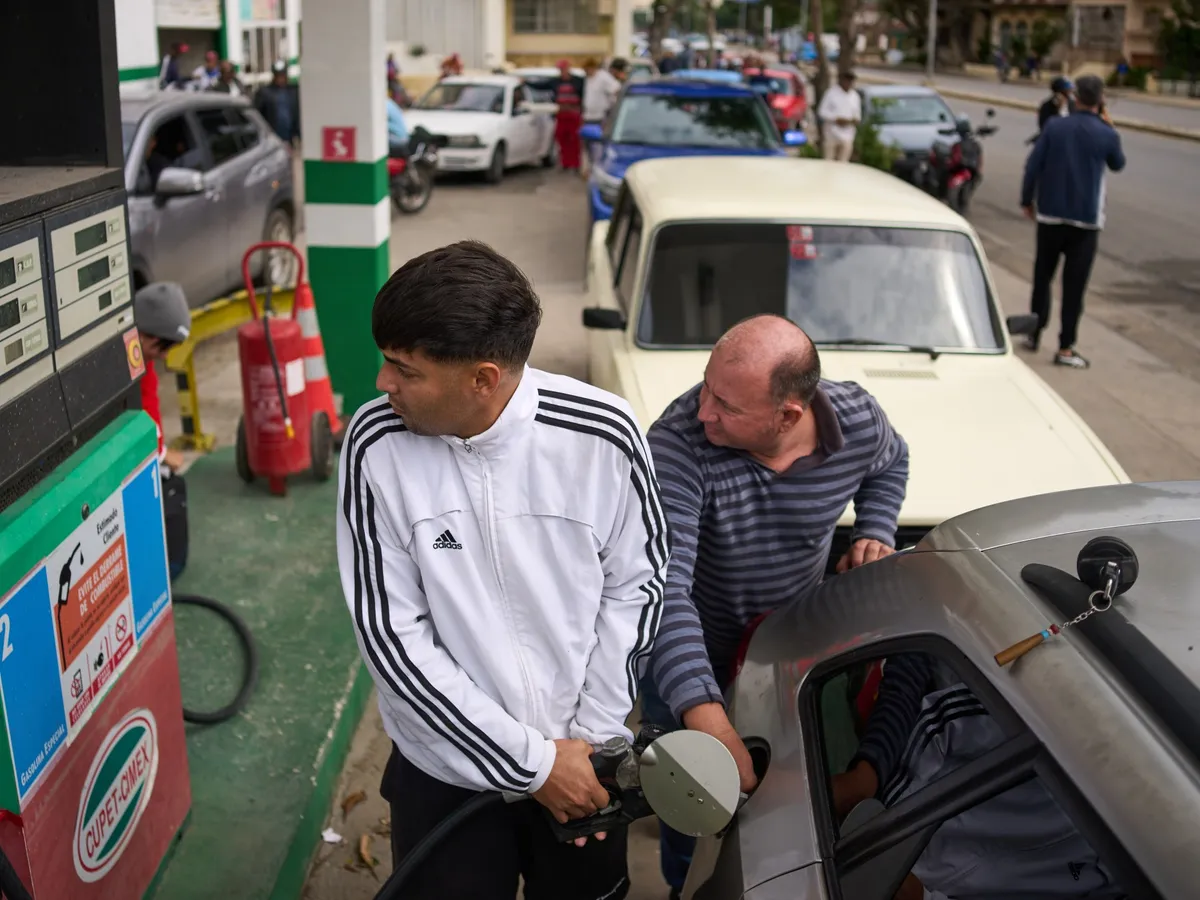
US actions are fuelling a humanitarian crisis in Cuba. Is US President Donald Trump seeking a deal, or to topple the government?A driver refuels at a petrol or gas station as others wait behind in a long line in Havana, Cuba [Ramon Espinosa/The Associated Press]Published On 11 Feb 2026Cuba has been reeling, with the island nation of 11 million staggering under the yoke of major fuel shortages that have trammelled nearly every aspect of life.The fomenting humanitarian crisis is a direct result of a new, aggressive approach by the administration of United States President Donald Trump in the wake of the US military abduction of Venezuelan leader Nicolas Maduro. Trump has gone far beyond Washington’s decades-long embargo on the island, threatening crippling tariffs on any country that provides fuel shipments, and, in turn, stifling lifeline supplies from Venezuela and Mexico.Recommended Stories list of 3 itemslist 1 of 3Cuba to introduce plan to address fuel shortage amid US blockadelist 2 of 3Latin America: In the Shadow of the US | Ep 1 – Coupslist 3 of 3Air Canada suspends flights to Cuba due to fuel shortageend of listBut as the impact of US policy on the lives of Cubans just 90 miles (145 km) away from the US state of Florida comes into increasing focus, the same clarity has not emerged on what the Trump administration actually hopes to achieve in its strategy, analysts have told Al Jazeera.That comes as Trump has sent a contradicting message: He has both told reporters he seeks to “work a deal” with the communist government led by Miguel Diaz-Canel and, alternately, plans to make Cuba “free again”, hinting at the regime change long sought by US Secretary of State Marco Rubio.“One possibility is that they actually do come to some kind of a deal,” William LeoGrande, a professor focusing on US foreign policy in Latin America at American University, told Al Jazeera. “But the $64,000 question is, what would be the terms of such a deal be?”“The second possibility, of course, is that this oil embargo causes social collapse on the island, no electricity, no gasoline, no fuel for anything, and the society literally begins to crumble,” he said.A third possibility, LeoGrande explained, is that the US could adopt a Venezuelan-style approach, keeping the government in place while installing a more pliable leader.“But I think even if there were such a person high enough up in the Cuban government that they could actually win the loyalty of the armed forces and the government and party bureaucracies, which I doubt, I don’t think the Trump administration has any way to identify them or to communicate with them,” he said.‘Try and bend the Cuban government’In the short term, Trump, who has long portrayed himself as the dealmaker-in-chief, appears to be leaning into messaging that calls for an agreement with Diaz-Canel’s strained government, according to Tiziano Breda, a Latin America and the Caribbean senior analyst at the Armed Conflict Location and Event Data Project (ACLED).Trump has said both sides are in discussions, although the nature of any contacts and the terms of any proposal have not yet emerged.“Trump has shown less interest and eagerness to engage with these left-wing governments on ideological battles,” Breda told Al Jazeera.”The circumstances give me the impression that Trump’s goal would be rather to try and bend the Cuban government, rather than prompting its collapse.”Diaz-Canal, meanwhile, has said he was open to talking to the US, but would only enter dialogue “without pressure or precondition” and with respect to sovereignty.In the same breath, he decried Washington’s “criminal policy against a country, as it affects food, transportation, hospitals, schools, economic production and the functioning of our vital systems”.Cuba, Diaz-Canel added in statements last week, sought peace, but was developing a defence plan “in case we have to move to a state of war”.Unclear termsSeveral analysts assessed that some type of new agreement between the US and Cuba remained on the table, but any terms seen as an existential threat to the government in Havana would be non-starters.It remained unclear what extractions Trump would consider satisfactory.Cuba has far less to offer economically than Venezuela, a South American country with the world’s largest proven oil reserves. However, it contains significant deposits of rare and critical earth minerals, including the world’s third-largest reserve of cobalt, a key mineral used in lithium-ion batteries and other advanced technologies.“Economically, Cuba has little to offer beyond agreements on the tourism industry or some trade deals,” according to Breda, although he added that Trump may try to pressure Havana to “give in on certain conditions, such as migration, the presence of US competitors in the country, and security cooperation between Russia and China”.In an executive order declaring Cuba an “unusual and extraordinary threat” to the US last month, Trump focused heavily on relations between Russia and China, which both cooperate with Cuba on defence, but do not have known military bases on the island.The order, which also highlighted crackdowns on dissent by Cuba’s government, further accused Havana of hosting what Washington considers “transnational terrorist groups”, including Hamas and Hezbollah.Cuba experts have regularly dismissed the threat posed by Cuba as overblown, while noting there is scant evidence to support the “terrorist group” claims.That has raised further questions over what tangible concessions the government could offer Trump, if his order is seen as a prelude to negotiations.Regime change?To be sure, Trump’s stated desire to pursue talks with Cuba’s current government puts him at odds with the decades-old ideology of the US Republican Party writ large, which has long eschewed any form of engagement with the communist government founded by Cuban leader Fidel Castro in 1959.That approach has been particularly championed by Trump’s top diplomat, Rubio, who is himself the son of Cuban immigrants with a political career predicated on a hawkish approach to the island.Rubio has for months pushed the notion that the government in Havana is on the verge of collapse, laying the groundwork for Trump’s current pressure campaign. His stance dovetails with an influential Cuban-American voting bloc, which has been a key part of the Republicans’ electoral coalition.“Rubio’s goal is to get rid of this regime in Cuba,” LeoGrande said, “so he would not be happy with any kind of deal like that Trump has cut in Venezuela, particularly if it were more or less a permanent deal.”LeoGrande, meanwhile, downplayed the likelihood of Trump deploying boots on the ground in Cuba, noting the president has so far avoided prolonged military engagement.A more surgical operation like the one targeting Maduro also remains unlikely, he assessed, with top roles in the armed forces still dominated by direct appointees of former President Raul Castro, who served as the Communist Party’s top official until his retirement in 2021.Instead, according to ACLED’s Breda, any approach to topple the government would likely result in a continuation of the current pressure campaign to fuel dissent among a population beleaguered by shortages.“But it remains to be seen whether Rubio will be able to convince Trump that there would not be great consequences in terms of migration, instability and violence in the island, and that this cannot have a spillover effect,” Breda said.What comes next?Discerning Trump’s motives may be akin to reading tea leaves, according to Louis Perez, a professor who has long focused on Cuban history at the University of North Carolina at Chapel Hill, who notes that “deep historical antecedents” to his current actions may help illuminate what comes next.Perez pointed to US policy that preceded the Cuban Revolution in 1959, reaching back to the US-established military government in Cuba in the early 20th century, and the Monroe Doctrine of 1823, which first sought to assert US influence across Latin America.“So widening the screen and pulling back, one sees the long view of a remarkable continuity of policy that reveals itself in many iterations,” he told Al Jazeera. “But the thread that links all of these iterations together in one package is the determination to deny Cuba sovereignty and self-determination.”
SRCAl Jazeera
LANGEN
LEANCenter
WORDS1 331
ENT11
WED · 2026-02-11 · 21:13 GMTBRIEF NSR-2026-0211-15462
NSR-2026-0211-15462Analysis·EN·Economic Impact
Beyond pressure: What is the Trump administration’s endgame in Cuba?
In 2026, Cuba is facing a humanitarian crisis due to severe fuel shortages, exacerbated by the Trump administration's aggressive policies. These policies, implemented after the US military abduction of Venezuelan leader Nicolas Maduro, go beyond the existing embargo, threatening tariffs on countries supplying fuel to Cuba.
Joseph StepanskyAl JazeeraFiled 2026-02-11 · 21:13 GMTLean · CenterRead · 6 min
Al JazeeraFIG 01
Reading time
6min
Word count
1 331words
Sources cited
2cited
Entities identified
11entities
Quality score
100%
§ 01
Briefing Summary
AI-generatedNEWSAR · AI
In 2026, Cuba is facing a humanitarian crisis due to severe fuel shortages, exacerbated by the Trump administration's aggressive policies. These policies, implemented after the US military abduction of Venezuelan leader Nicolas Maduro, go beyond the existing embargo, threatening tariffs on countries supplying fuel to Cuba. The US actions have stifled crucial supplies from Venezuela and Mexico. Analysts are uncertain about the Trump administration's ultimate goal, as Trump has expressed interest in both negotiating a deal with the Cuban government and pursuing regime change. Possible outcomes include a negotiated agreement, social collapse in Cuba due to the oil embargo, or the installation of a more compliant leader.
Confidence 0.90Sources 2Claims 5Entities 11
§ 02
Article analysis
Model · rule-basedFraming
Economic Impact
Political Strategy
Tone
Measured
AI-assessed
CalmNeutralAlarmist
Factuality
0.60 / 1.00
Mixed
LowHigh
Sources cited
2
Limited
FewMany
§ 03
Key claims
5 extracted01
Trump has both told reporters he seeks to “work a deal” with the communist government and plans to make Cuba “free again”.
quoteAl Jazeera (article's own claim)
Confidence
1.00
02
Trump has threatened crippling tariffs on any country that provides fuel shipments to Cuba.
factualAl Jazeera (article's own claim)
Confidence
1.00
03
Cuba has been reeling, with the island nation of 11 million staggering under the yoke of major fuel shortages.
factualAl Jazeera (article's own claim)
Confidence
0.80
04
US actions are fuelling a humanitarian crisis in Cuba.
factualAl Jazeera (article's own claim)
Confidence
0.70
05
One possibility is that this oil embargo causes social collapse on the island.
predictionWilliam LeoGrande
Confidence
0.60
§ 04
Full report
6 min read · 1 331 words§ 05
Entities
11 identifiedKey playerOppositionContextPositiveNeutralNegative
People4
Organizations1
§ 06
Keywords & salience
9 termsus-cuba relations
0.90
trump administration
0.80
fuel shortage
0.80
humanitarian crisis
0.70
regime change
0.60
embargo
0.60
tariffs
0.50
nicolas maduro
0.40
foreign policy
0.40
§ 07
Topic connections
Interactive graph Network visualization showing 51 related topics
View Full Graph Person Organization Location Event|Click node to navigate|Edge numbers = shared articles