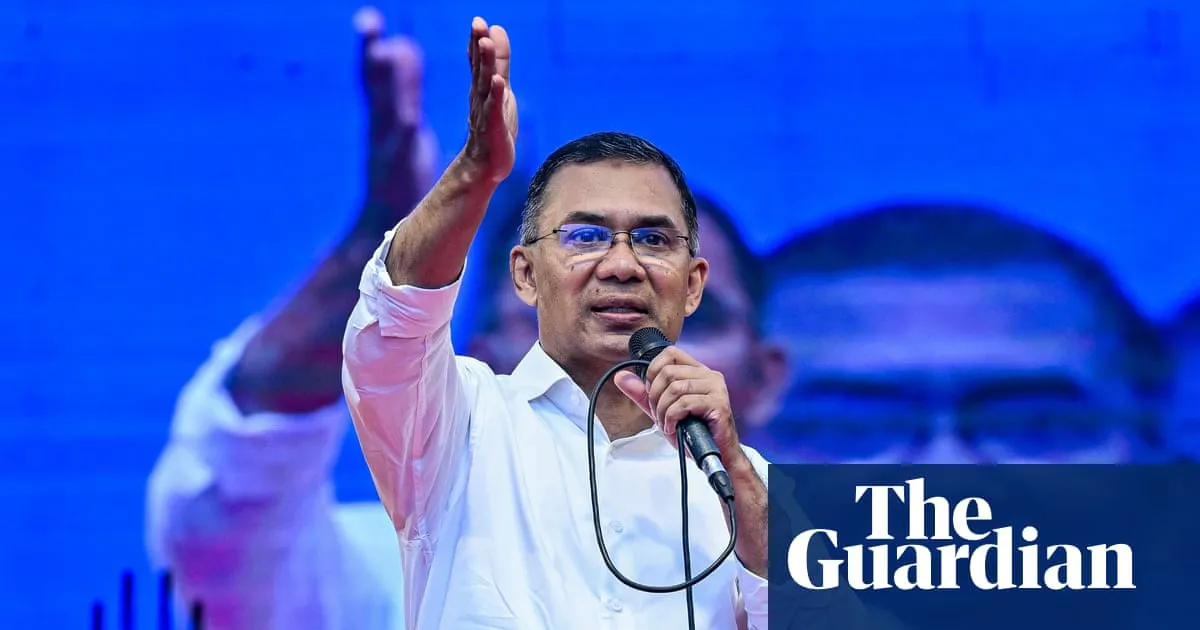
Tarique Rahman, who after 17 years in exile is the main contender to be the next prime minister of Bangladesh, has pledged to end entrenched corruption and put the country on a “new path” as voting began in the first free and fair elections in almost two decades.Speaking to the Guardian before polls opened on Thursday morning, Rahman promised a new era of clean politics, including a “top down, no tolerance” approach to graft, if his Bangladesh Nationalist party (BNP) was brought to power.According to polls, the BNP are likely to win a sizeable majority over their rival, the Islamist party Jamaat e-Islami, returning the party to power after 20 years.Softly spoken and understated, 60-year-old Rahman acknowledged the elections were taking place at a pivotal but “challenging” moment for Bangladesh, which has long ranked among the world’s most corrupt countries and where democracy has faced a sustained attack for more than a decade.“We saw in the last regime that corruption was encouraged,” said Rahman. “Our economy was left destroyed. It will take time, but if we establish real accountability in every part of the government and send a message down the chain, that will eventually control corruption.”BNP supporters cheer Tarique Rahman at a rally in Pallabi, on 8 February. Photograph: Mohammad Ponir Hossain/ReutersThe elections are the first since the fall of autocratic prime minister Sheikh Hasina in the summer of 2024. The student-led uprising that toppled Hasina after 15 years in power left an estimated 1,400 people dead according to the UN, after it was met with a ruthless and violent crackdown by the state.Last year, the former prime minister – now exiled in India – was found guilty of crimes against humanity committed during the final days of her rule and sentenced to death.For the past three elections, Hasina and her Awami League party have been accused of rigging the results and ruthlessly crushing and jailing opponents, including thousands of BNP activists and leaders.Since August 2024, Bangladesh has been led by an interim government, headed by Nobel laureate Muhammad Yunus, tasked with restoring democracy and readying the country for free and fair polls. However, the country has remained in turmoil, amid a decline in law and order and frustrations over economic stagnation.Analysts emphasised that a fair and violence-free election would be a vital step forward for the country. There are 127 million registered voters and in a bid to keep security tight, more than 900,000 police, army and security personnel have been deployed on polling day.“This is the first credible election the country’s held in 17 years so it’s incredibly significant,” said Thomas Kean, Crisis Group’s senior consultant on Bangladesh. “People are eager to have the chance to vote after so long.”In Dhaka, young voters spoke of their thrill at experiencing democracy first hand. “I am excited, this is the first time I am freely taking part in an election,” said Yasmin Sorupa, 30, who said she intended to vote BNP. “In the past, I could never cast my vote because when I went to the polling station, somebody had already cast it.”BNP supporters walk in support of Tarique Rahman during a campaign rally. Photograph: Sajjad Hussain/AFP/Getty ImagesRahman returned to Bangladesh to fight the elections on Christmas day, ending more than 17 years spent as a political fugitive. He took over leadership of the BNP from his mother, former prime minister Khaleda Zia, a giant of Bangladeshi politics and longtime political nemesis of Hasina. She died just five days after Rahman’s return home in December.“Physically, I may have been out of the country but for all those years I was always connected to my people in Bangladesh,” he said. “As soon as the opportunity came to serve my people, I came back.”Rahman’s time in self-imposed exile in London, living in the suburb of Kingston with his wife and daughter, is said by associates to have mellowed him. His experiences of day-to-day British life also left an imprint, from his push for more tolerance in Bangladeshi politics to his determination to introduce weekly rubbish bin collections in the country.Many in Bangladesh say they cannot forget the corruption that flourished during the last BNP regime between 2001 and 2006, under his mother. Rahman did not dispute that “mistakes” had been made by his party in the past. “I will not deny that. If we do, it will not help anything,” he said.Border Guard Bangladesh personnel stand guard next to a bullet proof bus of BNP chair and election candidate Tarique Rahman, who features alongside his late parents, Khaleda Zia and Ziaur Rahman. Photograph: Sajjad Hussain/AFP/Getty ImagesThough Rahman did not serve an official role in the previous regime, he was seen as having undue influence and in a leaked 2008 diplomatic cable was described as “a symbol of kleptocratic government”.He was jailed in 2007 as part of an anti-corruption drive by a military-backed caretaker government on charges he denies. In 2008, he was released to seek medical treatment in London, after being so badly tortured in jail that he was taken to the plane in a wheelchair.During Hasina’s subsequent 15-year rule, he was convicted of a slew of terror and corruption charges, which he alleges were politically motivated to keep him out of Bangladesh. In 2024, after Hasina’s fall, the courts overturned his convictions, finally freeing him to return home.“It’s been more than 18 years and they’ve failed to prove anything,” said Rahman. “Don’t you think that’s good enough, long enough to prove that I did nothing wrong?”Yet not all in Bangladesh have cheered Rahman’s return. Both his parents were Bangladeshi prime ministers and to many, he is just the next generation of dynastic politicians, continuing the grip that two families have had over Bangladesh since independence in 1971 and which many had hoped the July uprising would bring to an end.Jamaat-e-Islami leader Shafiqur Rahman, centre, and other leaders during the last day of an election rally. Photograph: Anupam Nath/APEven if the BNP win a sizeable majority in the election, analysts emphasised that the resurgence of the Islamist Jamaat e-Islami party and their Islamist alliance – parties that were banned under Hasina – could present major challenges for the BNP and Bangladesh’s secularism in the future.Jamaat e-Islami, alongside allies that follow even more hardline Islamist politics, all believe in the introduction of sharia law and are likely to gain the largest vote share in their history and form a formidable opposition.Jamaat e-Islami’s leader has already been accused of regressive policies and controversial views on women’s rights in the home and workplace. Human rights groups have also raised an alarm over a recent surge in moral policing of women, with incidents such as girls being prevented from playing football and enforcement of modest dress and headscarves.Rahman acknowledged there were “some extremist people who are trying to do these things” but he said it didn’t have “any relation with Islam or religion”. Instead, he attributed it to the “absence of democracy … People were not allowed to express themselves for so long, it has built up frustration and in some cases, extremism”.Tarique Rahman waves from a vehicle after he arrives back in Dhaka from London, in December 2025. Photograph: Fatima Tuj Johora/ReutersHe insisted the rise of radical Islamist politics was not a threat to the plurality of Bangladesh. “If we are able to practise democracy, if we can create jobs for young people and the opportunity to have a decent life, I believe people will come away from this kind of thought.”One of the biggest geopolitical challenges facing the new government of Bangladesh will be rebuilding relations with its neighbour India. Under Hasina, India was Bangladesh’s closest ally but ties severely frayed after her government fell and have become outwardly hostile in recent months.Rahman acknowledged that there were “issues” with India and he would only want “a relationship of mutual respect, mutual understanding”.Questioned on whether India and Bangladesh could rebuild a friendship while Delhi continued to give a safe haven to Hasina and hundreds of her party members, Rahman was cagey. “That depends,” he said. “It has to be on them too.”
SRCThe Guardian - World News
LANGEN
LEANCenter-Left
WORDS1 348
ENT8
THU · 2026-02-12 · 01:10 GMTBRIEF NSR-2026-0212-15522
NSR-2026-0212-15522News Report·EN·Political Strategy
Tarique Rahman promises era of clean politics as Bangladesh holds first election since fall of Hasina
Bangladesh is holding its first election since the fall of autocratic Prime Minister Sheikh Hasina. Tarique Rahman, leader of the Bangladesh Nationalist Party (BNP) and a main contender for prime minister after 17 years in exile, has pledged to combat corruption and reform politics if elected.
Hannah Ellis-Petersen and Redwan Ahmed in DhakaThe Guardian - World NewsFiled 2026-02-12 · 01:10 GMTLean · Center-LeftRead · 6 min
The Guardian - World NewsFIG 01
Reading time
6min
Word count
1 348words
Sources cited
2cited
Entities identified
8entities
Quality score
100%
§ 01
Briefing Summary
AI-generatedNEWSAR · AI
Bangladesh is holding its first election since the fall of autocratic Prime Minister Sheikh Hasina. Tarique Rahman, leader of the Bangladesh Nationalist Party (BNP) and a main contender for prime minister after 17 years in exile, has pledged to combat corruption and reform politics if elected. Rahman stated that the BNP would take a "top down, no tolerance" approach to graft. The election follows a period of political turmoil, including a student-led uprising that led to Hasina's ouster and her subsequent conviction for crimes against humanity. Since August 2024, an interim government led by Muhammad Yunus has been in place, tasked with restoring democracy and overseeing fair elections. Analysts emphasize the importance of a peaceful and fair election for the country's future.
Confidence 0.90Sources 2Claims 10Entities 8
§ 02
Article analysis
Model · rule-basedFraming
Political Strategy
Human Rights
Tone
Mixed Tone
AI-assessed
CalmNeutralAlarmist
Factuality
0.70 / 1.00
Factual
LowHigh
Sources cited
2
Limited
FewMany
§ 03
Key claims
10 extracted01
Tarique Rahman pledged to end corruption and put Bangladesh on a “new path”.
quoteTarique Rahman
Confidence
1.00
02
Hasina was found guilty of crimes against humanity and sentenced to death.
factual
Confidence
1.00
03
The elections are the first since the fall of Sheikh Hasina in the summer of 2024.
factual
Confidence
1.00
04
There are 127 million registered voters.
statistic
Confidence
1.00
05
Tarique Rahman pledged to end corruption and put Bangladesh on a “new path”.
quoteTarique Rahman
Confidence
1.00
06
The elections are the first since the fall of Sheikh Hasina in the summer of 2024.
factual
Confidence
1.00
07
1,400 people died in the uprising that toppled Hasina, according to the UN.
statisticUN
Confidence
0.90
08
1,400 people died during the student-led uprising that toppled Hasina, according to the UN.
statisticUN
Confidence
0.90
09
Hasina and her Awami League party have been accused of rigging the results in the past three elections.
factual
Confidence
0.80
10
This is the first credible election the country’s held in 17 years.
quoteThomas Kean, Crisis Group’s senior consultant on Bangladesh
Confidence
0.80
§ 04
Full report
6 min read · 1 348 words§ 05
Entities
8 identifiedKey playerOppositionContextPositiveNeutralNegative
People3
Organizations3
§ 06
Keywords & salience
9 termsbangladesh election
1.00
clean politics
0.80
corruption
0.80
tarique rahman
0.70
bnp
0.70
sheikh hasina
0.60
political reform
0.60
democracy
0.50
economic stagnation
0.40
§ 07
Topic connections
Interactive graph Network visualization showing 51 related topics
View Full Graph Person Organization Location Event|Click node to navigate|Edge numbers = shared articles