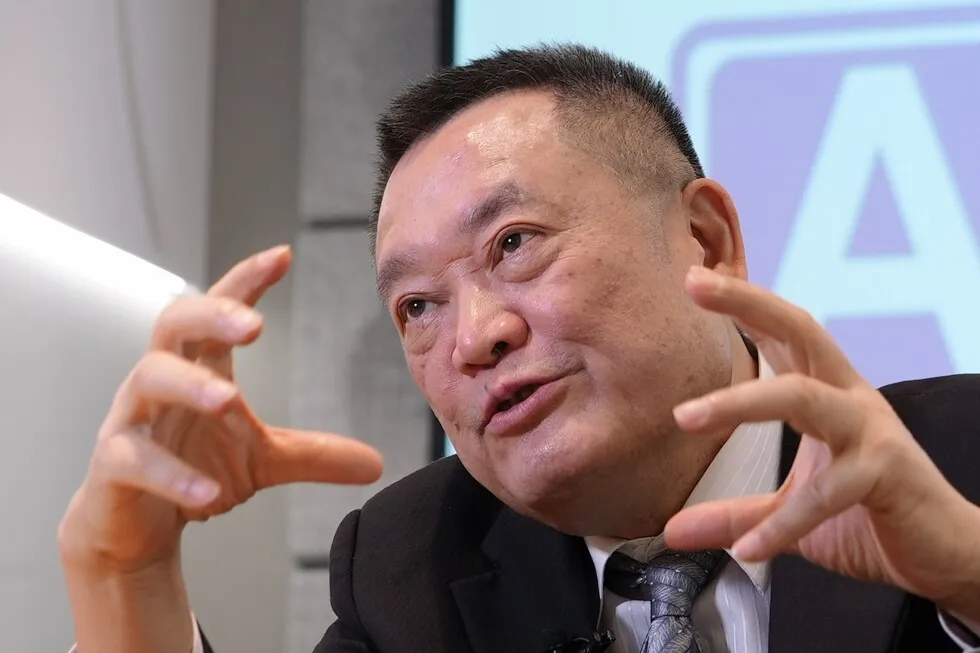
Taiwan’s AI-powered economy soars in the shadow of bubble fears and China threats 1 of 5 | Asia Vital Components Chairman Spencer Shen speaks during an interview with The Associated Press in New Taipei City, Taiwan, Friday, Jan. 30, 2026. (AP Photo/Chiang Ying-ying) 2 of 5 | Asia Vital Components (AVC) Chairman Spencer Shen introduces the laboratory equipment during an interview with The Associated Press in New Taipei City, Taiwan, Friday, Jan. 30, 2026. (AP Photo/Chiang Ying-ying) 3 of 5 | A worker walks past the logo of TSMC or Taiwan Semiconductor Manufacturing Corp., a Taiwanese multinational semiconductor contract manufacturing and design company, in Hsinchu, Taiwan, on Thursday, Jan. 29, 2026. (AP Photo/Daniel Ceng) 4 of 5 | A man walks past the entrance to a Foxconn or Hon Hai company complex in Taipei, Taiwan, on Tuesday, Jan. 27, 2026. (AP Photo/Daniel Ceng) 5 of 5 | A woman walks past a building of TSMC or Taiwan Semiconductor Manufacturing Corp., a Taiwanese multinational semiconductor contract manufacturing and design company, in Hsinchu, Taiwan, on Thursday, Jan. 29, 2026. (AP Photo/Daniel Ceng) 1 of 5 Asia Vital Components Chairman Spencer Shen speaks during an interview with The Associated Press in New Taipei City, Taiwan, Friday, Jan. 30, 2026. (AP Photo/Chiang Ying-ying) Add AP News on Google Add AP News as your preferred source to see more of our stories on Google. 2 of 5 Asia Vital Components (AVC) Chairman Spencer Shen introduces the laboratory equipment during an interview with The Associated Press in New Taipei City, Taiwan, Friday, Jan. 30, 2026. (AP Photo/Chiang Ying-ying) Add AP News on Google Add AP News as your preferred source to see more of our stories on Google. 3 of 5 A worker walks past the logo of TSMC or Taiwan Semiconductor Manufacturing Corp., a Taiwanese multinational semiconductor contract manufacturing and design company, in Hsinchu, Taiwan, on Thursday, Jan. 29, 2026. (AP Photo/Daniel Ceng) Add AP News on Google Add AP News as your preferred source to see more of our stories on Google. 4 of 5 A man walks past the entrance to a Foxconn or Hon Hai company complex in Taipei, Taiwan, on Tuesday, Jan. 27, 2026. (AP Photo/Daniel Ceng) Add AP News on Google Add AP News as your preferred source to see more of our stories on Google. 5 of 5 A woman walks past a building of TSMC or Taiwan Semiconductor Manufacturing Corp., a Taiwanese multinational semiconductor contract manufacturing and design company, in Hsinchu, Taiwan, on Thursday, Jan. 29, 2026. (AP Photo/Daniel Ceng) Add AP News on Google Add AP News as your preferred source to see more of our stories on Google. Updated [hour]:[minute] [AMPM] [timezone], [monthFull] [day], [year] Taipei, Taiwan (AP) — In Taipei, real estate agent Jason Sung is betting that home prices around a high-tech industrial park in the northern part of Taiwan’s capital will soon take flight – because of computer chip maker Nvidia.The area is where Nvidia plans to build its new Taiwan headquarters as it rapidly expands on the island, set to surpass Apple to become the biggest customer of Taiwan semiconductor maker TSMC, the biggest contract manufacturer of the advanced chips needed for artificial intelligence. Nvidia CEO Jensen Huang describes Taiwan as the “center of the world’s computer ecosystem.” It’s riding high on the global AI frenzy. Its economy grew at an 8.6% annual pace last year, and it’s hoping to maintain that momentum after it recently sealed a trade deal with U.S. President Donald Trump that cut U.S. tariffs on Taiwan to 15% from 20%. “We have been lucky,” said Wu Tsong-min, an emeritus economics professor at National Taiwan University and a former board member of Taiwan’s central bank.But Taiwan’s heavy reliance on computer chip makers and other technology companies carries the growing risk of the AI craze turning out to be a bubble. “What if the AI bubble is real, and what if its rapid growth pace slows, what’s next for Taiwan? That’s the question many have been asking,” Wu said. Escalating tensions with Beijing, which claims independently governed Taiwan as mainland China’s territory, are another abiding threat, despite the island’s vital role in global chip and AI supply chains. Taiwan’s leads in chipmaking An island of about 23 million people, Taiwan depends heavily on exports. They jumped nearly 35% year-on-year in 2025, as shipments to the U.S. surged 78% due to ballooning AI demand.That’s thanks largely to TSMC, or Taiwan Semiconductor Manufacturing Corp., and electronics giant Foxconn, which makes AI servers for Nvidia and is a major supplier to Apple.Taiwan has undergone massive economic changes while shifting from mainly labor-intensive industries such as plastics and textiles to advanced manufacturing like semiconductor fabrication. The AI frenzy has made TSMC one of the world’s top 10 most valuable companies. Its profit jumped 46% last year to $1.7 trillion Taiwan dollars ($54 billion).The chipmaker is investing heavily both in Taiwan and in new factories in Arizona in the U.S. It produces more than 90% of the world’s most advanced chips.Foxconn, formally known as Hon Hai Precision Industry Co., has doubled its value since 2023. The maker of Apple’s iPhone and iPads now produces AI servers and racks and has a partnership with OpenAI to supply AI data center equipment.Taiwan’s heavy reliance on its technology industry means its biggest risk is that growth will be “very highly contingent on the AI boom and tech race continuing,” said Lynn Song, chief economist for Greater China at ING Bank. Risks persist of an AI bubble?Worries that the AI craze may prove to be a bubble prone to a bust similar to the dot.com crash in 2000 that swept through markets, alarming many in Taiwan.“I’m also very nervous about it,” C.C. Wei, TSMC’s chairman said when asked about a potential AI bubble during an earnings call in January. “Because we have to invest about $52-$56 billion (this year).”“If we did not do it carefully, that will be a big disaster to TSMC for sure,” he said. “I want to make sure that my customers’ demands are real.”In a recent report, analysts from Fitch Ratings argued that AI demand will remain strong at least in the near term. In the longer term, however, the risks “will depend on the evolution of AI, as well as trade and investment policies and the adaptability of Taiwanese firms,” they wrote.Taiwanese electronics company Asia Vital Components, a key supplier of liquid cooling systems for Nvidia, is investing heavily in research and development. Its chairman, Spencer Shen, said he saw no signs of a slowdown in AI-related demand so far. The company is already designing thermal solutions for 2028 AI servers, he said.“We do not believe this is a bubble,” Shen told The Associated Press in an interview. “AI is driven by companies with real products and massive cash flows, like Amazon, Microsoft, Google and Meta.”“In fact, AI infrastructure is still in short supply,” Shen added. “I expect AI to trickle through to our everyday level and change the way that things will work fundamentally.” Taiwan has a ‘silicon shield’ against BeijingSome in Taiwan believe that its pivotal role in the technology sector, especially as a maker of computer chips whose main material is silicon, helps to protect the island from attack by communist-ruled Beijing, whose leaders have vowed to reunite the island with the Chinese mainland, by force if necessary.The two governments split in 1949 during a civil war. Beijing has been stepping up pressure, conducting military drills nearby. Exercises in late December included live rounds landing closer to the island than before, Taiwan officials said.Such geopolitical factors cloud the economic outlook, though many in Taiwan including its former President Tsai Ing-wen believe its importance to global chipmaking would deter China from attacking. The risk of an invasion is unclear. Both global tech companies and Chinese industries would suffer from massive disruptions of the chip supply chain, said Wu of National Taiwan University.Still, some companies have been identifying contingency scenarios in recent years on how to respond in case of military action by China, said Chen Shin-horng, vice president of the semi-official Chung-Hua Institution for Economic Research.“We need to understand the potential risk, potential damages to Taiwan,” said Chen.While many of its core research and development activities are in Taiwan, TSMC already has plants in China, Japan and the U.S., and it’s expanding its offshore production in the U.S., Germany and Japan. Roughly 65% of Foxconn’s manufacturing is in China, and the company has factories in other parts of the world such as India, Mexico and the U.S. AVC has been expanding its production capacity in Vietnam.While some have called for Taiwan to diversify its economy away from technology to reduce risks, others argue that doubling down on its world-leading technology is the way forward. “It is our greatest strength,” said Shen of AVC.Some in Taiwan are being left behindThe AI boom has done wonders for Taiwan’s stock exchange, where the benchmark Taiex has climbed nearly 250% over the past decade, making many investors rich. Economists have significantly upgraded forecasts for Taiwan’s economic growth for 2026 based on its robust AI-related exports.But as is true elsewhere, the wealth is not evenly spread. Many Taiwan residents feel they have been left behind.Taiwan’s wealth gap, according to official data, has roughly quadrupled over the past three decades.The pay of tech workers already earning high wages, especially chip engineers and managers, has skyrocketed. For other traditional industries, such as plastics and machine toolmakers, growth has lagged.Economists say that gap might widen as the AI frenzy continues.“It can be tough to make a living,” said Jean Lin, a 30-something manager of a takeaway outlet selling bento meals in a Taipei neighborhood where Foxconn’s office is located.“Many of the younger generation still can’t afford to buy an apartment,” Lin, who wishes to start her own business one day, added. “A lot of young people still feel they don’t have much money.”___Associated Press video journalist Johnson Lai contributed. Chan covers China business, economy and finance for The Associated Press, reporting on key sectors from technology to trade. He is based in Hong Kong.
SRCAssociated Press (AP)
LANGEN
LEANCenter
WORDS1 685
ENT4
THU · 2026-02-12 · 07:53 GMTBRIEF NSR-2026-0212-15568
NSR-2026-0212-15568News Report·EN·Economic Impact
Taiwan’s AI-powered economy soars in the shadow of bubble fears and China threats
As of January 2026, Taiwan's economy is experiencing significant growth fueled by advancements in artificial intelligence. Companies like TSMC and Foxconn are key players in this AI-driven expansion.
By
CHAN HO-HIMAssociated Press (AP)Filed 2026-02-12 · 07:53 GMTLean · CenterRead · 7 min
Associated Press (AP)FIG 01
Reading time
7min
Word count
1 685words
Sources cited
1cited
Entities identified
4entities
Quality score
100%
§ 01
Briefing Summary
AI-generatedNEWSAR · AI
As of January 2026, Taiwan's economy is experiencing significant growth fueled by advancements in artificial intelligence. Companies like TSMC and Foxconn are key players in this AI-driven expansion. However, this economic boom is shadowed by concerns of a potential economic bubble. The island nation also faces ongoing threats from China, adding geopolitical uncertainty to its economic outlook. Asia Vital Components (AVC) Chairman Spencer Shen discussed these issues in an interview, highlighting both the opportunities and risks facing Taiwan's AI-powered economy. The article provides a snapshot of Taiwan's economic landscape amidst technological advancements and external pressures.
Confidence 0.90Sources 1Claims 3Entities 4
§ 02
Article analysis
Model · rule-basedFraming
Economic Impact
National Security
Tone
Mixed Tone
AI-assessed
CalmNeutralAlarmist
Factuality
0.70 / 1.00
Factual
LowHigh
Sources cited
1
Limited
FewMany
§ 03
Key claims
3 extracted01
Nvidia plans to build its new Taiwan headquarters in a high-tech industrial park in northern Taipei.
factual
Confidence
1.00
02
Taiwan’s AI-powered economy soars.
factual
Confidence
0.80
03
Real estate agent Jason Sung is betting that home prices around a high-tech industrial park will soon take flight.
predictionJason Sung
Confidence
0.60
§ 04
Full report
7 min read · 1 685 words§ 05
Entities
4 identifiedKey playerOppositionContextPositiveNeutralNegative
Organizations1
§ 06
Keywords & salience
8 termsai-powered economy
0.90
taiwan
0.80
china threats
0.70
bubble fears
0.70
tsmc
0.60
semiconductor
0.60
foxconn
0.50
asia vital components
0.50
§ 07
Topic connections
Interactive graph Network visualization showing 51 related topics
View Full Graph Person Organization Location Event|Click node to navigate|Edge numbers = shared articles