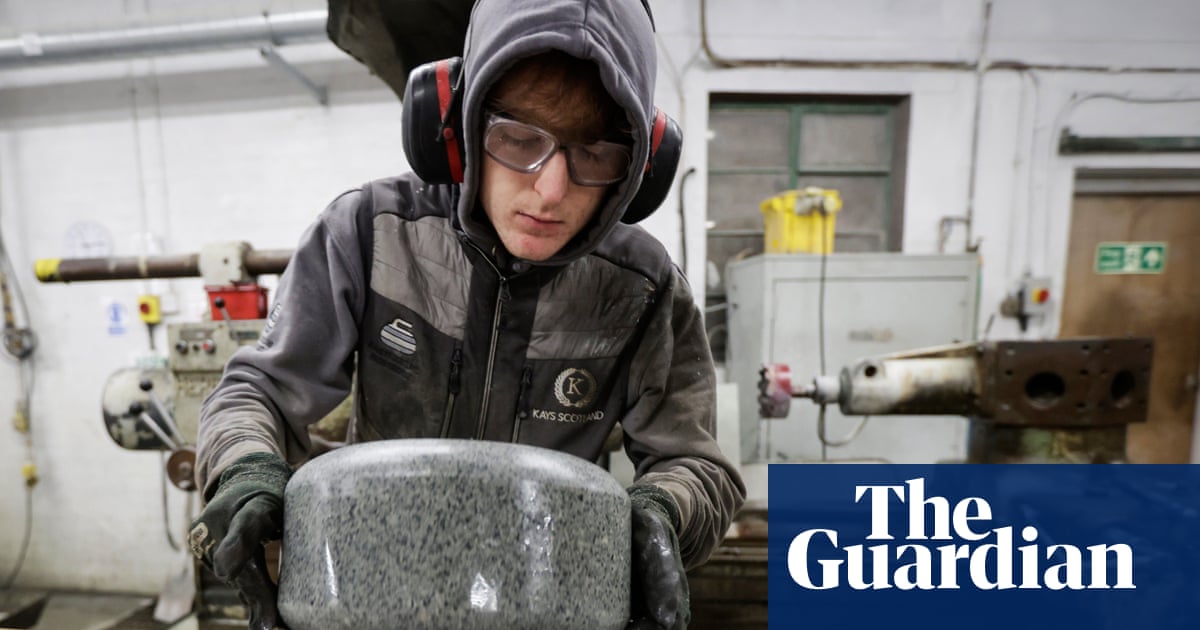
“It takes 60m years and about six hours to make a curling stone,” shouts Ricky English above the whine of the lathes. The operations manager at Kays Scotland is surrounded by wheels of ancient granite in varying states of refinement.It is a small business with a big responsibility: the only factory in the world to supply the Winter Olympics with curling stones. Competitors don’t travel with their own stones, which weigh about 18kg each, and with 16 required for a game. Instead, this year, 132 stones were crafted in the East Ayrshire town of Mauchline and shipped to northern Italy.“It’s not just robots and machines and automated tools doing it,” says English. “It’s handcrafted, it’s traditional, it’s got history. It’s a great wee place.”The family company, founded in 1851 and employing just 15 staff, began its association with the inaugural Winter Olympics in Chamonix in 1924 and has made every stone since curling was added as a medal sport in 1998, English says. Has he been watching the Winter Olympics himself, where curling has offered some dramatic moments with the GB men and women in action on Friday and over the weekend.“They do look quite good coming down the ice,” he says, allowing himself a modest grin.The stones are made from a kind of granite that is only found on Ailsa Craig, a tiny volcanic island in the Firth of Clyde, home to an array of seabirds, and described by John Keats as a “craggy ocean pyramid” in his eponymous sonnet.Person making a curling stone with machinery in a factoryThe body of the curling stone is made from a single piece of common green granite. “It’s got elasticity and when two stones hit together it acts like a spring,” says English. The running band, the only part of the stone that touches the ice, is an insert made of blue hone granite. “It’s basically a waterproof granite, which makes it perfect for running across ice. And the only place on the planet you can get that is Ailsa Craig.” Both types are extremely hard wearing, he says, and once put together “make the perfect curling stone”.On the factory floor, each machine takes the initial rough round of granite further along its journey – shaping, integrating the two different granites and then drilling the central hole for the handle. Sparks fly as the stones are polished to a liquid shine using pumice and diamond pads.The fine craftsmanship is also evident in the miniature curling stones, drinks cubes and coasters being fashioned in one corner. This year, Kays also landed a contract to make official giftware for the Winter Olympics, a huge boost for the business and also a logistical challenge. Gift boxes are piled up in the office ready to ship, with many orders from the US. English wonders whether the American rapper Snoop Dogg’s recent interest in the sport may have boosted the market.Native to Scotland and one of the world’s oldest team sports, the earliest known curling stone dates back to 1511, with the game originally played on frozen lochs and taken all over the world by Scots immigrants. The Royal Caledonian Curling Club was established in 1838, and the rules were standardised thereafter as milder winter temperatures forced the game to evolve from an outdoor to an indoor sport.The finished stones – which cost £750 each – are packed on pallets ready to be shipped all over the globe. Canada and China are big buyers, while the furthest afield order last year came from Antarctica.Kays aims to complete 48 stones a week, and each has a unique number that can be traced back to the original boulder from which it was hewn. The granite is harvested from Ailsa Craig every six or seven years, and with an estimated 680m tonnes of it left there is no issue with supply.Curling stones are especially long-lasting, and can be returned to the factory for refurbishment. “I think this is the only product in the world where you can come back after 20 years,” says English. “It’s about reliability and performance and they’re used on the biggest stage in the world.”
SRCThe Guardian - World News
LANGEN
LEANCenter-Left
WORDS689
ENT4
FRI · 2026-02-13 · 09:00 GMTBRIEF NSR-2026-0213-15928
NSR-2026-0213-15928News Report·EN·Human Interest
‘A great wee place’: the small Scottish factory crafting Olympic curling stones
Kays Scotland, a small, family-owned factory in Mauchline, East Ayrshire, is the sole supplier of curling stones for the Winter Olympics. The company, founded in 1851, has been providing stones since the first Winter Olympics in 1924 and every games since curling became a medal sport in 1998.
Libby Brooks Scotland correspondentThe Guardian - World NewsFiled 2026-02-13 · 09:00 GMTLean · Center-LeftRead · 3 min
The Guardian - World NewsFIG 01
Reading time
3min
Word count
689words
Sources cited
1cited
Entities identified
4entities
Quality score
100%
§ 01
Briefing Summary
AI-generatedNEWSAR · AI
Kays Scotland, a small, family-owned factory in Mauchline, East Ayrshire, is the sole supplier of curling stones for the Winter Olympics. The company, founded in 1851, has been providing stones since the first Winter Olympics in 1924 and every games since curling became a medal sport in 1998. This year, they crafted 132 stones for the competition in Italy. Each stone is made from granite sourced exclusively from Ailsa Craig, a Scottish island, with the body made of common green granite and the running band of blue hone granite. The six-hour process involves shaping, combining the two granites, and polishing, blending traditional craftsmanship with machinery.
Confidence 0.90Sources 1Claims 5Entities 4
§ 02
Article analysis
Model · rule-basedFraming
Human Interest
Economic Impact
Tone
Measured
AI-assessed
CalmNeutralAlarmist
Factuality
0.80 / 1.00
Factual
LowHigh
Sources cited
1
Limited
FewMany
§ 03
Key claims
5 extracted01
The body of the curling stone is made from a single piece of common green granite.
factualRicky English
Confidence
1.00
02
The family company, founded in 1851, began its association with the inaugural Winter Olympics in Chamonix in 1924.
factualRicky English
Confidence
1.00
03
This year, 132 stones were crafted in the East Ayrshire town of Mauchline and shipped to northern Italy.
factualnull
Confidence
1.00
04
Kays Scotland is the only factory in the world to supply the Winter Olympics with curling stones.
factualnull
Confidence
1.00
05
It takes 60m years and about six hours to make a curling stone.
factualRicky English
Confidence
1.00
§ 04
Full report
3 min read · 689 words§ 05
Entities
4 identifiedKey playerOppositionContextPositiveNeutralNegative
§ 06
Keywords & salience
9 termscurling stones
1.00
winter olympics
0.80
kays scotland
0.70
granite
0.70
ailsa craig
0.60
craftsmanship
0.60
scottish factory
0.50
manufacturing
0.50
blue hone granite
0.40
§ 07
Topic connections
Interactive graph No topic relationship data available yet. This graph will appear once topic relationships have been computed.