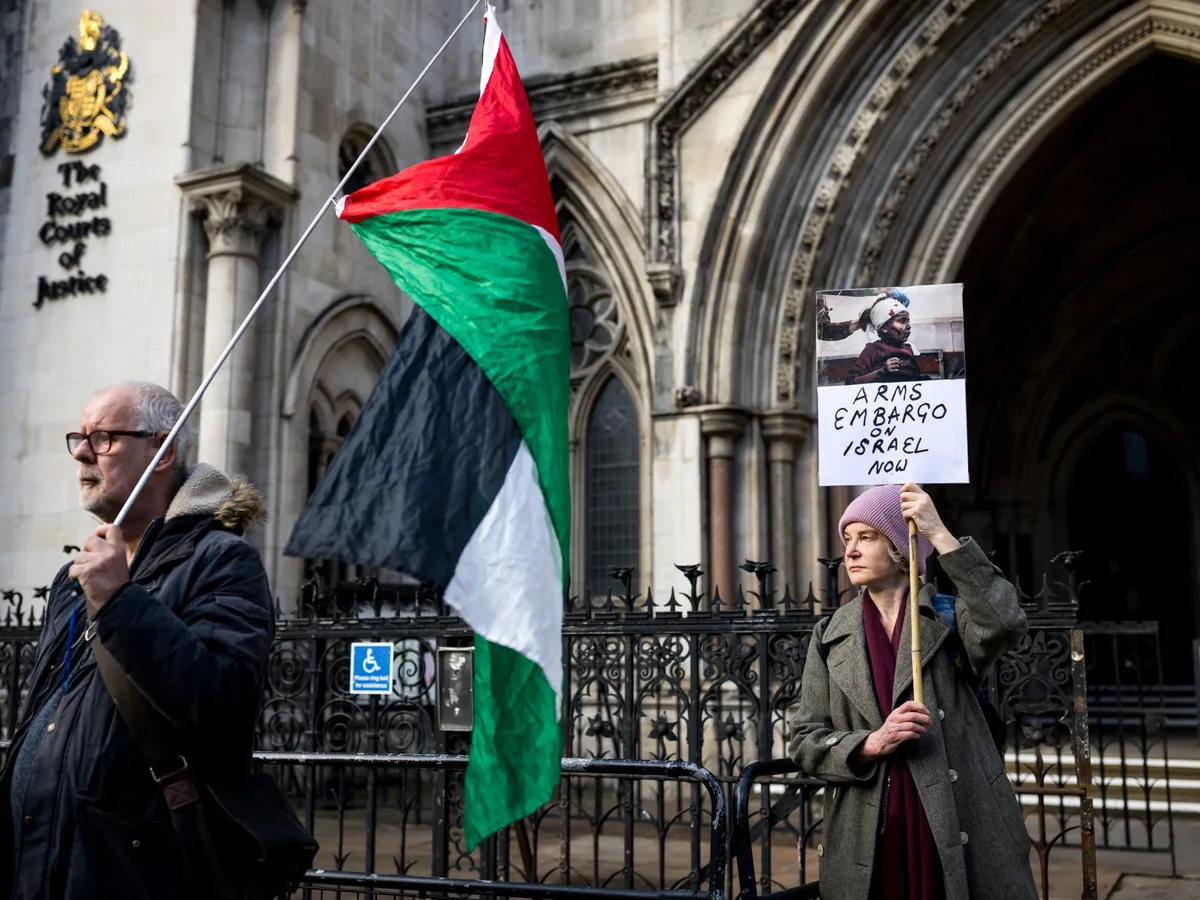
Activists welcome the court ruling as the UK government, which designated the group as a ‘terrorist’ organisation, says it will appeal the verdict.Protesters holding a placard and a Palestinian flag gather outside the Royal Courts of Justice in London, United Kingdom [File: Jack Taylor/Getty Images]Published On 13 Feb 2026In a landmark ruling celebrated by human rights groups, the High Court in London has called the United Kingdom government’s ban on the pro-Palestinian campaign group, Palestine Action, “unlawful”.In July last year, the UK government had banned the group, which had protested against Israel’s genocidal war on Gaza and the UK’s support for Israel. The Labour government led by Prime Minister Keir Starmer designated it as a “terrorist” organisation and a national security threat, putting it on par with armed groups like al-Qaeda and ISIL (ISIS).Recommended Stories list of 3 itemslist 1 of 3Corbyn alleges UK ‘complicity’ after Streeting’s admission of Gaza abuseslist 2 of 3UK decision to ban Palestine Action as ‘terror group’ unlawful, court sayslist 3 of 3UK ban on Palestine Action was unlawful, says courtend of listHere’s a timeline of when and why Palestine Action was banned and what members of the group have had to endure so far:What does Friday’s ruling mean?On Friday morning, judges at the Royal Courts of Justice struck down the British government’s proscription against Palestine Action, ruling that they were “satisfied that the decision to proscribe Palestine Action was disproportionate”.Sean Summerfield, a UK-based barrister specialising in international criminal law and human rights at Doughty Street Chambers, told Al Jazeera that Friday’s ruling mainly vindicates those who stood in solidarity with Palestine Action and will not have an effect on those directly engaged with the group.Since the ban, the UK police have arrested 2,787 people for holding signs like “I oppose genocide”, “I support Palestine Action” in silent vigils across the UK, according to a statement by the campaign group, Defend Our Juries.After Friday’s court ruling, holding such placards will no longer be considered unlawful.Defend Our Juries said that after Friday’s ruling, seven people charged with Section 12 (Terrorism Act 2000) offences for addressing Zoom calls as part of the Lift the Ban campaign against Palestine Action will also have their arrests deemed unlawful.Summerfield said the UK’s Director of Public Prosecutions will now have a decision to make about what to do with those already arrested.“Do they respect the decision of the High Court and discontinue those prosecutions, or do they continue to prosecute pending appeal? The Metropolitan police have already indicated they will now stop arresting people for holding placards, but that does not preclude further arrests if the appeal succeeds,” he said.“But given the early indications that the government will appeal, the thousands of people arrested for holding placards are likely to remain in limbo,” he added.Summerfield said that with respect to those activists directly engaged with Palestine Action who have broken into arms factories or disrupted supply chains on behalf of the group, prosecution will continue.“This is because they have been charged with things like criminal damage. They will still be prosecuted,” he said.Why was Palestine Action banned?Last July, members of the UK parliament voted in favour of banning Palestine Action, which was established in July 2020. The direct action group describes itself as a movement “committed to ending global participation in Israel’s genocidal and apartheid regime”.The government proscribed the group under the UK’s Terrorism Act 2000. Other groups banned under the law include armed groups such as ISIS (ISIL), al-Qaeda and Tehreek-e Taliban Pakistan.The ban came after activists from Palestine Action entered the Royal Air Force station in Brize Norton, the UK’s largest airbase, in June 2025 and vandalised military aircraft with red paint. At the time, the group said they carried out this action since “these [Royal Air Force] aircraft can be used to refuel and have been used to refuel Israeli fighter jets.”Prime Minister Starmer condemned the incident. “The act of vandalism committed at RAF Brize Norton is disgraceful,” he said in a post.Previously, in August 2024, Palestine Action activists had driven a van into Israeli defence and technology company Elbit’s headquarters in Bristol, causing extensive damage.At about the same time, they had also spray-painted the Ministry of Defence, in central London, red and defaced a statue of Arthur Balfour with tomato ketchup inside the House of Commons. Balfour was a former Conservative prime minister who, serving as foreign secretary in 1917, authored the Balfour Declaration, which supported the establishment of a Jewish “national home” in Palestine.What has happened since the ban?Following the ban, Palestine Action said on X that “the real crime” was not the “red paint being sprayed on these warplanes, but the war crimes that have been enabled with those planes because of the UK government’s complicity in Israel’s genocide”.The group added that the government’s move could risk criminalising legitimate protest.Since the ban, being a member of the group or supporting Palestine solidarity protests organised by the group in the UK was considered an offence punishable by up to 14 years in prison.Last week, six people linked to Palestine Action were acquitted of aggravated burglary in connection with an alleged break-in at Elbit Systems in August 2024. The jury was unable to reach a verdict on charges of criminal damage.In total, 24 activists linked to the Palestinian direct action group arrested at different times are still awaiting trial, and many have been held beyond the maximum six-month detention limits.Several Palestine Action activists launched hunger strikes late last year, seeking better conditions in prison, rights to a fair trial, and for the UK government to reverse its decision to ban the group.In January, a few of the activists ended their strike after a number of their demands were met, while others ended it due to health reasons.What are the reactions to Friday’s ruling?The court’s ruling has, however, been celebrated by people in the country, human rights groups, and members of the British government.“This is a monumental victory both for our fundamental freedoms here in Britain and in the struggle for freedom for the Palestinian people, striking down a decision that will forever be remembered as one of the most extreme attacks on free speech in recent British history,” Huda Ammori, the Palestine Action cofounder, said.John Moxham, a retired professor of medicine who was standing outside the court at the time of the ruling, told Al Jazeera he’s “absolutely delighted”.“I feel absolutely delighted because my wife was arrested for sitting down and supporting Palestine Action. I’ve been on all the marches and it’s just a wonderful day,” he said.“The whole banning in the first place was just a total travesty, and it was obviously ridiculous. It’s so wonderful that it’s now been turned over. There ought to be a lot of resignations of government ministers and people. The prime minister and David Lammy [secretary of justice] have got a lot of blood on their hands.”Anas Mustapha, head of public Advocacy at CAGE International, said: “Today’s decision is the correct legal outcome, though it was secured only through principled sacrifice and collective will.“This ruling against the Home Secretary’s decision should now result in the withdrawal of charges against all Palestine Action activists in prison and the thousands who acted on their conscience, as part of the largest civil disobedience campaign this country has seen in recent years,” he added.British Green Party MP Adrian Ramsay welcomed the ruling.
SRCAl Jazeera
LANGEN
LEANCenter
WORDS1 228
ENT11
FRI · 2026-02-13 · 15:41 GMTBRIEF NSR-2026-0213-16018
NSR-2026-0213-16018News Report·EN·Legal & Judicial
UK court says Palestine Action ban ‘unlawful’: What does the verdict mean?
In February 2026, the UK High Court ruled the government's ban on Palestine Action as "unlawful." The Labour government, led by Prime Minister Keir Starmer, had designated the pro-Palestinian group a "terrorist" organization in July of the previous year due to their protests against Israel's actions in Gaza and the UK's support. The court found the ban to be disproportionate.
Al JazeeraFiled 2026-02-13 · 15:41 GMTLean · CenterRead · 5 min
Al JazeeraFIG 01
Reading time
5min
Word count
1 228words
Sources cited
1cited
Entities identified
11entities
Quality score
100%
§ 01
Briefing Summary
AI-generatedNEWSAR · AI
In February 2026, the UK High Court ruled the government's ban on Palestine Action as "unlawful." The Labour government, led by Prime Minister Keir Starmer, had designated the pro-Palestinian group a "terrorist" organization in July of the previous year due to their protests against Israel's actions in Gaza and the UK's support. The court found the ban to be disproportionate. The ruling means that actions like holding signs in support of Palestine Action will no longer be considered unlawful. The UK government has stated it will appeal the verdict. The ruling may also affect the status of arrests made under terrorism legislation related to supporting the group.
Confidence 0.90Sources 1Claims 5Entities 11
§ 02
Article analysis
Model · rule-basedFraming
Legal & Judicial
Human Rights
Tone
Measured
AI-assessed
CalmNeutralAlarmist
Factuality
0.80 / 1.00
Factual
LowHigh
Sources cited
1
Limited
FewMany
§ 03
Key claims
5 extracted01
The UK government designated Palestine Action as a “terrorist” organisation and a national security threat.
factualAl Jazeera
Confidence
1.00
02
Judges at the Royal Courts of Justice ruled that the decision to proscribe Palestine Action was disproportionate.
factualAl Jazeera
Confidence
1.00
03
UK government had banned Palestine Action, which had protested against Israel’s war on Gaza.
factualAl Jazeera
Confidence
1.00
04
High Court in London called the UK government’s ban on Palestine Action “unlawful”.
factualAl Jazeera
Confidence
1.00
05
UK police have arrested 2,787 people for holding signs like “I oppose genocide”, “I support Palestine Action”.
statisticDefend Our Juries
Confidence
0.90
§ 04
Full report
5 min read · 1 228 words§ 05
Entities
11 identifiedKey playerOppositionContextPositiveNeutralNegative
Organizations5
§ 06
Keywords & salience
8 termspalestine action
1.00
uk court ruling
0.90
unlawful ban
0.80
pro-palestinian
0.70
terrorism act
0.60
human rights
0.50
gaza
0.50
national security
0.40
§ 07
Topic connections
Interactive graph Network visualization showing 34 related topics
View Full Graph Person Organization Location Event|Click node to navigate|Edge numbers = shared articles