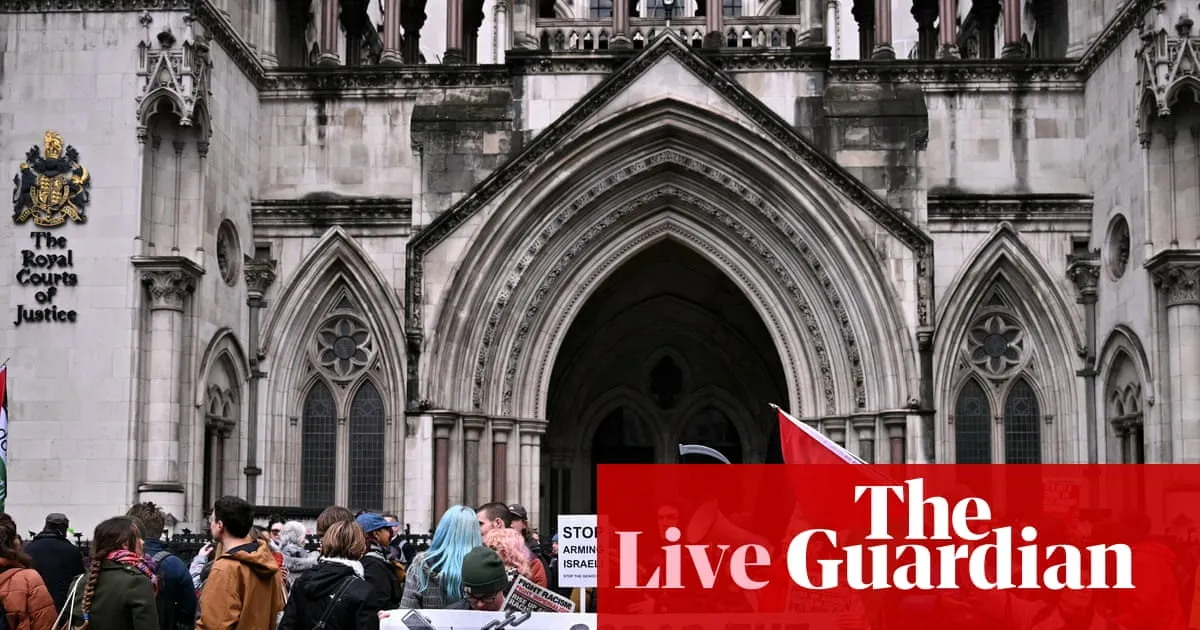
From 1h agoUK ban on Palestine Action unlawful, high court judges rulePalestine Action’s co-founder Huda Ammori has won a legal challenge against the decision to proscribe the group under anti-terrorism laws.Key events22m agoProscription of Palestine Action 'disproportionate', judges rule39m agoHome secretary 'disappointed' by ruling, plans to appeal45m agoBan will stay in place until government decides on appeal1h agoAmmori: This is a monumental victory for fundamental freedoms and for Palestine1h agoUK ban on Palestine Action unlawful, high court judges rule2h agoOpening summaryShow key events onlyPlease turn on JavaScript to use this featureWe are getting lots of reaction from rights and activist groups to the high court’s ruling this morning, many of them calling for the charges against protesters who have showed support for Palestine Action to be dropped. Tom Southerden, Amnesty International UK’s law and human rights director, described the ruling as a “vital affirmation of the right to protest”. He added: “The high court’s decision sends a clear message: the government cannot simply reach for sweeping counter‑terrorism powers to silence critics or suppress dissent … it draws an important line in the sand against attempts to narrow the democratic space and undermine public confidence in the right to speak out. Greenpeace UK’s co-executive director Areeba Hamid said the government’s decision to ban a protest group “is the stuff of dystopian novels”. She added: “Arresting thousands of protesters – many of them pensioners who were simply holding signs – is the stuff of satire. Hopefully this ruling will deliver a much-needed reality check.” Yasmine Ahmed, UK director of Human Rights Watch, called for a “thorough and independent investigation” on the government’s decision to proscribe Palestine Action. She said the court’s ruling “reinforces what many of us having been saying all along- that the government’s misuse of terrorism legislation was a brazen and gross abuse of power that served to stifle legitimate criticism of Israel and those profiting from its atrocities”. Stop the War Coalition has called on the Metropolitan Police commissioner Mark Rowley and former home secretary Yvette Cooper to resign. Lindsey German, convener of the Stop the War, said: “Now the CPS must drop all the charges against those wrongly arrested and imprisoned without trial for peacefully protesting a genocide.” Before the ban, Palestine Action had used direct action to target Israeli-linked companies in the UK, from occupying buildings and blocking access, to more disruptive methods such as spray-painting and damaging equipment. It particularly focused its demonstrations against factories of Israeli weapons manufacturer Elbit Systems, which the group describes on its website as its “main target”.Founded in 2020 by activists Huda Ammori and Richard Barnard, Palestine Action campaigns against companies that it says are complicit in the “occupation, apartheid and genocide of Palestine”. In the wake of Israel’s war on Gaza, the group’s demonstrations intensified.Police make an arrest outside the Royal Courts of Justice at the start of a legal challenge to the ban on Palestine Action in November. Photograph: Martin Godwin/The GuardianSince the ban took effect, thousands of arrests have been linked to support for Palestine Action under terrorism laws, as well as ongoing protests and legal challenges. Critics of the ban argue that damaging property does not amount to terrorism, with the UN human rights chief, Volker Türk, commenting that the proscription “appears disproportionate and unnecessary”.The government has argued that the ban was justified on national security grounds, and that it was proportionate given the alleged escalation in the group’s activities.Proscription of Palestine Action 'disproportionate', judges ruleThe high court upheld two grounds of challenge, including that the ban was a disproportionate interference with the right to freedom of expression and freedom of assembly.The president of the king’s bench division, Dame Victoria Sharp, sitting with Mr Justice Swift and Mrs Justice Steyn, said that “Palestine Action is an organisation that promotes its political cause through criminality and encouragement of criminality”, but that proscription was still “disproportionate”.In a 46-page judgment, she said: “A very small number of its actions have amounted to terrorist action within the definition [of the Terrorism Act 2000].”Home secretary 'disappointed' by ruling, plans to appealHome secretary Shabana Mahmood said she was ‘disappointed’ by the ruling and that she plans to appeal it.In a statement, she said: I am disappointed by the court’s decision and disagree with the notion that banning this terrorist organisation is disproportionate. “The proscription of Palestine Action followed a rigorous and evidence-based decision-making process, endorsed by parliament. The proscription does not prevent peaceful protest in support of the Palestinian cause, another point on which the court agrees. “As a former lord chancellor, I have the deepest respect for our judiciary. Home secretaries must however retain the ability to take action to protect our national security and keep the public safe. I intend to fight this judgment in the court of appeal.” Ban will stay in place until government decides on appealJudges Victoria Sharp, Jonathan Swift and Karen Steyn said the ban will remain in place while the government considers whether to appeal.A group of protesters outside the high court erupted into cheers and chanted “Free Palestine” after the ruling was given, the PA news agency reported.People hold banners outside Royal Courts of Justice. Photograph: Tolga Akmen/EPAAmmori: This is a monumental victory for fundamental freedoms and for PalestineAmmori has released a statement describing the high court’s ruling as a “monumental victory” and that the government proscribed Palestine Action as a terror group “in a Trumpian abuse of power”.She said: “This is a monumental victory both for our fundamental freedoms here in Britain and in the struggle for freedom for the Palestinian people, striking down a decision that will forever be remembered as one of the most extreme attacks on free speech in recent British history. “Palestine Action is the first civil disobedience organisation that does not advocate for violence to be proscribed by the British Government as a ‘terrorist’ group, in a Trumpian abuse of power which would have seen this Labour Government proscribe the Suffragettes. This ban was unlawful, resulting in the unlawful arrest of nearly 3,000 people - among them priests, vicars, former magistrates and retired doctors – under terrorism laws for simply sitting in silence while holding signs reading: ‘I oppose genocide – I support Palestine Action’. Huda Ammori, co-founder of Palestine Action. Photograph: Abdullah Bailey/AlamyThe co-founder of Palestine Action has won a legal challenge to the home secretary’s decision to ban the group under anti-terrorism laws.The proscription of Palestine Action, which categorised it alongside the likes of Islamic State, was the first of a direct action protest group and attracted widespread condemnation as well as a civil disobedience campaign defying the ban, during which more than 2,000 people have been arrested.On Friday, three judges, led by the president of the king’s bench division, Dame Victoria Sharp, ruled that the decision to proscribe the group was unlawful.Read the full report by our legal affairs correspondent Haroon Siddique here:UK ban on Palestine Action unlawful, high court judges rulePalestine Action’s co-founder Huda Ammori has won a legal challenge against the decision to proscribe the group under anti-terrorism laws.Here are some images from outside the high court coming through the newswires this morning:Protesters hold a banner outside the Royal Courts of Justice in London. Photograph: Ben Stansall/AFP/Getty ImagesA demonstrator wearing a costume of the grim reaper outside the high court. Photograph: Jaimi Joy/ReutersA police officer observes protesters. Photograph: Jonathan Brady/PAThe ruling, expected to begin at 10am, comes after a group of six Palestine Action activists were cleared of aggravated burglary last week over a break-in at an Israeli defence firm’s UK site.The youngest of the group, Fatema Rajwani, 21, said the verdicts were a vindication of their cause.After 18 months in jail, she was released on bail last Wednesday, having also been acquitted by a jury at Woolwich crown court of violent disorder in relation to the raid on the Elbit Systems factory in Filton, near Bristol, on 6 August 2024.Rajwani told the Guardian: “The verdicts are a reflection of the reality that the first chance that the public had to decide what happened to us, they vindicated us. It is plain to see that the British public do not want their citizens to be scapegoated for this Labour government’s political aims, they do not want to be criminalised for supporting a people’s inalienable right to freedom, to dignity, and to self-determination.”Read the full report by our legal affairs correspondent Haroon Siddique here:Opening summaryThe high court is set to rule on whether the Home Office’s decision to proscribe Palestine Action as a terrorist group was lawful.Huda Ammori, the co-founder of Palestine Action, took legal action against the government to challenge the decision by then-home secretary Yvette Cooper to ban the group under the Terrorism Act 2000.The ban, which took effect on 5 July 2025, made membership of, or support for, the direct action group a criminal offence punishable by up to 14 years in prison.During a hearing in November, a lawyer for Ammori told the court in London that the ban was unlawful and should be quashed, saying the group had engaged in an “honourable tradition” of direct action and civil disobedience prior to proscription.The court heard that there had been more than 2,000 arrests after Palestine Action’s proscription, including “priests, teachers, pensioners, retired British Army officers” and an “81-year-old former magistrate”.Lawyers representing the Home Office said the proscription had had the intended effect of “disrupting PA’s [Palestine Action] pattern of escalatory conduct” and had “not prevented people from protesting in favour of the Palestinian people or against Israel’s actions in Gaza”.Follow our blog to get the latest updates from the ruling.
SRCThe Guardian - World News
LANGEN
LEANCenter-Left
WORDS1 598
ENT10
FRI · 2026-02-13 · 10:36 GMTBRIEF NSR-2026-0213-15925
NSR-2026-0213-15925News Report·EN·Legal & Judicial
High court rules ban on Palestine Action is unlawful – live
The UK High Court ruled the government's ban on Palestine Action unlawful, prompting a legal victory for the group's co-founder, Huda Ammori. The court deemed the proscription under anti-terrorism laws "disproportionate." While the Home Secretary expressed disappointment and plans to appeal, the ban remains in place pending the government's decision.
Taz AliThe Guardian - World NewsFiled 2026-02-13 · 10:36 GMTLean · Center-LeftRead · 7 min
The Guardian - World NewsFIG 01
Reading time
7min
Word count
1 598words
Sources cited
6cited
Entities identified
10entities
Quality score
100%
§ 01
Briefing Summary
AI-generatedNEWSAR · AI
The UK High Court ruled the government's ban on Palestine Action unlawful, prompting a legal victory for the group's co-founder, Huda Ammori. The court deemed the proscription under anti-terrorism laws "disproportionate." While the Home Secretary expressed disappointment and plans to appeal, the ban remains in place pending the government's decision. Rights and activist groups, including Amnesty International UK, Greenpeace UK, and Human Rights Watch, have reacted strongly, criticizing the government's use of counter-terrorism powers and calling for charges against Palestine Action supporters to be dropped. Some groups are calling for investigations into the government's decision and resignations of key officials. Palestine Action, before the ban, engaged in direct action targeting companies they accuse of profiting from Israeli actions.
Confidence 0.90Sources 6Claims 5Entities 10
§ 02
Article analysis
Model · rule-basedFraming
Legal & Judicial
Human Rights
Tone
Measured
AI-assessed
CalmNeutralAlarmist
Factuality
0.70 / 1.00
Factual
LowHigh
Sources cited
6
Well sourced
FewMany
§ 03
Key claims
5 extracted01
Amnesty International UK described the ruling as a “vital affirmation of the right to protest”.
quoteTom Southerden, Amnesty International UK
Confidence
1.00
02
Proscription of Palestine Action 'disproportionate', judges rule.
quoteArticle
Confidence
1.00
03
Home secretary 'disappointed' by ruling, plans to appeal.
factualArticle
Confidence
1.00
04
High court judges rule UK ban on Palestine Action unlawful.
factualArticle
Confidence
1.00
05
Palestine Action campaigns against companies that it says are complicit in the “occupation, apartheid and geno
factualArticle
Confidence
0.90
§ 04
Full report
7 min read · 1 598 words§ 05
Entities
10 identifiedKey playerOppositionContextPositiveNeutralNegative
Organizations6
Locations1
§ 06
Keywords & salience
10 termspalestine action
1.00
ban
0.90
unlawful
0.80
high court
0.70
protest
0.60
anti-terrorism laws
0.60
human rights
0.50
freedom of speech
0.50
dissent
0.40
legal challenge
0.40
§ 07
Topic connections
Interactive graph Network visualization showing 34 related topics
View Full Graph Person Organization Location Event|Click node to navigate|Edge numbers = shared articles