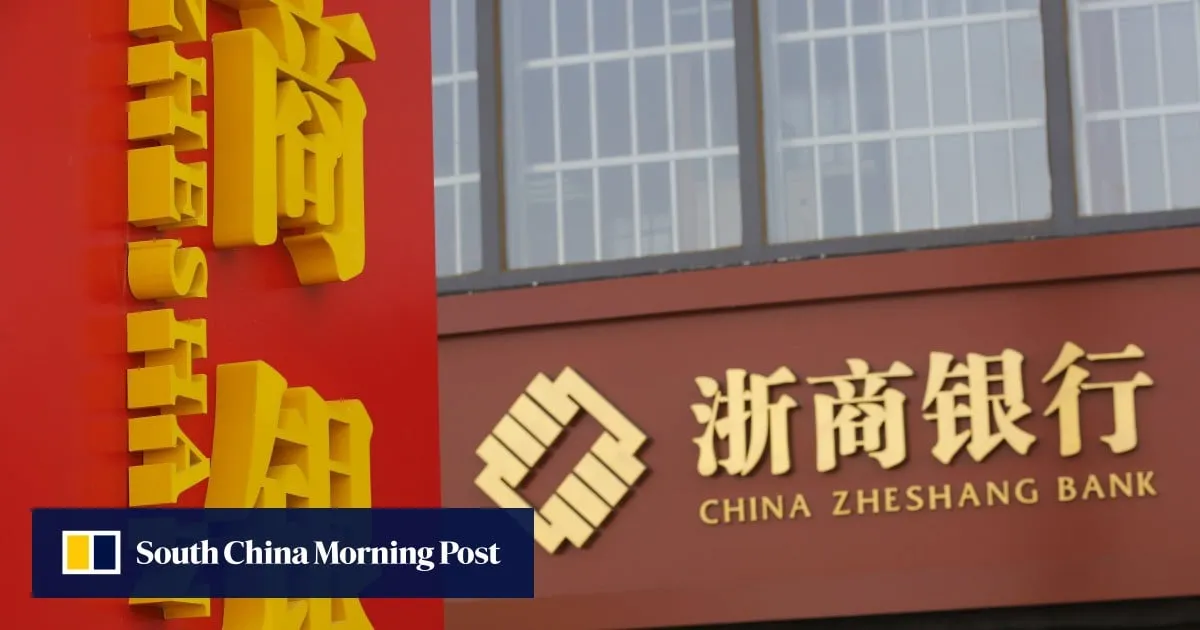
China has expanded its list of domestic systemically important banks (D-SIBs) – institutions subject to tighter regulatory standards – as authorities step up macroprudential oversight to safeguard financial stability amid high exposure to property sector debt.China Zheshang Bank, a joint-stock lender in east China’s Zhejiang province with total assets of 3.35 trillion yuan (US$485 billion), was added to the list released on Friday by the People’s Bank of China and the National Financial Regulatory Administration (NFRA).The D-SIB list now stands at 21 institutions, up from 19 when it was first published in 2021. It includes six state-owned commercial banks, 10 joint-stock commercial banks and five urban lenders, accounting for the vast majority of the country’s financial assets.“We will continuously strengthen the supplementary supervision of systemically important banks and promote their safe, sound operation,” the central bank and the regulatory body said in a joint online statement.The expanded list came as Beijing doubles down on efforts to shore up the banking system, which remains on alert amid a prolonged property market downturn.So far, Chinese banks have not reported a sharp rise in bad assets. The non-performing loan ratio of commercial banks stood at 1.5 per cent at the end of 2025, unchanged from a year earlier, according to NFRA data. The bad-loan ratio of large commercial banks was 1.22 per cent, and that of joint-stock commercial banks was 1.21 per cent.Even so, containing spillovers from property sector risks remains a policy priority.
SRCSouth China Morning Post
LANGEN
LEANCenter-Right
WORDS241
ENT5
SUN · 2026-02-15 · 09:00 GMTBRIEF NSR-2026-0215-16405
NSR-2026-0215-16405News Report·EN·Economic Impact
China expands oversight of major banks amid property sector risks
China has expanded its list of domestic systemically important banks (D-SIBs) from 19 to 21, adding China Zheshang Bank to the list on Friday. The People's Bank of China and the National Financial Regulatory Administration (NFRA) released the updated list, which now includes six state-owned commercial banks, ten joint-stock commercial banks, and five urban lenders.
Carol YangSouth China Morning PostFiled 2026-02-15 · 09:00 GMTLean · Center-RightRead · 1 min
South China Morning PostFIG 01
Reading time
1min
Word count
241words
Sources cited
2cited
Entities identified
5entities
Quality score
100%
§ 01
Briefing Summary
AI-generatedNEWSAR · AI
China has expanded its list of domestic systemically important banks (D-SIBs) from 19 to 21, adding China Zheshang Bank to the list on Friday. The People's Bank of China and the National Financial Regulatory Administration (NFRA) released the updated list, which now includes six state-owned commercial banks, ten joint-stock commercial banks, and five urban lenders. This expansion signifies a move to strengthen macroprudential oversight and safeguard financial stability amid concerns about the property sector. Authorities aim to reinforce the supervision of these banks to ensure their safe operation, particularly as the property market faces a downturn. While non-performing loan ratios remain stable, containing potential risks from the property sector is a key policy priority for Beijing.
Confidence 0.90Sources 2Claims 5Entities 5
§ 02
Article analysis
Model · rule-basedFraming
Economic Impact
Political Strategy
Tone
Measured
AI-assessed
CalmNeutralAlarmist
Factuality
0.80 / 1.00
Factual
LowHigh
Sources cited
2
Limited
FewMany
§ 03
Key claims
5 extracted01
We will continuously strengthen the supplementary supervision of systemically important banks.
quotePeople’s Bank of China and the National Financial Regulatory Administration
Confidence
1.00
02
The non-performing loan ratio of commercial banks stood at 1.5 per cent at the end of 2025.
statisticNFRA data
Confidence
1.00
03
The D-SIB list now stands at 21 institutions.
factualnull
Confidence
1.00
04
China Zheshang Bank was added to the D-SIB list.
factualnull
Confidence
1.00
05
China has expanded its list of domestic systemically important banks (D-SIBs).
factualnull
Confidence
1.00
§ 04
Full report
1 min read · 241 words§ 05
Entities
5 identifiedKey playerOppositionContextPositiveNeutralNegative
Organizations2
§ 06
Keywords & salience
9 termssystemically important banks
0.90
property sector risks
0.80
financial stability
0.70
regulatory oversight
0.60
macroprudential oversight
0.60
banking system
0.50
non-performing loan ratio
0.50
people’s bank of china
0.40
china zheshang bank
0.40
§ 07
Topic connections
Interactive graph Network visualization showing 51 related topics
View Full Graph Person Organization Location Event|Click node to navigate|Edge numbers = shared articles