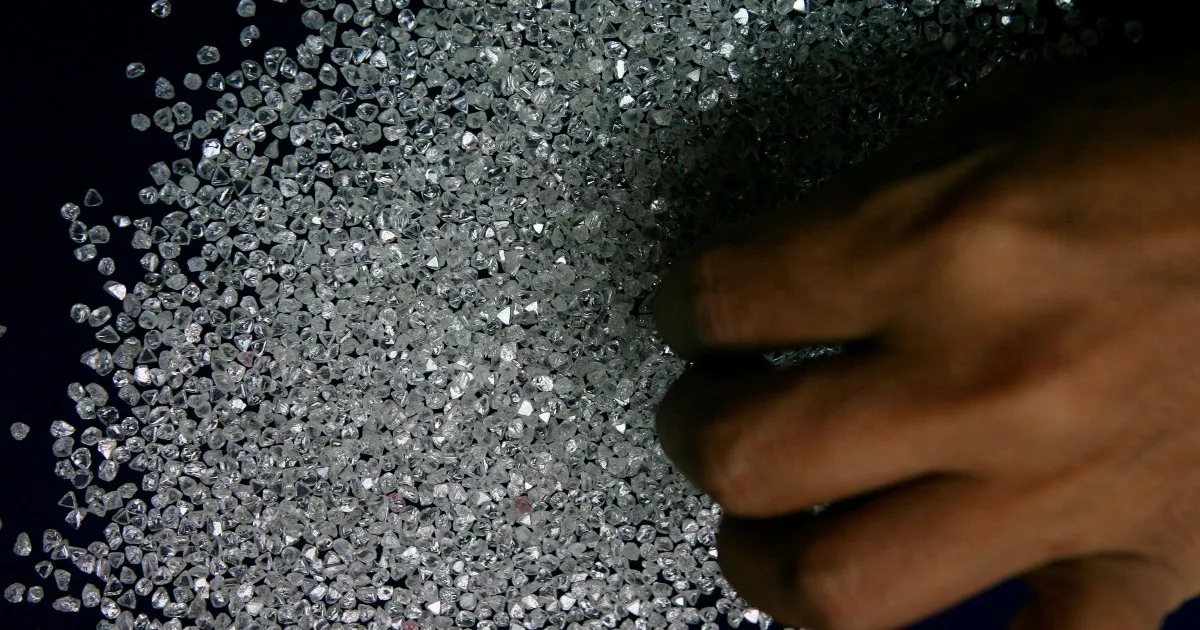
For decades, India’s diamond industry offered workers a way to a better income and life for their families. Not anymore.India's Diamond Workers Union has urged government authorities to address the issue of the growing number of school dropouts among workers' children [File: Arko Datta/Reuters]Published On 9 Dec 2025Surat, India – In 2018, Alpesh Bhai enrolled his three-year-old daughter in an English-language private school in Surat. This was something he never imagined possible while growing up in his village in the Indian state of Gujarat, where his family survived on small fields of fennel, castor and cumin, with their earnings barely enough to cover basic needs.He had studied in a public school, where, he recalled, “teachers were a rarity, and English almost didn’t exist”.Recommended Stories list of 4 itemslist 1 of 4Golden Globes 2026: Which films got nominations, and who was snubbed?list 2 of 4Trump announces $12bn package to aid farmers hurt by his tariffslist 3 of 4Waymo runs into safety concerns and competition as it expands in the USlist 4 of 4Costco sues Trump administration for US tariff refundend of list“Maybe if I knew English, I would have been some government worker. Who knows?”, he said, referring to the dream of a majority of Indians, as government jobs come with tenure and benefits.His finances improved once he joined the diamond cutting industry in Surat, a city perched along India’s Arabian Sea coast, where nearly 80 percent of the world’s diamonds are cut and polished. Monthly earnings of 35,000 rupees ($390) for the first time brought Alpesh a sense of stability, and with it, the means to give his children the education he never had.“I was determined that at least my children would get the kind of private education I was deprived of,” he said.But that dream did not last. The first disruption to business came with Russia’s full-scale invasion of Ukraine in 2022. The sanctions on Russia hurt supply chains, as India sourced at least a third of its raw diamonds from Russia, leading to layoffs.Alpesh’s earnings fell to 18,000 rupees ($200) a month, then to 20,000 rupees ($222). Soon, the 25,000 rupees ($280) annual school fee became unmanageable. By the time his older daughter reached grade three, just as his younger child started school, the pressure became impossible.Earlier this year, he pulled both children out of private school and enrolled them in a nearby public one. A few months later, when new United States tariffs deepened the crisis as demand slumped further, his polishing unit laid off 60 percent of its workers, Alpesh among them.“Seems like I’ve come back to where I started,” he said.Surat, India’s diamond hub, employs more than 600,000 workers, and hosts 15 large polishing units with annual sales exceeding $100m. For decades, Surat’s diamond‑polishing industry has offered migrant workers from rural Gujarat, many with little or no education, higher incomes, in some cases up to 100,000 rupees ($1,112) a month, and a path out of agrarian hardship.But recent shocks have exposed the fragility of that ladder, with close to 400,000 workers having faced layoffs, pay cuts, or reduced hours.Even before Russia’s war on Ukraine began in February 2022, Surat’s diamond industry faced multiple challenges: disrupted supplies from African mines, weakening demand in key Western markets, and inconsistent exports to China, the second-largest customer. With the onset of the war, India’s exports of cut and polished diamonds in the financial year ending on March 31, 2024, fell by 27.6 percent, with sharp declines in its top markets – the US, China, and the United Arab Emirates.The 50 percent tariffs imposed by US President Donald Trump have worsened the downturn.Alpesh now works loading and unloading textile consignments for about 12,000 rupees ($133) a month, barely enough to cover food and rent.“If I had kept them in the private school, I don’t know how I would have survived,” Alpesh said. “People here have killed themselves over debts and school fees. When you don’t have enough to eat, how will you think of teaching your children well?”His daughters are still adjusting. “They sometimes tell me, ‘Pupa, the studies aren’t as good now’. I tell them we’ll put them back in the private school soon, but I don’t know when that will happen.”‘An exodus’Some workers have returned to their villages, as many migrant families in Surat can no longer afford rent or find alternative work.Shyam Patel, 35, was among them. When exports slowed and US tariffs hit in August, the polishing unit where he worked shut down. With no other work available, he returned to his village in the Banaskantha district the following month.“What other option was there?” he said. “In the city, there’s rent to pay even when there’s no work.”He now works as a daily-wage labourer in cotton fields in his village. His son, who was in the final year of high school, dropped out after four months of the new academic session.“We’ll put him back in school next year,” Shyam said. “The government school said they can’t take new students in the middle of the term. Till then, he helps me in the fields.”Across the city, the disruption is evident in government data. More than 600 students left school mid-session last year as their parents lost work or returned to their villages, mostly in Saurashtra and north Gujarat.“Most migrants come to Surat to settle – the city has entire [neighbourhoods] and housing clusters built for diamond workers,” said Bhavesh Tank, vice president of the Diamond Workers Union Gujarat. “An exodus in the middle of the year is unprecedented, and the drop in school enrolment suggests many are not coming back soon.”The union estimates that about 50,000 workers have left Surat over the past 12 to 14 months.The Vishwa Hindu Parishad (VHP), a Hindu nationalist group allied with Prime Minister Narendra Modi’s governing Bharatiya Janata Party (BJP), has been closely observing the diamond industry crisis in Surat.“The number of dropouts has reached a point where even government schools are struggling to take in new students, said Purvesh Togadia, a VHP representative in the city. “The poor quality of education is making the transition even more disheartening for families.”The poor quality of education in public schools is well established. In 2024, only 23.4 percent of grade three students could read at a grade two level, compared with 35.5 percent in private schools. By grade 5, the gap persisted – 44.8 percent in government schools versus 59.3 percent in private ones.Kishor Bhamre, director at Pratham, an organisation working on children’s rights across education and labour, said the setback is not just academic but psychological.“Children moving from private to government schools lose the environment they grew up in – their friends, familiar teachers, and a sense of community. For many, it also means shifting from an urban to a rural setting, which makes the adjustment even harder and affects their learning,” he said.Al Jazeera reached out to the Surat Municipal Corporation and the state’s education minister for comment, but did not receive a response.Limited helpThe Diamond Workers Union has repeatedly appealed to the state government to provide an economic relief package and revise salaries in line with inflation. The union has also urged authorities to address the equally pressing situation of the growing number of school dropouts among workers’ children.The Gujarat government in May introduced a special assistance package for affected diamond workers – a rare move in the industry.Under the scheme, the state government committed to paying for one year of school fees for diamond polishers’ children, up to 13,500 rupees ($150) annually. To qualify, workers must have been unemployed for the past year and have at least three years of experience in a diamond factory. The fees will be paid directly to the schools.The government received nearly 90,000 requests from diamond workers across Gujarat, including about 74,000 from Surat alone. After a slow start – it had provided assistance to only 170 children by July – officials reported disbursing 82.8 million rupees ($921,000) towards school fees for 6,368 children of jobless diamond workers in Surat by mid-September.
SRCAl Jazeera
LANGEN
LEANCenter
WORDS1 338
ENT2
TUE · 2025-12-09 · 00:13 GMTBRIEF NSR-2025-1209-1642
NSR-2025-1209-1642News Report·EN·Economic Impact
US tariffs ruin education dreams for children in India’s diamond hub
US tariffs are negatively impacting the education of children in Surat, India, a major diamond processing hub. Diamond worker Alpesh Bhai, who once aspired to provide his children with private education, was forced to move them to public schools due to financial strain.
By Anuj Behal and Suchak PatelAl JazeeraFiled 2025-12-09 · 00:13 GMTLean · CenterRead · 6 min
Al JazeeraFIG 01
Reading time
6min
Word count
1 338words
Sources cited
2cited
Entities identified
2entities
Quality score
100%
§ 01
Briefing Summary
AI-generatedNEWSAR · AI
US tariffs are negatively impacting the education of children in Surat, India, a major diamond processing hub. Diamond worker Alpesh Bhai, who once aspired to provide his children with private education, was forced to move them to public schools due to financial strain. A combination of factors, including the Russia-Ukraine war's impact on diamond supplies starting in 2022 and recently implemented US tariffs, have reduced diamond workers' incomes. This has led to a growing number of families being unable to afford private school fees, jeopardizing their children's educational opportunities. The India Diamond Workers Union is urging government intervention to address the rising number of school dropouts.
Confidence 0.90Sources 2Claims 5Entities 2
§ 02
Article analysis
Model · rule-basedFraming
Economic Impact
Human Interest
Tone
Mixed Tone
AI-assessed
CalmNeutralAlarmist
Factuality
0.70 / 1.00
Factual
LowHigh
Sources cited
2
Limited
FewMany
§ 03
Key claims
5 extracted01
Monthly earnings of 35,000 rupees ($390) brought Alpesh a sense of stability.
quoteAlpesh Bhai
Confidence
1.00
02
The Diamond Workers Union has urged government authorities to address the issue of school dropouts.
factualIndia's Diamond Workers Union
Confidence
1.00
03
Surat employs more than 600,000 workers in the diamond industry.
statisticArticle's own claim
Confidence
1.00
04
India sourced at least a third of its raw diamonds from Russia, leading to layoffs due to sanctions.
factualArticle's own claim
Confidence
0.90
05
US tariffs deepened the crisis as demand slumped further, leading to layoffs in the diamond polishing unit.
factualArticle's own claim
Confidence
0.90
§ 04
Full report
6 min read · 1 338 words§ 05
Entities
2 identifiedKey playerOppositionContextPositiveNeutralNegative
§ 06
Keywords & salience
9 termsus tariffs
0.90
education
0.80
diamond industry
0.80
india
0.70
school dropouts
0.70
private school
0.60
supply chains
0.50
public school
0.50
layoffs
0.40
§ 07
Topic connections
Interactive graph Network visualization showing 2 related topics
View Full Graph Person Organization Location Event|Click node to navigate|Edge numbers = shared articles