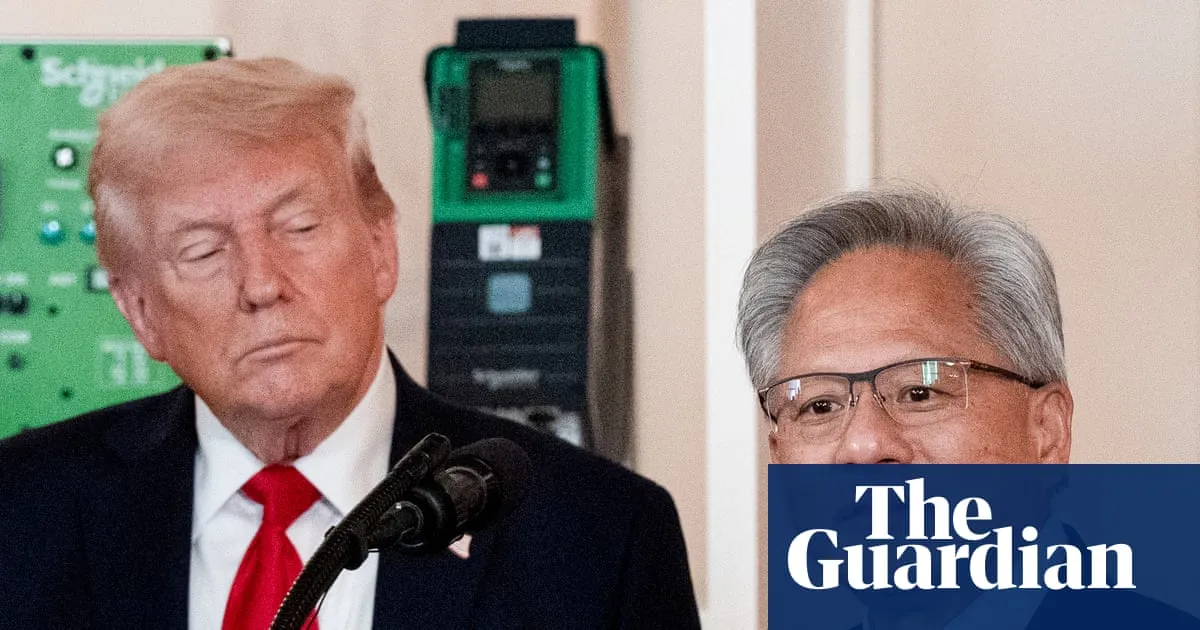
Donald Trump has cleared the way for Nvidia to begin selling its powerful AI computer chips to China, marking a win for the chip maker and its CEO Jensen Huang, who has spent months lobbying the White House to open up sales in the country.Before Monday’s announcement, the US had prohibited sales of Nvidia’s most advanced chips to China over national security concerns.“I have informed President Xi, of China, that the United States will allow Nvidia to ship its H200 products to approved customers in China, and other Countries, under conditions that allow for continued strong National Security,” Trump posted to Truth Social on Monday. “President Xi responded positively!”Trump said the Department of Commerce is finalising the details and that he was planning to make the same offer to other chip companies, including Advanced Micro Devices (AMD) and Intel. Nvidia’s H200 chips are the company’s second-most powerful, and far more advanced than the H20, which was originally designed as a lower-powered model for the Chinese market, which wouldn’t breach restrictions, but which was the US banned anyway in April.The president said the US would receive 25% of the proceeds, more than the 15% previously agreed to with Nvidia in an earlier deal to lift restrictions, and following similar unorthodox plans for the federal government to take a financial cut from private business dealings. In August, Trump said the US would receive a 10% stake in the tech company Intel. Some lawmakers have questioned the legality of such arrangements.According to the Hill, Democratic senators Elizabeth Warren of Massachusetts and Andy Kim of New Jersey sent a letter to commerce secretary Howard Lutnick last week, outlining their concerns with selling these chips to China and saying it risked powering the country’s “surveillance, censorship, and military applications”.“I urge you to stop ignoring the input of bipartisan members of Congress and your own experts in order to cut deals that trade away America’s national security,” the senators wrote.On social media, Warren called for Huang to appear before Congress to testify under oath.Huang has worked closely with Trump since the inauguration, and has made several trips to the White House. The CEO attended the president’s AI summit in July, met with Trump as recently as last week and was even a guest at the White House dinner for the Saudi crown price Mohammed bin Salman. Huang has also pledged to invest $500bn in AI infrastructure in the US over the next four years.Huang has also visited China several times, meeting with officials and Chinese tech executives, as US bans were variously lifted and reintroduced. Earlier this year, China imposed its own controls on the imports of Nvidia chips, with top tech firms reportedly instructed to cancel orders, citing national security concerns and confidence in China’s domestic chip development.In October Huang said Nvidia has gone from having 95% of the Chinese market to having 0%, and called the bans a “strategic mistake”.Now, selling chips to China – the world’s second-largest economy – could mean a windfall worth billions of dollars for Nvidia, which is already valued at $4.5tn.“We applaud President Trump’s decision,” said a Nvidia spokesperson. He added that offering the H200 chips “to approved commercial customers, vetted by the Department of Commerce, strikes a thoughtful balance that is great for America”.The Nvidia spokesperson and Trump said the move would support US jobs and manufacturing. In his Truth Social post, Trump condemned the Biden administration’s policies, which imposed strict export controls on powerful chips. The Biden administration had said withholding such technology from China bolstered US competition, protected national security and hampered AI development in China.“That Era is OVER!” Trump wrote. “My Administration will always put America FIRST.” .Chinese authorities were yet to respond to the announcement. Ma Jihua, a telecom industry analyst, told state media outlet, the Global Times, that years of US curbs on AI exports had “provided a rare chance of China’s domestic chip industry to grow and catch up”.
SRCThe Guardian - World News
LANGEN
LEANCenter-Left
WORDS657
ENT9
TUE · 2025-12-09 · 01:53 GMTBRIEF NSR-2025-1209-1644
NSR-2025-1209-1644News Report·EN·National Security
Trump clears way for Nvidia to sell powerful AI chips to China
Donald Trump has approved Nvidia to sell its H200 AI chips to approved customers in China, reversing previous restrictions due to national security concerns. Trump stated the US would receive 25% of the proceeds from these sales, a higher percentage than previously negotiated.
Dara KerrThe Guardian - World NewsFiled 2025-12-09 · 01:53 GMTLean · Center-LeftRead · 3 min
The Guardian - World NewsFIG 01
Reading time
3min
Word count
657words
Sources cited
5cited
Entities identified
9entities
Quality score
100%
§ 01
Briefing Summary
AI-generatedNEWSAR · AI
Donald Trump has approved Nvidia to sell its H200 AI chips to approved customers in China, reversing previous restrictions due to national security concerns. Trump stated the US would receive 25% of the proceeds from these sales, a higher percentage than previously negotiated. He intends to extend this offer to other chip companies like AMD and Intel. This decision follows months of lobbying by Nvidia CEO Jensen Huang, who has close ties to Trump. Some lawmakers, including Senators Warren and Kim, have voiced concerns that selling these chips could bolster China's surveillance, censorship, and military capabilities, urging the Commerce Secretary to reconsider. Warren has called for Huang to testify before Congress.
Confidence 0.90Sources 5Claims 5Entities 9
§ 02
Article analysis
Model · rule-basedFraming
National Security
Economic Impact
Tone
Measured
AI-assessed
CalmNeutralAlarmist
Factuality
0.80 / 1.00
Factual
LowHigh
Sources cited
5
Well sourced
FewMany
§ 03
Key claims
5 extracted01
Senators Warren and Kim expressed concerns that selling chips to China risked powering the country’s surveillance, censorship, and military applications.
quoteSenators Elizabeth Warren and Andy Kim
Confidence
1.00
02
The US had prohibited sales of Nvidia’s most advanced chips to China over national security concerns.
factualArticle
Confidence
1.00
03
Huang has pledged to invest $500bn in AI infrastructure in the US over the next four years.
factualHuang
Confidence
0.90
04
Donald Trump has cleared the way for Nvidia to begin selling its powerful AI computer chips to China.
factualArticle
Confidence
0.90
05
Trump said the US would receive 25% of the proceeds from Nvidia sales to China.
factualTrump
Confidence
0.80
§ 04
Full report
3 min read · 657 words§ 05
Entities
9 identifiedKey playerOppositionContextPositiveNeutralNegative
People4
Organizations3
§ 06
Keywords & salience
10 termsai chips
1.00
china
0.90
nvidia
0.90
national security
0.80
donald trump
0.70
chip sales
0.70
trade restrictions
0.60
jensen huang
0.50
h200 chips
0.50
technology
0.40
§ 07
Topic connections
Interactive graph Network visualization showing 51 related topics
View Full Graph Person Organization Location Event|Click node to navigate|Edge numbers = shared articles