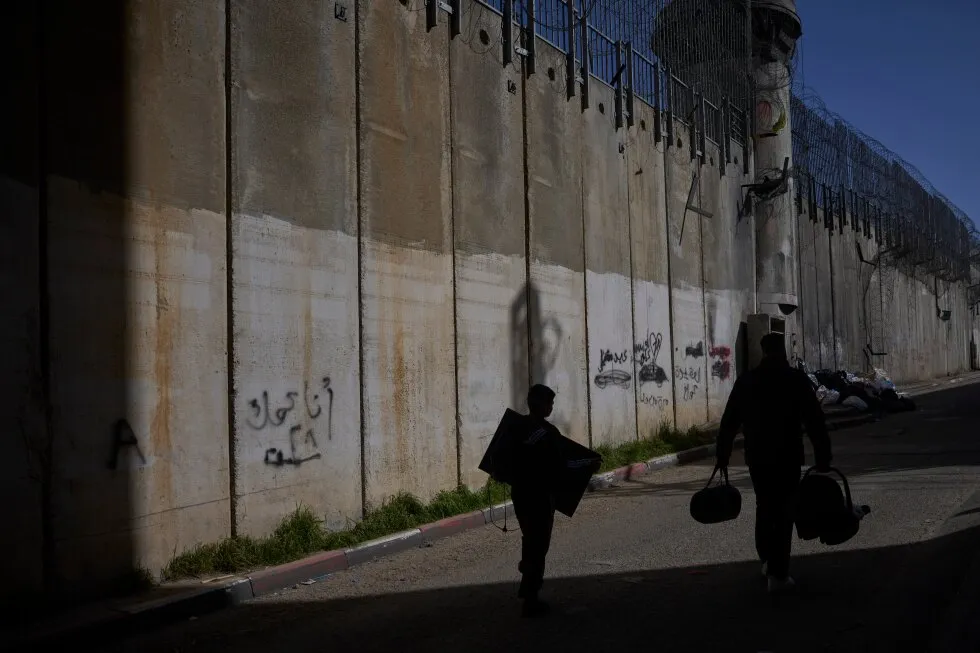
Israel will begin contentious West Bank land registration in new step to deepen control 1 of 2 | Palestinians walk along the separation barrier between the West Bank and east Jerusalem neighborhood of Beit Hanina, Sunday Feb. 15, 2026. (AP Photo/Ohad Zwigenberg) 2 of 2 | Palestinians walk along the separation barrier between the West Bank and east Jerusalem neighborhood of Beit Hanina, Sunday Feb. 15, 2026. (AP Photo/Ohad Zwigenberg) 1 of 2 Palestinians walk along the separation barrier between the West Bank and east Jerusalem neighborhood of Beit Hanina, Sunday Feb. 15, 2026. (AP Photo/Ohad Zwigenberg) Add AP News on Google Add AP News as your preferred source to see more of our stories on Google. 2 of 2 Palestinians walk along the separation barrier between the West Bank and east Jerusalem neighborhood of Beit Hanina, Sunday Feb. 15, 2026. (AP Photo/Ohad Zwigenberg) Add AP News on Google Add AP News as your preferred source to see more of our stories on Google. Updated [hour]:[minute] [AMPM] [timezone], [monthFull] [day], [year] TEL AVIV, Israel (AP) — Israel will begin a contentious land regulation process in a large part of the occupied West Bank, which could result in Israel gaining control over wide swaths of the area for future development, according to a government decision on Sunday.It paves the way for the resumption of “settlement of land title” processes, which had been frozen in the West Bank since the Mideast War in 1967. It means that when Israel begins the land registration process for a certain area, anyone with a claim to the land must submit documents proving ownership.The Israeli anti-settlement group Peace Now said the process likely amounts to a “mega land grab” from Palestinians.“This move is very dramatic and allows the state to gain control of almost all of Area C,” said Hagit Ofran, the director of Peace Now’s Settlement Watch program. Area C refers to the 60% of the West Bank that is under full Israeli military control, according to agreements reached in the 1990s with the Palestinians. Palestinian Authority President Mahmoud Abbas’ office in a statement called the decision “a grave escalation and a flagrant violation of international law,” which amounts to “de facto annexation.” It called on the international community, especially the U.N. Security Council and the United States, to intervene immediately. Israeli steps in recent monthsThe decision is the latest step to deepen Israeli control over the West Bank. In recent months, Israel has greatly expanded construction in Jewish settlements, legalized outposts and made significant bureaucratic changes to its policies in the territory to strengthen its hold and weaken the Palestinian Authority.Israel’s Foreign Ministry in a statement claimed, without offering evidence, that the Palestinian Authority was “advancing illegal land registration procedures in Area C” and said Sunday’s decision was taken for greater transparency.The decision was first announced last May but required further development before it was approved in this week’s Cabinet meeting. Under the decision, Israeli authorities will announce certain areas to undergo registration, which will force anyone who has a claim to the land to prove their ownership. Ofran said the process for proving ownership can be “draconian” and is rarely transparent, meaning any land that undergoes the registration process in areas currently owned by Palestinians is likely to revert to Israeli state control. “Palestinians will be sent to prove ownership in a way that they will never be able to do,” Ofran told The Associated Press. “And this way Israel might take over 83% of the Area C, which is about half of the West Bank.”The registration process could start as soon as this year, she said.The proposal had been put forward by some of Israel’s far-right members of the ruling coalition, including the Minister of Justice Yariv Levin. “The government of Israel is committed to strengthening its grip on all its parts, and this decision is an expression of that commitment,” he said. A ‘dangerous escalation’Jordan’s Foreign Ministry in a statement called on the international community to “assume its legal and moral responsibilities, and to compel Israel, the occupying power, to stop its dangerous escalation.”Qatar’s foreign ministry said it considered Israel’s decision “an extension of its illegal plans to deprive the Palestinian people of their rights.”Previous U.S. administrations have sharply condemned an expansion of Israeli activity and control in the West Bank, but Prime Minister Benjamin Netanyahu has a particularly close relationship with President Donald Trump. The two met last week in Washington, their seventh meeting in the past year.And yet Trump has opposed annexation, Ofran noted.Palestinians are not permitted to sell land privately to Israelis, though measures announced last week aim to nullify this. Currently, settlers can buy homes on land controlled by Israel’s government. Last week’s decision also aimed to expand Israeli enforcement of several aspects of in the West Bank, including environmental and archaeological matters in Palestinian-administered areas. More than 700,000 Israelis live in the occupied West Bank and east Jerusalem, territories captured by Israel in 1967 from Jordan and sought by the Palestinians for a future state. The international community overwhelmingly considers Israeli settlement construction in these areas to be illegal and an obstacle to peace.Over 300,000 Palestinians are estimated to live in Area C of the West Bank, with many more in surrounding communities dependent on its agricultural and grazing lands, including plots for which families retain land deeds or tax records dating back decades.___Associated Press journalist Areej Hazboum in Jerusalem contributed to this report. Lidman is an Associated Press reporter based in Tel Aviv, Israel.
SRCAssociated Press (AP)
LANGEN
LEANCenter
WORDS919
ENT10
SUN · 2026-02-15 · 17:53 GMTBRIEF NSR-2026-0215-16466
NSR-2026-0215-16466News Report·EN·Political Strategy
Israel will begin contentious West Bank land registration in new step to deepen control
Israel will begin a land registration process in the occupied West Bank, specifically in Area C, which is under full Israeli military control. This process, frozen since 1967, requires anyone claiming land ownership to provide documentation.
By
MELANIE LIDMANAssociated Press (AP)Filed 2026-02-15 · 17:53 GMTLean · CenterRead · 4 min
Associated Press (AP)FIG 01
Reading time
4min
Word count
919words
Sources cited
3cited
Entities identified
10entities
Quality score
100%
§ 01
Briefing Summary
AI-generatedNEWSAR · AI
Israel will begin a land registration process in the occupied West Bank, specifically in Area C, which is under full Israeli military control. This process, frozen since 1967, requires anyone claiming land ownership to provide documentation. The Israeli government says this will allow for future development. Peace Now, an Israeli anti-settlement group, claims this amounts to a "mega land grab" from Palestinians, potentially giving Israel control of almost all of Area C. Palestinian Authority President Mahmoud Abbas condemned the decision as a violation of international law and a de facto annexation, calling for international intervention. This decision is the latest in a series of steps by Israel to deepen its control over the West Bank.
Confidence 0.90Sources 3Claims 5Entities 10
§ 02
Article analysis
Model · rule-basedFraming
Political Strategy
Conflict
Tone
Mixed Tone
AI-assessed
CalmNeutralAlarmist
Factuality
0.70 / 1.00
Factual
LowHigh
Sources cited
3
Well sourced
FewMany
§ 03
Key claims
5 extracted01
Area C refers to the 60% of the West Bank that is under full Israeli military control.
factualAP
Confidence
1.00
02
The process had been frozen in the West Bank since the Mideast War in 1967.
factualAP
Confidence
1.00
03
Israel will begin a land regulation process in the occupied West Bank.
factualAP
Confidence
1.00
04
This move is very dramatic and allows the state to gain control of almost all of Area C.
quoteHagit Ofran, Peace Now
Confidence
0.90
05
The process could result in Israel gaining control over wide swaths of the area.
predictionAP
Confidence
0.80
§ 04
Full report
4 min read · 919 words§ 05
Entities
10 identifiedKey playerOppositionContextPositiveNeutralNegative
Organizations3
§ 06
Keywords & salience
9 termswest bank
1.00
land registration
0.90
israeli control
0.80
settlement of land title
0.70
area c
0.70
palestinians
0.60
land grab
0.60
de facto annexation
0.50
international law
0.40
§ 07
Topic connections
Interactive graph Network visualization showing 51 related topics
View Full Graph Person Organization Location Event|Click node to navigate|Edge numbers = shared articles