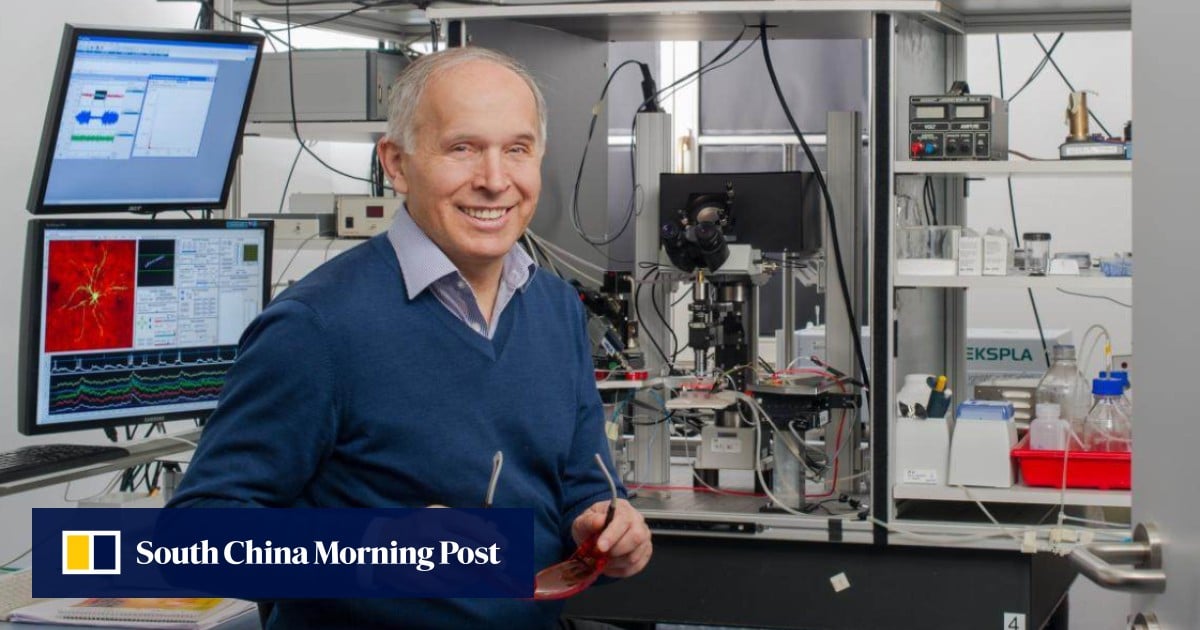
Arthur Konnerth, a recipient of the prestigious Brain Prize, has joined the Shenzhen Bay Laboratory (SZBL) on a full-time basis, the institute announced on January 29.Konnerth is a leading figure in neuroscience whose work has helped transform the understanding of how the brain processes information. His research focuses on the fundamental mechanisms of learning and memory, employing a combination of electrophysiological, imaging and cellular techniques.Konnerth pioneered the in vitro brain slice patch-clamp recording method – a technique that has become a cornerstone of modern neuroscience – and made fundamental discoveries in synaptic transmission and plasticity.The technique uses a glass microelectrode to form a seal against the surface of a brain cell, preventing electricity from leaking away and allowing scientists to measure the electrical currents moving through a single “gate” in the cell’s membrane.In 1989, Konnerth – working with Bert Sakmann, Frances Edwards and Tomoyuki Takahashi – helped transform the technique from concept to a standard method. They extended its use from isolated cells to neurons still connected within slices of brain tissue. This breakthrough laid the foundation for modern slice electrophysiology.In 2003, he and his team introduced an imaging method that, for the first time, enabled scientists to watch entire networks of brain cells in action, seeing every individual cell at once. This technique is now widely used to study how the brain controls behaviour.
SRCSouth China Morning Post
LANGEN
LEANCenter-Right
WORDS225
ENT3
MON · 2026-02-16 · 04:00 GMTBRIEF NSR-2026-0216-16571
NSR-2026-0216-16571News Report·EN·Technology
Top neuroscientist Arthur Konnerth leaves Germany for full-time role in China
Renowned neuroscientist Arthur Konnerth, a Brain Prize winner, has accepted a full-time position at the Shenzhen Bay Laboratory (SZBL) in China, as announced on January 29th. Konnerth is known for his groundbreaking research on learning and memory, particularly his development of the in vitro brain slice patch-clamp recording method, a crucial technique in modern neuroscience.
Shi HuangSouth China Morning PostFiled 2026-02-16 · 04:00 GMTLean · Center-RightRead · 1 min
South China Morning PostFIG 01
Reading time
1min
Word count
225words
Sources cited
1cited
Entities identified
3entities
Quality score
100%
§ 01
Briefing Summary
AI-generatedNEWSAR · AI
Renowned neuroscientist Arthur Konnerth, a Brain Prize winner, has accepted a full-time position at the Shenzhen Bay Laboratory (SZBL) in China, as announced on January 29th. Konnerth is known for his groundbreaking research on learning and memory, particularly his development of the in vitro brain slice patch-clamp recording method, a crucial technique in modern neuroscience. This method allows scientists to measure electrical currents in individual brain cells, leading to fundamental discoveries in synaptic transmission and plasticity. Furthermore, in 2003, Konnerth introduced an imaging method enabling the observation of entire brain cell networks in action. His move to SZBL signifies a shift in his research focus to China.
Confidence 0.90Sources 1Claims 5Entities 3
§ 02
Article analysis
Model · rule-basedFraming
Technology
Economic Impact
Tone
Measured
AI-assessed
CalmNeutralAlarmist
Factuality
0.90 / 1.00
Factual
LowHigh
Sources cited
1
Limited
FewMany
§ 03
Key claims
5 extracted01
In 2003, he and his team introduced an imaging method that enabled scientists to watch entire networks of brain cells in action.
factual
Confidence
1.00
02
Konnerth pioneered the in vitro brain slice patch-clamp recording method.
factual
Confidence
1.00
03
Konnerth is a recipient of the prestigious Brain Prize.
factual
Confidence
1.00
04
Arthur Konnerth has joined the Shenzhen Bay Laboratory (SZBL) on a full-time basis.
factualthe institute
Confidence
1.00
05
Konnerth's work has helped transform the understanding of how the brain processes information.
factual
Confidence
0.90
§ 04
Full report
1 min read · 225 words§ 05
Entities
3 identifiedKey playerOppositionContextPositiveNeutralNegative
§ 06
Keywords & salience
10 termsneuroscience
1.00
arthur konnerth
1.00
brain research
0.80
brain slice patch-clamp recording
0.70
electrophysiology
0.70
shenzhen bay laboratory
0.70
learning and memory
0.60
synaptic transmission
0.60
imaging method
0.50
brain cell networks
0.50
§ 07
Topic connections
Interactive graph No topic relationship data available yet. This graph will appear once topic relationships have been computed.