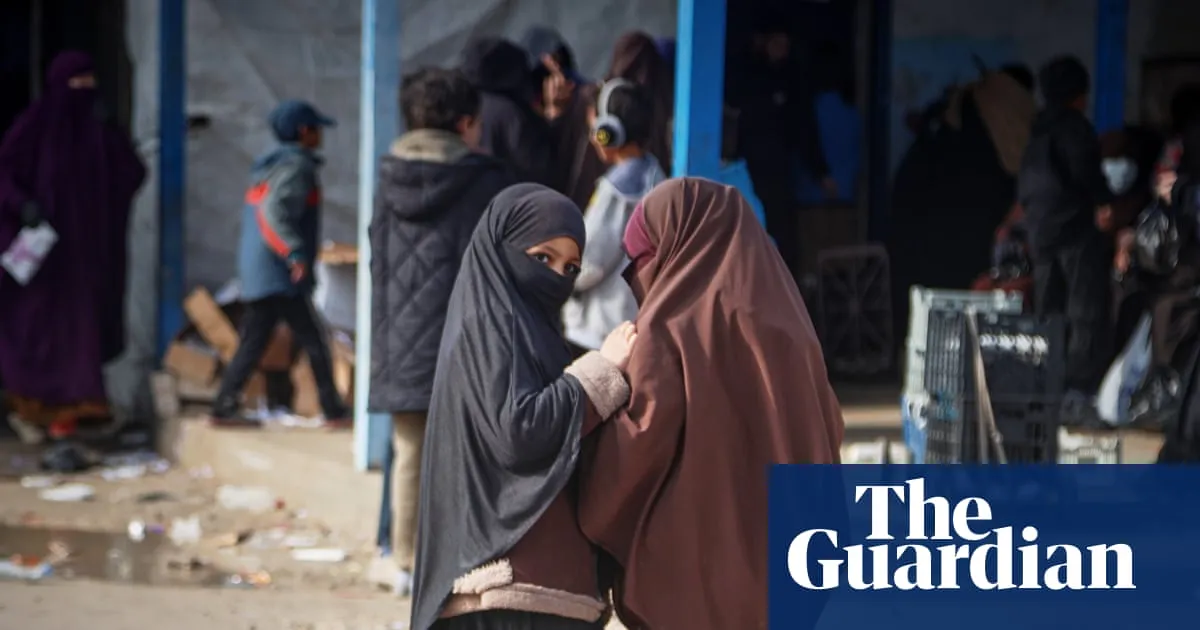
Australian women and children held for years without charge in a squalid detention camp in north-east Syria have been released ahead of their expected repatriation to Australia.The 34 women and children in the group are the wives, widows and children of dead or jailed Islamic State fighters.The administrators of Roj camp, near to the Iraq border, told North Press that 11 Australian families would leave the camp for Damascus, from where they will be repatriated to Australia. Video footage shows the group preparing to leave the camp, women and children were shown hauling luggage into small passenger vans, hoodies drawn and hats low over their faces as they looked down to avoid cameras.The Guardian understands this repatriation has not been organised by the Australian Government.However, reports emerging from Syria on Monday suggest the group was stopped and turned around after being told by the Syrian government that they could not travel to Damascus. While every member of the group is an Australian citizen and has the right to enter Australia, their immediate passage out of Syria was unclear.Most of the Australian women and children have been held in the Roj camp – run the Kurdish SDF – since 2019, and some of the children were born in the camp and have never left.For years, the Australian Government has resisted pressure to repatriate the women and children, while humanitarian and legal advocates have urged their evacuation out of Syria, warning that the conditions in detention facilities were “life-threatening”.None of the Australians held in Roj camp has been charged with a crime or face warrants for arrest, although they could face charges on return to Australia.A spokesperson for the Australian Government said the government was not helping the women and children return to Australia.“The Australian Government is not and will not repatriate people from Syria.“Our security agencies have been monitoring – and continue to monitor – the situation in Syria to ensure they are prepared for any Australians seeking to return to Australia.”The spokesperson said that those returning could face charges.“People in this cohort need to know that if they have committed a crime and if they return to Australia they will be met with the full force of the law.“The safety of Australians and the protection of Australia’s national interests remain the overriding priority.”Conditions in Roj camp have steadily deteriorated, and the camp is a regular target for Islamic State incursions. The US has described the Syrian detentions camps as “incubators for radicalisation”.Shamima Begum, the formerly British woman who was stripped of her citizenship for travelling to Syria as a teenager where she married an IS fighter, is also thought to be held at Roj.Dysentery and influenza outbreaks are common, spreading quickly across populations living in close quarters in dilapidated tents, particularly among underdeveloped and undernourished children, and fires regularly break out in camp tents. Heating fuel is reportedly running low. One Australian child developed frostbite in a previous winter.Human Rights Watch has described “inhuman, degrading, and life-threatening conditions” in the camps, saying the indefinite detention of the women and children, without charge or trial, was unlawful.The US funds the bulk of security operations across north-east Syria through the Kurdish-led Syrian Democratic Forces. It wants the camp closed, and has withdrawn funding and pushed allies to repatriate their citizens.Islamic State “continues to seek to indoctrinate residents and to infiltrate the detention facilities” at Roj.The commander of US Central Command, Adm Brad Cooper, told a UN conference in September “as time goes on, these camps are incubators for radicalisation”.“This problem will only get worse with time … inaction is not an option. Every day without repatriation compounds the risk to all of us.”Cooper urged “every nation with detained or displaced personnel in Syria to return your citizens”.The Australian Government undertook two successful repatriation missions – of eight orphaned children in 2019, and of four women and 13 children in 2022 – but said consistently it had no plan to repatriate the final group.In October, two women and four children escaped al-Hawl detention camp nearer to Iraq, making their way across Syria to Lebanon, where they were given passports at the Australian embassy. They returned to Australia on a commercial flight.In 2024, Clare O’Neil as home affairs minister was preparing to bring a plan to repatriate the remaining Australians to cabinet for approval. But there were concerns within government over backlash to any repatriation from community groups in electorally critical marginal seats in western Sydney, despite the fact many of those still held in Roj camp were from Victoria.The chief executive of Save the Children Australia, Mat Tinkler, said his organisation did not fund or undertake reparations, and was not involved in the extraction of the Australians from the camps.“These reports underscore what national security experts have repeatedly said: that the unmanaged return of Australian citizens would inevitably happen in the absence of federal government action to repatriate them.“Australians should never be left without a safe or viable pathway home. These innocent children have already lost years of their childhood, and deserve the chance to rebuild their lives in safety at home, and to reintegrate into the Australian way of life.”The Guardian has put questions to the federal government about the women and children’s return.The release of the Australian families comes as detention camps in northeast Syria holding IS-affiliated families have rapidly emptied out over the past two weeks. Al-Hawl camp, which had a population of 25,000 IS-affiliated residents from 42 different countries just last month, became almost uninhabited this week.The remainder of the camp’s residents were transferred to a new camp in Aleppo by the Damascus government. The new camp would have new prefabricated houses, WiFi and would not have a locked gate – a stark contrast to the squalid, securitised camps which imprisoned families for years in northeast Syria.Residents have already began to make their way back to their home countries, with a Belgian woman returning to Belgium last weekend seemingly independently. She was immediately arrested.Since the territorial defeat of IS in 2019, tens of thousands of suspected IS fighters and their families have been held in camps and prisons across northeast Syria, guarded by the Kurdish-led Syrian Democratic Forces (SDF). The SDF and their international partners urged the international community to take back its citizens, warning that any escape by detainees could lead to a resurgence in IS in Syria and across the region.For years, the international community ignored these please. Since Damascus took over many of these camps as part of its battle against the SDF, however, repatriations and release of these residents have suddenly accelerated, in murky circumstances. Damascus, in contrast to the SDF, has a seemingly different approach to the camps, viewing the previous policy of indefinite detention as unsustainable and inhumane. The US-led international coalition to defeat IS, has transferred around 5,700 male IS detainees to prisons in Iraq over the last month, finishing the transfers on Friday.Rights groups have raised concerns over the transfers, pointing to abuses in Iraqi prisons and the fact that the detained men have not yet faced a judge. Likely among those transferred to Iraq is Mustafa Hajj-Obeid, an Australian man who was found by the Guardian to be in custody of the SDF in northeast Syria in 2025.
SRCThe Guardian - World News
LANGEN
LEANCenter-Left
WORDS1 208
ENT7
MON · 2026-02-16 · 10:38 GMTBRIEF NSR-2026-0216-16634
NSR-2026-0216-16634News Report·EN·Human Rights
Australian women and children released from Syrian detention camp
A group of 34 Australian women and children, family members of deceased or imprisoned ISIS fighters, were released from the Roj detention camp in northeast Syria, where they have been held since 2019. The group, consisting of 11 families, was initially expected to be transported to Damascus for repatriation to Australia.
William Christou and Ben DohertyThe Guardian - World NewsFiled 2026-02-16 · 10:38 GMTLean · Center-LeftRead · 5 min
The Guardian - World NewsFIG 01
Reading time
5min
Word count
1 208words
Sources cited
3cited
Entities identified
7entities
Quality score
100%
§ 01
Briefing Summary
AI-generatedNEWSAR · AI
A group of 34 Australian women and children, family members of deceased or imprisoned ISIS fighters, were released from the Roj detention camp in northeast Syria, where they have been held since 2019. The group, consisting of 11 families, was initially expected to be transported to Damascus for repatriation to Australia. However, reports indicate they were stopped by the Syrian government and prevented from traveling to Damascus. The Australian government maintains it is not involved in the repatriation effort, despite calls from advocates to evacuate the Australians due to the camp's deteriorating conditions. While none of the individuals have been charged with crimes, the Australian government has stated that returnees could face legal consequences if they have committed any offenses. The government insists its priority remains the safety of Australians and national interests.
Confidence 0.90Sources 3Claims 5Entities 7
§ 02
Article analysis
Model · rule-basedFraming
Human Rights
National Security
Tone
Mixed Tone
AI-assessed
CalmNeutralAlarmist
Factuality
0.80 / 1.00
Factual
LowHigh
Sources cited
3
Well sourced
FewMany
§ 03
Key claims
5 extracted01
The US has described the Syrian detentions camps as “incubators for radicalisation”.
quoteUS Government
Confidence
1.00
02
The Australian government is not helping the women and children return to Australia.
quoteAustralian government spokesperson
Confidence
1.00
03
Those returning to Australia could face charges if they have committed a crime.
factualAustralian government spokesperson
Confidence
0.90
04
34 Australian women and children held in a Syrian detention camp have been released.
factualNorth Press/The Guardian
Confidence
0.90
05
The group was stopped and turned around after being told by the Syrian government that they could not travel to Damascus.
factualReports emerging from Syria
Confidence
0.70
§ 04
Full report
5 min read · 1 208 words§ 05
Entities
7 identifiedKey playerOppositionContextPositiveNeutralNegative
§ 06
Keywords & salience
9 termsaustralian women and children
1.00
syrian detention camp
0.90
repatriation
0.80
roj camp
0.70
syria
0.70
australian government
0.60
islamic state fighters
0.60
detention conditions
0.50
national security
0.50
§ 07
Topic connections
Interactive graph Network visualization showing 51 related topics
View Full Graph Person Organization Location Event|Click node to navigate|Edge numbers = shared articles