It was a bright morning in August 2022 when Ángel Montenegro was taken. A 31-year-old construction worker, Montenegro had been out all night drinking with some work buddies in the city of Cuautla and was waiting for a bus back to nearby Cuernavaca where lived.At about 10am, a white van pulled up: several men jumped out and dragged Montenegro and a co-worker inside before speeding off. Montenegro’s co-worker was released a few hundred meters down the street, but Montenegro was driven away.As soon as she heard that her son had been taken, Montenegro’s mother, Patricia García, raced to Cuautla along with his wife, brother and some neighbors. Arriving at the bus stop, all they found were Montenegro’s cap and one of his tennis shoes.The group spent all day looking for any other trace of Montenegro, but came up empty-handed. “The desperation started when night fell,” said García, who has now spent more than three torturous years looking for her son.Montenegro is one of more than 130,000 people who are considered missing or disappeared in Mexico, an ongoing crisis that has devastated tens of thousands of families across the country. While disappearances began to surge in the early 2000s as the Mexican Government sought to take on the country’s cartels, a new report by the public policy analysis firm México Evalúa found that, in the last 10 years, disappearances have increased more than 200%.“It’s a problem that has become uncontrollable at the national level,” said Armando Vargas, a security analyst at México Evalúa. Disappearances “capture the lethal violence” that Mexico is experiencing.According to Vargas, the surge in disappearances over the last decade reflects the increasing takeover by criminal groups of vast swathes of the country, as well as the diversification of the activities these gangs are engaged in beyond just drug smuggling.Expanding their ranks often involves forced recruitment, while taking over new territory requires the “annihilation of rival groups”, said Vargas. But simply murdering other gang members is likely to catch the authorities’ attention: instead, cartels bury corpses in unmarked graves, burn them to ash or even dissolve them in vats of acid.By making bodies disappear, criminal groups “invisibilize the violence, because that puts them under the radar”, Vargas said.Meanwhile, criminal groups are increasingly engaging in activities that can involve abducting people and making them vanish, including organ trafficking, sex- and human-trafficking as well as migrant smuggling.The Mexican Government, however, has been unable to keep up with cartels as they expand territorially and into new markets, leaving large areas of the country under near-total control of these gangs.“Criminal power advances in parallel with institutional neglect,” said Vargas.In 2018, the government launched a National Search Commission to track and find the disappeared, encouraging more people to report their missing loved ones and creating an interactive public platform that recorded disappearances across the country.But the commission was poorly funded, and the platform soon became a political thorn in the government’s side: ahead of elections in 2024, the then president, Andrés Manuel López Obrador, launched an opaque “review” of the register, and reduced the number of disappeared to just 12,377, sparking an outcry among activists and human rights experts.When asked about the report from México Evalúa, President Claudia Sheinbaum was dismissive, saying “that platform has a lot of problems” and promising the government would be releasing a new report to more accurately account for the disappeared.But analysts say that, if anything, the number of registered disappearances is an undercount, given the extreme rates of violence across the country and the government’s weakness in finding and identifying bodies.When investigations do take place, they are often slow and ineffective, marred by corruption and incompetence: in 2022 more than 96% of crimes in Mexico went unsolved, according to the United Nations.The lack of a substantial government response to the crisis has forced many mothers, including García, to search on their own. García joined a collective of 12 women who went out searching weekly, probing the ground with metal rods for signs of buried corpses.The November after Montenegro was taken, García and the group searched in a field on the outskirts of Cuautla where his phone had last pinged a cell tower. They found six bodies buried there, but none were her son. Four months later they went back and found another five bodies. None were her son.Despite the gruesome work, García is still searching, refusing to give up hope. But the search has taken a terrible toll, with García forced to divide her time between caring for her family and looking for her son.“You’re left in broken pieces,” said García. “It’s like when a vase shatters: you can glue it back together but the cracks are always there.”
SRCThe Guardian - World News
LANGEN
LEANCenter-Left
WORDS781
ENT2
MON · 2026-02-16 · 13:00 GMTBRIEF NSR-2026-0216-16683
NSR-2026-0216-16683News Report·EN·Human Rights
Disappearances in Mexico surge by 200% over 10 years
In Mexico, disappearances have surged by over 200% in the last decade, according to a report by México Evalúa. This ongoing crisis, exemplified by the 2022 disappearance of Ángel Montenegro, has resulted in over 130,000 missing people nationally.
Oscar Lopez in Mexico CityThe Guardian - World NewsFiled 2026-02-16 · 13:00 GMTLean · Center-LeftRead · 4 min
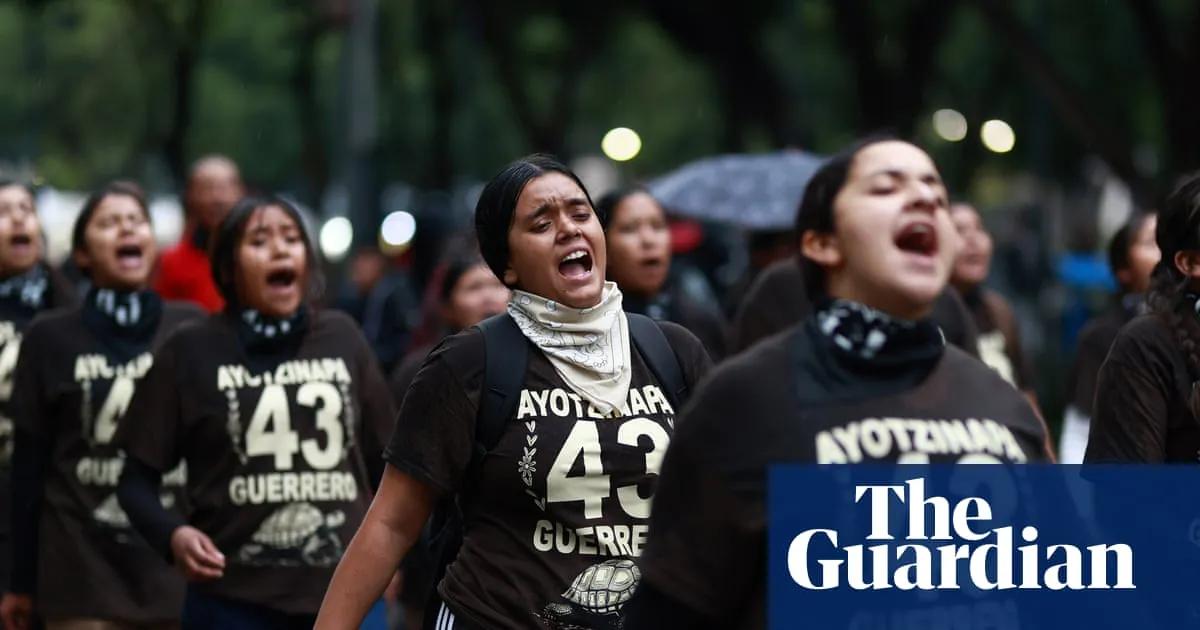
The Guardian - World NewsFIG 01
Reading time
4min
Word count
781words
Sources cited
2cited
Entities identified
2entities
Quality score
100%
§ 01
Briefing Summary
AI-generatedNEWSAR · AI
In Mexico, disappearances have surged by over 200% in the last decade, according to a report by México Evalúa. This ongoing crisis, exemplified by the 2022 disappearance of Ángel Montenegro, has resulted in over 130,000 missing people nationally. The increase reflects the growing power and territorial control of criminal groups, who are diversifying their activities beyond drug smuggling. These groups often forcibly recruit individuals and eliminate rivals by making bodies disappear to avoid detection by authorities. This "invisibilizing" of violence allows criminal organizations to operate with less scrutiny while engaging in activities like organ trafficking and human trafficking.
Confidence 0.90Sources 2Claims 5Entities 2
§ 02
Article analysis
Model · rule-basedFraming
Human Rights
National Security
Tone
Mixed Tone
AI-assessed
CalmNeutralAlarmist
Factuality
0.70 / 1.00
Factual
LowHigh
Sources cited
2
Limited
FewMany
§ 03
Key claims
5 extracted01
More than 130,000 people are considered missing or disappeared in Mexico.
statistic
Confidence
1.00
02
Disappearances in Mexico have increased more than 200% in the last 10 years.
statisticMéxico Evalúa
Confidence
1.00
03
Criminal power advances in parallel with institutional neglect.
quoteArmando Vargas
Confidence
0.90
04
It’s a problem that has become uncontrollable at the national level.
quoteArmando Vargas
Confidence
0.90
05
Criminal groups are increasingly engaging in organ trafficking, sex- and human-trafficking as well as migrant smuggling.
factual
Confidence
0.80
§ 04
Full report
4 min read · 781 words§ 05
Entities
2 identifiedKey playerOppositionContextPositiveNeutralNegative
Organizations1
Locations1
§ 06
Keywords & salience
8 termsdisappearances
1.00
mexico
0.90
criminal groups
0.80
cartels
0.70
violence
0.70
missing persons
0.60
forced recruitment
0.50
organ trafficking
0.40
§ 07
Topic connections
Interactive graph Network visualization showing 51 related topics
View Full Graph Person Organization Location Event|Click node to navigate|Edge numbers = shared articles