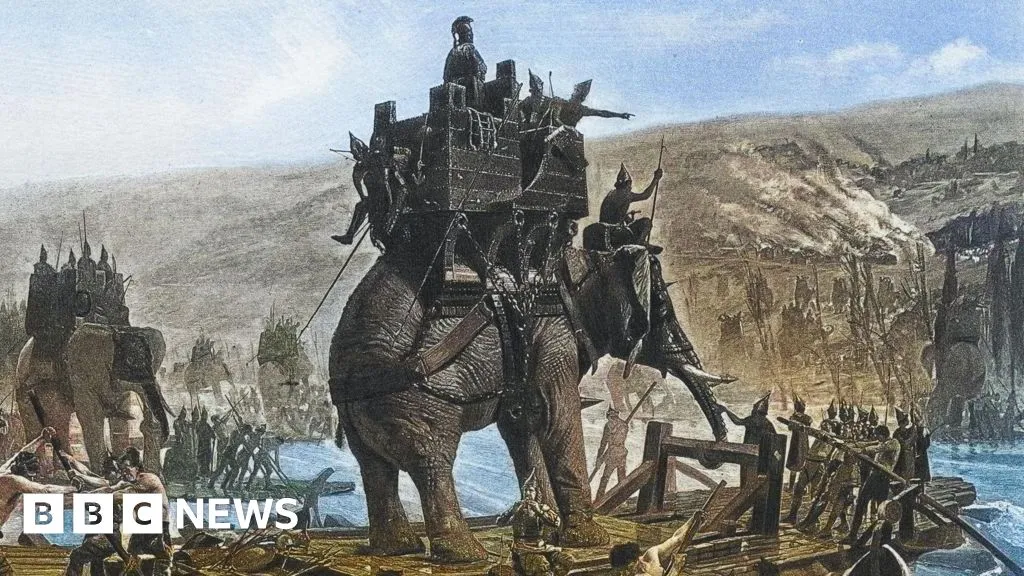
Ancient bone may prove legendary war elephant crossing of Alps6 hours agoGeorgina RannardScience reporterGetty ImagesHannibal's invasion of Europe has acquired almost mythical statusAn elephant foot bone found by archaeologists digging in southern Spain may be evidence that a troop of war elephants stomped through ancient Europe.It would be the first concrete proof of the legendary Carthaginian General Hannibal's troop of battle elephants, according to academics.Drawings of Hannibal's war against the Romans had long suggested that the beasts were used in fighting, but no hard evidence backed up the theories.Now the creatures' skeletal remains appear to have been found in an Iron Age dig near Cordoba."Beyond ivory, the discovery of elephant remains in European archaeological contexts is exceptionally rare," says the team of scientists in a paper published in Journal of Archaeological Science: Reports.Often considered one of the most successful commanders of classical times, Hannibal led his army from the powerful imperial city Carthage, in modern day Tunisia, into Europe as he battled to control the Mediterranean.It is thought he took soldiers and animals from Carthage through Spain and France to invade Italy, crossing the Alps with 37 elephants in 218 BCE during the second of the so-called Punic Wars.The remains found in Spain are presumed to be from an animal that died before reaching the Alps.The archaeologists, led by Professor Rafael M. Martínez Sánchez, found the elephant's bone beneath a collapsed wall on a site called Colina de los Quemados. Martínez Sánchez et alThe top row is the Iron Age elephant bone found in SpainThey used carbon dating techniques to estimate the age of the 10cm cube-shaped bone. The result led them to believe it is from the Second Punic War.They also compared the bone of modern elephants and steppe mammoths to determine which animal it came from.The team found artillery, coins and ceramics during the excavations in 2020, providing more clues that the place was the site of a battle."As non-native species and the largest living terrestrial animals, these imported beasts would have required transportation by ship," the academics said.They say that it is very unlikely that dead animals were transported, and the bones are unattractive suggesting they were not decorative or used in craft.But the scientists say it will be very challenging to work out which species of elephant the creature was."While [the bone] would not represent one of the mythical specimens Hannibal took across the Alps, it could potentially embody the first known relic − so sought after by European scholars of the Modern Age − of the animals used in the Punic Roman wars for the control of the Mediterranean," the scientists conclude in their paper.
SRCBBC News - World
LANGEN
LEANCenter
WORDS440
ENT7
MON · 2026-02-16 · 17:26 GMTBRIEF NSR-2026-0216-16775
NSR-2026-0216-16775News Report·EN·Human Interest
Ancient bone may prove legendary war elephant crossing of Alps
Archaeologists in Spain have potentially discovered the first concrete evidence of Hannibal's legendary war elephants. A foot bone, unearthed at an Iron Age dig site near Cordoba, is believed to be from an elephant that died during Hannibal's campaign in 218 BCE.
BBC News - WorldFiled 2026-02-16 · 17:26 GMTLean · CenterRead · 2 min
BBC News - WorldFIG 01
Reading time
2min
Word count
440words
Sources cited
1cited
Entities identified
7entities
Quality score
100%
§ 01
Briefing Summary
AI-generatedNEWSAR · AI
Archaeologists in Spain have potentially discovered the first concrete evidence of Hannibal's legendary war elephants. A foot bone, unearthed at an Iron Age dig site near Cordoba, is believed to be from an elephant that died during Hannibal's campaign in 218 BCE. The team, led by Professor Rafael M. Martínez Sánchez, used carbon dating to estimate the bone's age and compared it to modern elephants and steppe mammoths. The discovery supports historical accounts and drawings suggesting Hannibal employed war elephants in his battles against the Romans during the Second Punic War. The bone was found alongside artillery, coins, and ceramics, further suggesting the site was the location of a battle. While the exact species of elephant remains uncertain, the find offers compelling evidence of Hannibal's army moving through Europe with the animals.
Confidence 0.90Sources 1Claims 5Entities 7
§ 02
Article analysis
Model · rule-basedFraming
Human Interest
Tone
Measured
AI-assessed
CalmNeutralAlarmist
Factuality
0.80 / 1.00
Factual
LowHigh
Sources cited
1
Limited
FewMany
§ 03
Key claims
5 extracted01
The archaeologists used carbon dating to estimate the bone's age.
factualGeorgina Rannard, Science reporter
Confidence
1.00
02
The bone was found in an Iron Age dig near Cordoba.
factualGeorgina Rannard, Science reporter
Confidence
1.00
03
Beyond ivory, the discovery of elephant remains in European archaeological contexts is exceptionally rare.
quoteteam of scientists in a paper published in Journal of Archaeological Science: Reports
Confidence
0.90
04
Hannibal crossed the Alps with 37 elephants in 218 BCE.
factualGeorgina Rannard, Science reporter
Confidence
0.90
05
An elephant foot bone found in Spain may be evidence of Hannibal's war elephants in ancient Europe.
factualGeorgina Rannard, Science reporter
Confidence
0.70
§ 04
Full report
2 min read · 440 words§ 05
Entities
7 identifiedKey playerOppositionContextPositiveNeutralNegative
Organizations1
§ 06
Keywords & salience
10 termswar elephants
1.00
hannibal
0.90
alps crossing
0.80
ancient bone
0.70
archaeological discovery
0.70
punic wars
0.60
carthage
0.60
iron age
0.50
carbon dating
0.50
cordoba
0.40
§ 07
Topic connections
Interactive graph No topic relationship data available yet. This graph will appear once topic relationships have been computed.