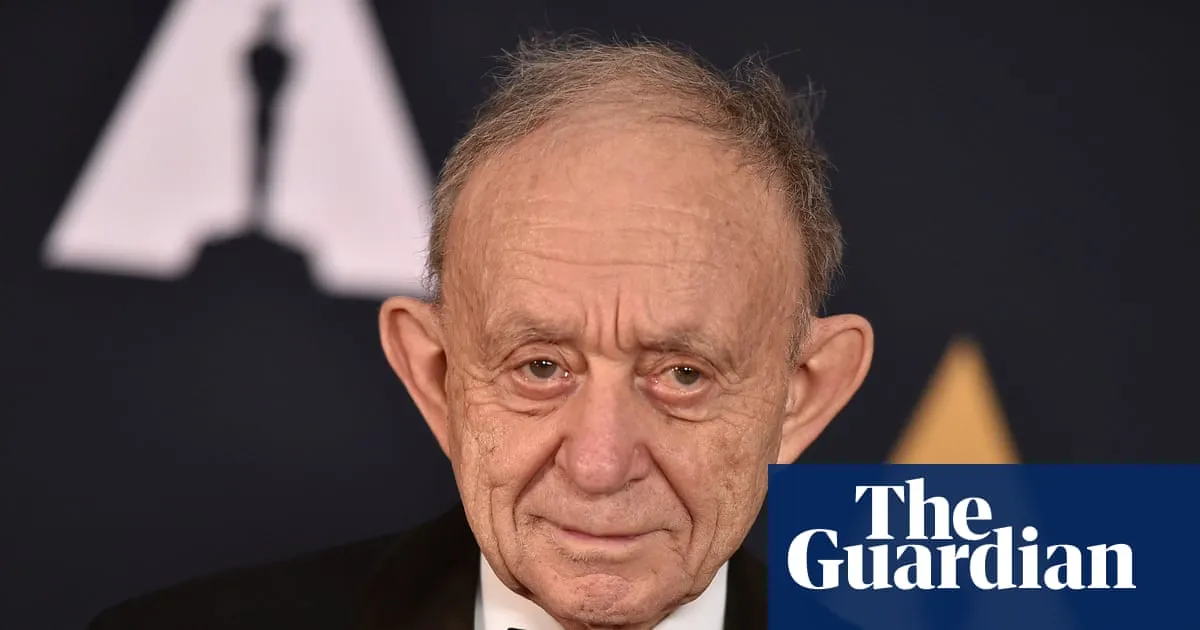
Frederick Wiseman, the prolific film-maker whose documentaries primarily explored US public institutions and communities, has died aged 96.His death on Monday was announced in a joint statement from the Wiseman family and his production company, Zipporah Films.“For nearly six decades, Frederick Wiseman created an unparalleled body of work, a sweeping cinematic record of contemporary social institutions and ordinary human experience primarily in the United States and France,” the statement read. “His films – from Titicut Follies (1967) to his most recent work, Menus-Plaisirs – Les Troisgros (2023) – are celebrated for their complexity, narrative power and humanist gaze.”Wiseman, whose extraordinary career was recognised with an honorary Academy Award in 2016, directed and produced almost 50 films, including City Hall (2020), about Boston’s city government; Ex Libris (2017), about the New York Public Library; and In Jackson Heights (2015), about a neighbourhood in the New York borough of Queens.Often associated with the direct cinema and vérité movements, he never conducted interviews or staged events for his documentaries and used only natural lighting and diegetic sound, without voiceovers or scores. He did no research before embarking on each project, and turned up with a sense of curiosity, eager to learn.“Making a movie is always an adventure,” Wiseman said when accepting his Academy Award in 2016. “I usually know nothing about the subject before I start … I never start with a point of view about the subject, or a thesis that I want to prove. I also don’t do any research in advance of the shooting. I usually don’t know in advance what’s going to be shot, or what I’m going to stumble across in any day or any moment of any day.”He documented hundreds of hours of footage of his subjects, sifting through it in an intensive editing process that could last up to 10 months.Even though he was associated with the vérité mode of documentary making, he described his films as closer to “visual novels” than journalistic accounts.Frederick Wiseman at his editing desk, c.1978. Photograph: Everett Collection Inc/AlamyBorn in Boston, Wiseman attended Williams College then Yale law school. After graduating in 1954, he was drafted into the US army, where he served for two years as a court reporter, before studying law in Paris under the GI Bill. Returning to the US, he took up a teaching post at the Boston University Institute of Law and Medicine.It was during this time that Wiseman became interested in documentary film-making, producing the 1963 semi-documentary The Cool World, adapted from Warren Miller’s novel about life in a Harlem gang. Four years later, he made his directorial debut with Titicut Follies, which documented life at Massachusetts’ Bridgewater state hospital for the criminally insane.It was almost his last film: his harrowing account of the dehumanising treatment of the hospital’s residents was banned from public screening by the Massachusetts supreme court, and until 1991 it could only be screened privately to medical professionals. But Wiseman forged ahead, turning out three films in the following three years.Wiseman had a longstanding passion for theatre and dance, as shown in films such as La Danse (2009), which offered a behind-the-scenes glimpse of the Paris Opera Ballet, and Crazy Horse (2011) about the notorious Paris cabaret club.His progressive political views were evident in his work, including films such as Welfare (1975) about the New York benefits system, though Wiseman said he had no interest in ideological film-making and resisted the notion that documentaries were forces for political or social change. Writing for Dox: Documentary Quarterly in 1994, he said: “Documentaries, like plays, novels, poems – are fictional in form and have no measurable social utility.”His most recent film, 2023’s Menus-Plaisirs – Les Troisgros, went behind the scenes at a renowned Michelin triple-starred restaurant in France.Talking about his approach to choosing subject matter, Wiseman said in 2016: “Each film is also an opportunity, an opportunity to learn something about a new subject. I’ve been involved in a 50-year course in adult education where I’m the alleged adult who studies a new subject every year.“The variety and complexity of the human behaviour observed in making one of the films, and cumulatively, all of the films is staggering, and I think it is important to document kindness, civility and generosity of spirit as it is to show cruelty, banality and indifference.”Wiseman is survived by two sons, David and Eric, and three grandchildren, as well as Karen Konicek, his friend and collaborator, who worked with him for 45 years. His wife of 65 years, Zipporah Batshaw Wiseman, died in 2021.
SRCThe Guardian - World News
LANGEN
LEANCenter-Left
WORDS756
ENT8
TUE · 2026-02-17 · 01:44 GMTBRIEF NSR-2026-0217-16805
NSR-2026-0217-16805News Report·EN·Human Interest
Frederick Wiseman, prolific documentary film-maker, dies aged 96
Frederick Wiseman, the acclaimed documentary filmmaker known for his in-depth explorations of American public institutions and communities, died on Monday at the age of 96. Over nearly six decades, Wiseman created almost 50 films, including "Titicut Follies," "City Hall," and "Ex Libris," recognized for their complexity and humanist perspective.
Dee JeffersonThe Guardian - World NewsFiled 2026-02-17 · 01:44 GMTLean · Center-LeftRead · 4 min
The Guardian - World NewsFIG 01
Reading time
4min
Word count
756words
Sources cited
2cited
Entities identified
8entities
Quality score
100%
§ 01
Briefing Summary
AI-generatedNEWSAR · AI
Frederick Wiseman, the acclaimed documentary filmmaker known for his in-depth explorations of American public institutions and communities, died on Monday at the age of 96. Over nearly six decades, Wiseman created almost 50 films, including "Titicut Follies," "City Hall," and "Ex Libris," recognized for their complexity and humanist perspective. Wiseman's films, often associated with direct cinema, avoided interviews, staging, voiceovers, and scores, relying on natural lighting and sound. Born in Boston, Wiseman attended Williams College and Yale Law School and served in the US Army before embarking on his filmmaking career. He received an honorary Academy Award in 2016 for his contributions to cinema.
Confidence 0.90Sources 2Claims 5Entities 8
§ 02
Article analysis
Model · rule-basedFraming
Human Interest
Tone
Measured
AI-assessed
CalmNeutralAlarmist
Factuality
0.90 / 1.00
Factual
LowHigh
Sources cited
2
Limited
FewMany
§ 03
Key claims
5 extracted01
His harrowing account of the dehumanising treatment of the hospital’s residents was banned from public screening by the Massachusetts court.
factualnull
Confidence
1.00
02
"Making a movie is always an adventure," Wiseman said when accepting his Academy Award in 2016.
quoteFrederick Wiseman
Confidence
1.00
03
He never conducted interviews or staged events for his documentaries and used only natural lighting and diegetic sound, without voiceovers or scores.
factualnull
Confidence
1.00
04
Wiseman directed and produced almost 50 films, including City Hall (2020), Ex Libris (2017), and In Jackson Heights (2015).
factualnull
Confidence
1.00
05
Frederick Wiseman, the prolific film-maker whose documentaries primarily explored US public institutions and communities, has died aged 96.
factualnull
Confidence
1.00
§ 04
Full report
4 min read · 756 words§ 05
Entities
8 identifiedKey playerOppositionContextPositiveNeutralNegative
Organizations1
Locations5
§ 06
Keywords & salience
9 termsfrederick wiseman
1.00
documentary filmmaker
0.90
documentary films
0.80
direct cinema
0.70
cinéma vérité
0.70
us public institutions
0.60
social institutions
0.50
visual novels
0.40
film editing
0.40
§ 07
Topic connections
Interactive graph No topic relationship data available yet. This graph will appear once topic relationships have been computed.