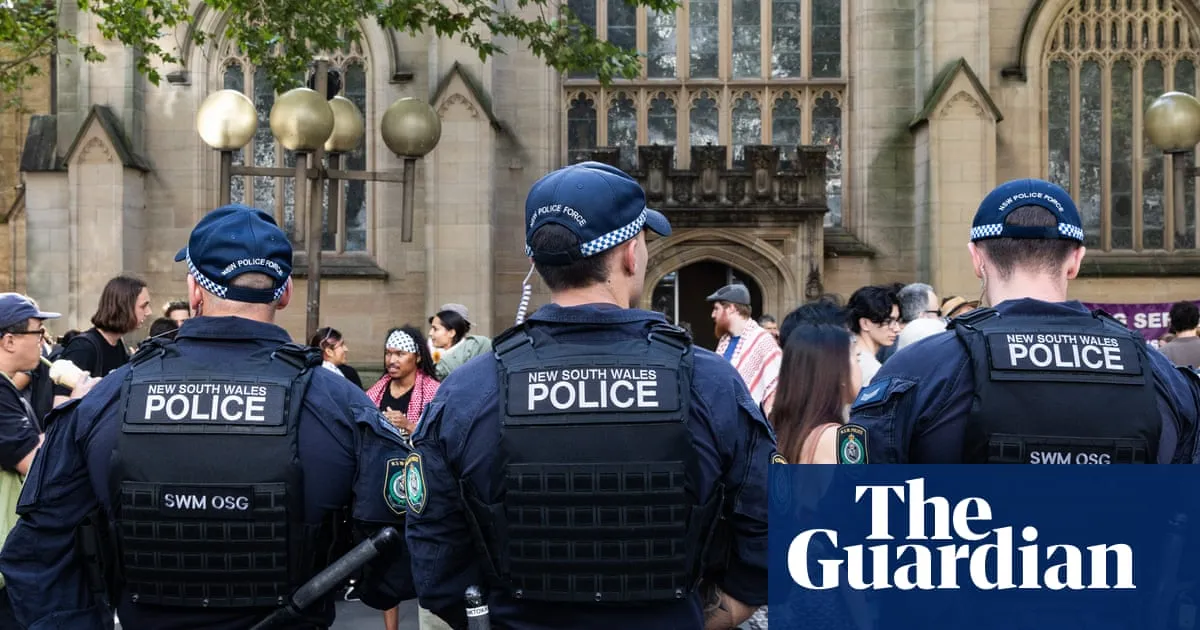
The New South Wales Police commissioner has ended a restriction on protests that effectively banned marches in designated areas now that Israeli president Isaac Herzog has left Australia.On Tuesday, Mal Lanyon announced the restriction would cease, meaning protester organisers can once again use the form 1 system to facilitate marches with police, without the risk of being arrested in the CBD and the eastern suburbs.Police were given the controversial power to restrict protests in 14 day increments for up to 90 days following a terror attack when the Minns government rushed laws through parliament last year in the wake of the Bondi Beach terror attack. The power is currently facing a constitutional challenge and will go before the court on Thursday.The police refused to facilitate Palestine Action Group’s planned march from Town Hall to state parliament last week on the basis of the restriction, alongside expanded powers handed to police under the major events act for the duration of Herzog’s visit. Widespread allegations of police brutality followed the rally.Lanyon said the recent protests, during which officers used pepper spray and a controversial tactic known as kettling, played “very little” role in the decision to end the restriction on public assemblies. But he said the powers were in place during Herzog’s visit earlier this month because he had “significant concerns about the safety of the community” at the time.Two weeks ago, Lanyon cited Herzog’s four-day visit to Australia, which ended last Thursday, as a “factor” in his decision to extend the public assembly restriction declaration (Pard). He was asked on Tuesday what those other factors were but did not cite anything other than Herzog’s visit.“Certainly the visit of a head of state, there was significant animosity towards that head of state,” he said.“There was a need for a police force to ensure that we provide protection to that head of state. There were also large events that were planned around the visit of that head of state. We did not want there to be conflict between protesters and the head of state.“With Mr Herzog now leaving the country I’m satisfied the conditions have changed such that we can resume managing public assemblies under [the] summary act,” he said.Last Saturday, the Minns government declared Herzog’s visit a “major event” under the state’s major event legislation. This handed the police sweeping powers, including additional move on and search powers in the same designated area covered by the Pard. The declaration hampers the ability for protesters to sue the state for alleged police brutality.Herzog has been accused by a UN commission of inquiry, which does not speak on behalf of the UN, as having incited genocide against the Palestinian people when he said that all Gazans were responsible for the 7 October attacks against Israel. He has denied the accusation and says his words were taken out of context.The Palestine Action Group challenged the major event declaration for Herzog’s visit in an urgent hearing held last Monday, arguing it was a “backdoor” way to curtail protests. They lost to the state, who had argued the powers were needed to secure the safety of the Israeli president and the community.PAG is considering appealing the decision. Meanwhile, lawyer Peter O’Brien has vowed to challenge the designation again as part of his client Jann Alhafny’s case. Alhafny, 69, is suing the state for personal injury after she was allegedly pushed down “violently” by a police officer and broke her vertebra in four places.On Friday the police watchdog announced it would launch an independent inquiry into how officers handled the protest.The premier, Chris Minns, has defended the police’s actions, saying the protesters created an “impossible situation”Meanwhile, a member of his own government, Stephen Lawrence, said after the protest the violence was “pretty much an inevitable consequence” of the Pard.Lanyon was asked about the comments on Tuesday when he announced the Pard would cease. He said: “I don’t have an opinion on that … We tried everything we could to provide a route to the organisers that would have allowed a safe and peaceful protest.“I think the Pard has worked very well, but I think this is about starting to get the community back to what is normal.”
SRCThe Guardian - World News
LANGEN
LEANCenter-Left
WORDS699
ENT9
TUE · 2026-02-17 · 03:49 GMTBRIEF NSR-2026-0217-16815
NSR-2026-0217-16815News Report·EN·Political Strategy
NSW police end restriction on protests now Israeli president has left the country
NSW Police Commissioner Mal Lanyon has lifted restrictions on protests, effectively ending a ban on marches in designated areas of Sydney. The restrictions were initially implemented following a terror attack, granting police expanded powers to control public assemblies for up to 90 days.
Jordyn BeazleyThe Guardian - World NewsFiled 2026-02-17 · 03:49 GMTLean · Center-LeftRead · 3 min
The Guardian - World NewsFIG 01
Reading time
3min
Word count
699words
Sources cited
3cited
Entities identified
9entities
Quality score
75%
§ 01
Briefing Summary
AI-generatedNEWSAR · AI
NSW Police Commissioner Mal Lanyon has lifted restrictions on protests, effectively ending a ban on marches in designated areas of Sydney. The restrictions were initially implemented following a terror attack, granting police expanded powers to control public assemblies for up to 90 days. The decision to lift the restrictions coincides with the departure of Israeli President Isaac Herzog from Australia, whose visit was cited as a key factor in maintaining the ban due to safety concerns and potential conflicts with protesters. The police's actions during recent protests, including the use of pepper spray and kettling, have drawn criticism. The expanded police powers are currently facing a constitutional challenge in court.
Confidence 0.90Sources 3Claims 5Entities 9
§ 02
Article analysis
Model · rule-basedFraming
Political Strategy
Human Rights
Tone
Measured
AI-assessed
CalmNeutralAlarmist
Factuality
0.80 / 1.00
Factual
LowHigh
Sources cited
3
Well sourced
FewMany
§ 03
Key claims
5 extracted01
Herzog has been accused by a UN commission of inquiry of inciting genocide.
factualnull
Confidence
1.00
02
The power to restrict protests is facing a constitutional challenge.
factualnull
Confidence
1.00
03
Police were given power to restrict protests in 14-day increments after the Bondi beach terror attack.
factualnull
Confidence
1.00
04
The restriction effectively banned marches in designated areas.
factualnull
Confidence
1.00
05
NSW police ended a restriction on protests after Israeli president Isaac Herzog left Australia.
factualnull
Confidence
1.00
§ 04
Full report
3 min read · 699 words§ 05
Entities
9 identifiedKey playerOppositionContextPositiveNeutralNegative
Organizations3