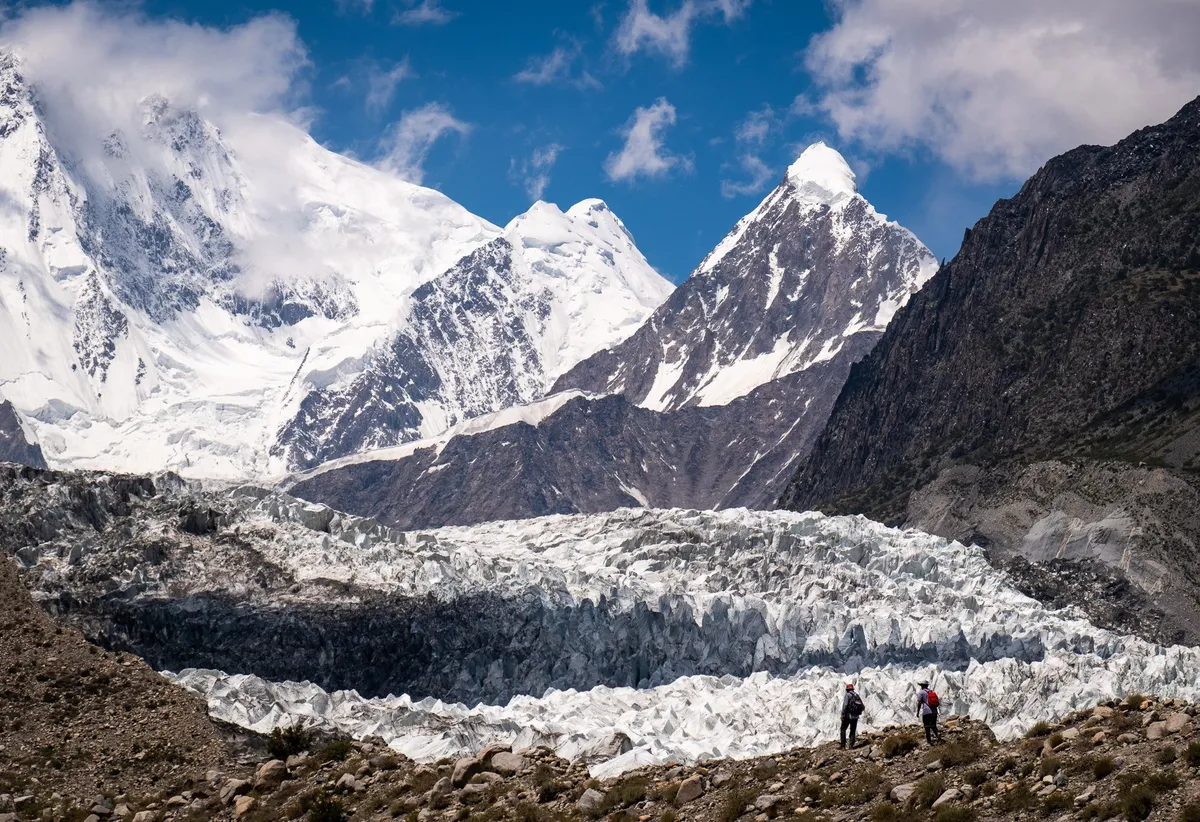
EXPLAINERResidents in the northern part of the country are creating artificial glaciers to tackle water shortages amid soaring temperatures.Pakistan is home to an estimated 13,000 glaciers [Nurettin Boydak/Anadolu via Getty Images]Published On 17 Feb 2026Skardu, Pakistan – As Pakistan grapples with the effects of rising temperatures that are melting its glaciers, residents in the country’s high-altitude Himalayan region have adopted a traditional technique, known as glacier grafting, to counter water scarcity.Pakistan, home to an estimated 13,000 glaciers, ranks among the top 10 most climate-vulnerable nations, even though it contributes less than one percent of global emissions.Recommended Stories list of 3 itemslist 1 of 3The youth raising climate change awareness in PakistanThis article will be opened in a new browser windowlist 2 of 3One year floods, the next drought: Farmers battle Pakistan’s climate plightlist 3 of 3How Indigenous knowledge is aiding Pakistan’s fight against climate changeend of listAs global warming worsens, the effect of more glaciers melting is “likely to be significant”, Pakistan’s National Disaster Management Authority (NDMA) said last year.What is glacier grafting?Glacier grafting, locally known as glacier marriage, is a technique that involves “planting” ice at carefully chosen high-altitude locations to create new artificial glaciers – a process that experts say dates back centuries.The technique involves storing ice fetched from glaciers closer to human settlements amid periods of water scarcity.According to Zakir Hussain Zakir, professor and researcher at the University of Baltistan in Skardu, the earliest recorded instance of glacier grafting goes back to the 14th century, when the Sufi saint Mir Syed Ali Hamadani grafted a glacier in the village of Giyari.“That glacier blocked the route through which invaders from Yarkand came to loot the people,” Zakir, who has researched the practice in the Himalayan region, told Al Jazeera.Over time, what began as a defensive act evolved into a method for managing water scarcity in one of the world’s most fragile mountain ecosystems.People in the Ladakh region across the border on the Indian side also use traditional knowledge to preserve ice amid climate change and receding natural glaciers. A relatively newer technique has been developed in Ladakh to create an “ice stupa”, which is formed after spraying water in freezing temperatures. The conical shape ice structure remains frozen for a longer period as its surface is not fully exposed to the sun.How is glacier grafting carried out?So-called “male” and “female” ice is sourced from different locations and brought together to create an artificial glacier. Villagers where this technique has been implemented as well as experts told Al Jazeera that volunteers go out to collect around 200kg (441 pounds) of “male” ice from one valley and “female” ice from another. Male ice is typically black in colour, while female ice is usually lighter, providing more fertile water that enhances agricultural productivity, according to locals.In ancient times, due to the absence of available transportation as well as steep, narrow and slippery routes through the mountains, volunteers would travel on foot for several days, carrying the ice in traditional wooden cages on their backs.The process requires specific materials: coal, grass, salt and water collected from seven different streams. Before setting out to the grafting site, the group would recite Quranic verses, perform spiritual rituals and pray for success.The material, including both sets of ice blocks, would be carried to the site while “strictly following environmentally respectful and culturally sacred practices”, the locals said.They would avoid the use of plastics, refrain from immoral actions and only consume locally produced foods such as wheat, barley, apricots and homemade bread during the process.Humour, music, or harm to living creatures is strictly prohibited, as the procedure was viewed as both a spiritual and ecological responsibility.At the grafting site, a small trench would be dug in a safe area, away from avalanche or flood-risk zones. The male and female ice pieces would be carefully layered together, mixed with salt, coal and grass.“The male pieces are put on the right, while on the left, female ice pieces,” Zakir said.Pakistan is home to an estimated 13,000 glaciers [Faras Ghani/Al Jazeera]Water collected from the seven streams would slowly be dripped over the ice to help bind the layers.Over several months, the pieces fused into a single ice mass. If the site received seasonal snowfall, the mass would gradually develop into a glacier. After surviving for at least three years and enduring seasonal snow cycles, the artificially grafted glacier would expand. Over the next few years, it would become a reliable water source.Zakir added that site selection is critical in the process: north-facing slopes, strong winds, less sun exposure and protection from direct flowing water are essential.Rituals, discipline and collective labourLocals and experts told Al Jazeera that the deep spiritual and cultural aspects surrounding this technique are what distinguish glacier grafting from purely technical interventions.Ice pieces are never allowed to touch the ground and must remain in continuous motion from collection to planting.“Often, vehicles that carry these ice pieces are never switched off,” Zakir recalled, adding that those helping out are forbidden from speaking, using plastic or relieving themselves near the site.“If one volunteer feels tired, without lying down, he will pass the basket [carrying the ice] to another volunteer.”Historically, glacier grafting has also concluded with local music known as Gang Lho that is sung directly to the ice. One such song, the professor recalled, addresses the glacier as a living being, calling it “my dear baby glacier” having “pastures to grow… mountains to climb”.Often, volunteers and villagers would have tears in their eyes, praying for the glacier’s establishment and survival in order to aid their survival and livelihood.How long does glacier grafting take? Is it guaranteed to survive?A successfully grafted glacier can start supplying water within two decades, making it a long-term investment in water security.However, experts warn that the process is vulnerable – not only to a failure of the natural process, a lack of snowfall, drops in temperatures, and climate change, but also to conflict.“In abnormal climatic conditions, such as during war, the process may fail,” Zakir warned.“Both India and Pakistan have deployed military forces in the glaciers, and the bullets they use, as well as the movement of soldiers and equipment, are very harmful to glaciers.”The South Asian neighbours have fought three wars over the disputed Kashmir region, which they both govern parts of.Can glacier grafting solve water scarcity problems?The mean temperature in Pakistan since the 1950s has risen by 1.3 degrees Celsius (2.34 degrees Fahrenheit), which is twice as fast as the global mean change, according to the World Bank.With temperatures rising globally, glacier grafting may not be able to offer a wholesome solution to Pakistan’s melting glaciers problem. But it remains a powerful example of how Indigenous knowledge, culture and collective care have long shaped survival in the mountains.Locals told Al Jazeera that glacier grafting is now more critical than ever to counter water scarcity and erratic snowfall that cause problems for irrigation, domestic consumption and livestock.They also worry that the practice of glacier grafting is rapidly disappearing. Younger generations, drawn to urban centres and alternative livelihoods such as tourism, education and business, no longer engage in traditional irrigation.This shift has disrupted the intergenerational transfer of Indigenous knowledge, they lamented.
SRCAl Jazeera
LANGEN
LEANCenter
WORDS1 196
ENT3
TUE · 2026-02-17 · 15:54 GMTBRIEF NSR-2026-0217-17007
NSR-2026-0217-17007News Report·EN·Environmental
Glacier grafting: How an Indigenous art is countering water scarcity
Faced with water scarcity due to rising temperatures and melting glaciers, residents in the Himalayan region of northern Pakistan are reviving a centuries-old Indigenous technique called glacier grafting. This involves transplanting ice to high-altitude locations to create artificial glaciers.
Ijlal Haider,Faras GhaniAl JazeeraFiled 2026-02-17 · 15:54 GMTLean · CenterRead · 5 min
Al JazeeraFIG 01
Reading time
5min
Word count
1 196words
Sources cited
2cited
Entities identified
3entities
Quality score
100%
§ 01
Briefing Summary
AI-generatedNEWSAR · AI
Faced with water scarcity due to rising temperatures and melting glaciers, residents in the Himalayan region of northern Pakistan are reviving a centuries-old Indigenous technique called glacier grafting. This involves transplanting ice to high-altitude locations to create artificial glaciers. Pakistan, despite being a low contributor to global emissions, is highly vulnerable to climate change and home to approximately 13,000 glaciers. Glacier grafting, also known as glacier marriage, was historically used for defense but has evolved into a method for managing water resources. Similar techniques are also used in the Ladakh region of India to preserve ice.
Confidence 0.90Sources 2Claims 5Entities 3
§ 02
Article analysis
Model · rule-basedFraming
Environmental
Human Interest
Tone
Measured
AI-assessed
CalmNeutralAlarmist
Factuality
0.80 / 1.00
Factual
LowHigh
Sources cited
2
Limited
FewMany
§ 03
Key claims
5 extracted01
Pakistan ranks among the top 10 most climate-vulnerable nations.
factual
Confidence
1.00
02
Pakistan is home to an estimated 13,000 glaciers.
statistic
Confidence
1.00
03
Residents in Pakistan's Himalayan region are using glacier grafting to counter water scarcity.
factual
Confidence
1.00
04
The earliest recorded instance of glacier grafting goes back to the 14th century.
factualZakir Hussain Zakir, professor and researcher at the University of Baltistan in Skardu
Confidence
0.90
05
Male ice is typically black in colour, while female ice is usually...
factualVillagers and experts
Confidence
0.80
§ 04
Full report
5 min read · 1 196 words§ 05
Entities
3 identifiedKey playerOppositionContextPositiveNeutralNegative
§ 06
Keywords & salience
9 termsglacier grafting
1.00
water scarcity
0.90
climate change
0.80
artificial glaciers
0.70
pakistan
0.70
glacier melting
0.60
himalayan region
0.50
indigenous knowledge
0.50
traditional technique
0.40
§ 07
Topic connections
Interactive graph Network visualization showing 51 related topics
View Full Graph Person Organization Location Event|Click node to navigate|Edge numbers = shared articles