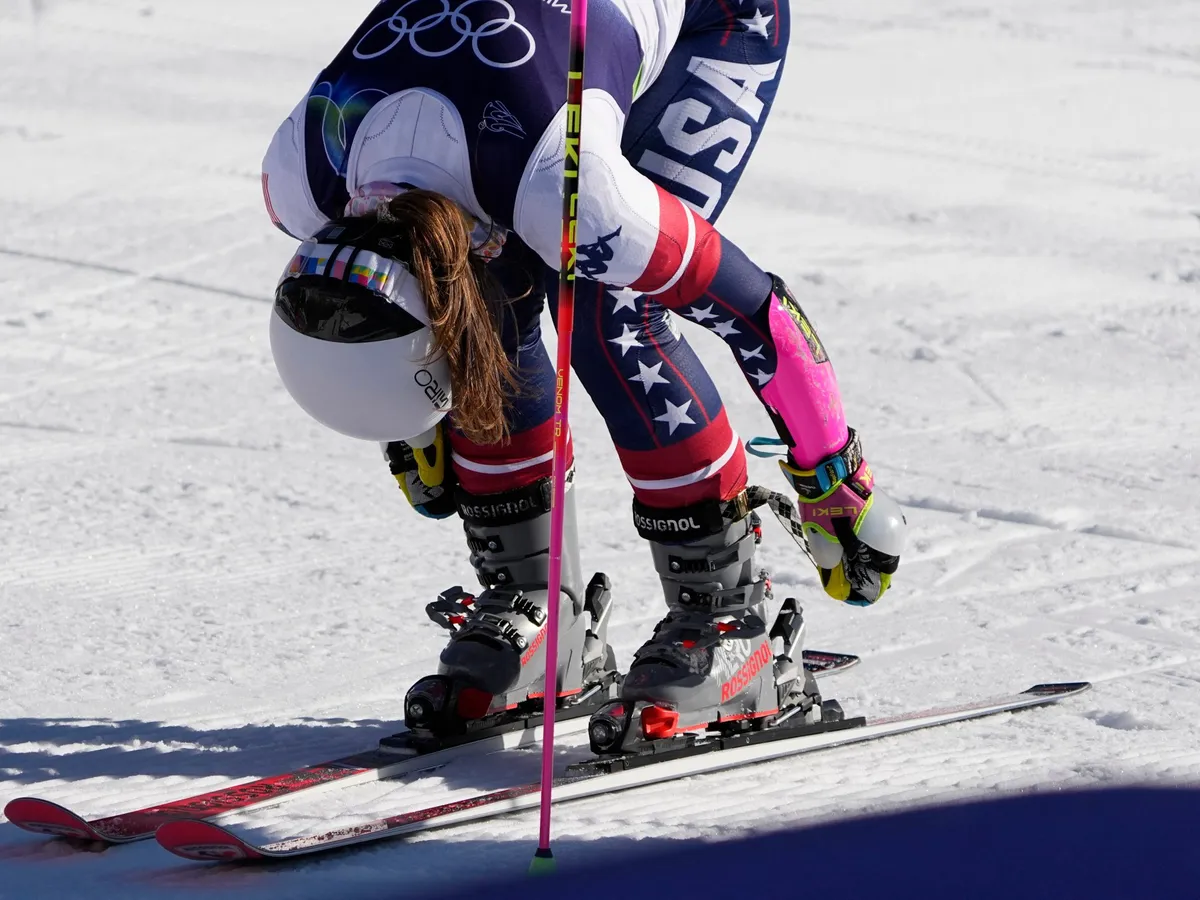
‘Smart binding’ system in development, but while safety is a concern, so are costs and whether skiers really want it.American Paula Moltzan unlatches her boots at the finish area of the women's giant slalom race at the 2026 Winter Olympics in Italy [Andy Wong/AP]Published On 18 Feb 2026The images of Lindsey Vonn down on the snow, screaming in pain and then being airlifted off the course by helicopter after a crash at the Olympics have been a stark reminder of the dangers of the downhill.So is this: Her skis didn’t come off.Recommended Stories list of 4 itemslist 1 of 4Mourinho, Benfica criticised after alleged racist abuse of Real’s Viniciuslist 2 of 4Boxing legend Manny Pacquiao to face Ruslan Provodnikov in Aprillist 3 of 4Ronda Rousey, Gina Carano end MMA retirements to fight in Maylist 4 of 4South Africa overcome UAE to finish unbeaten in T20 World Cup groupend of listVonn’s boots remained locked into her skis even after her pinwheeling fall at the Milano Cortina Winter Olympics 2026, and they pointed awkwardly in different directions as the American four-time world champion and 2010 Olympic gold medallist slid to a stop in obvious agony.It is impossible to know whether Vonn would have suffered a less serious injury – her complex tibia fracture has already required multiple surgeries – had her skis released. But the devastating injury has put a spotlight on the importance of bindings, which hold boots to the skis and remain some of the oldest technology in the sport.Officials told The Associated Press news agency that a binding system designed to automatically release skis when a racer like Vonn loses control is still in the drawing-board phase after years of stalled discussions.“Unfortunately, sometimes it does take horrific accidents to shine even more of a light on what can be done,” said Sophie Goldschmidt, president and CEO of the US Ski and Snowboard Association. “It’s an area we can’t be competitive in; we’ve all got to be in it together with our different country counterparts and FIS [the International Ski and Snowboard Federation].”Bindings haven’t significantly changed in their basic design for half a century: Once a skier steps in toes first and then locks in by stepping down with the heel, pressure needs to be applied for the system to release the boot. Less-skilled skiers have bindings that release more easily to avoid leg injuries. The higher the skill level and the more serious the skiing, the more the bindings are cranked down to keep elite racers on their skis.Few were surprised that Vonn’s skis did not release. The question is whether they should have.A ‘smarter’ bindingA “smart binding” system based on an algorithm and designed to automatically release when a skier loses control “would have surely” helped prevent Vonn from breaking her leg, said Peter Gerdol, the FIS women’s race director at the Olympics and on the World Cup circuit.“That’s exactly what the system will be designed to do,” Gerdol told AP. “Her skis would have definitely popped off. … We’ve seen a lot of other cases in which the bindings don’t open and it results in knee issues, especially when the still-attached ski acts as a lever, either on the net or on the snow or on a gate or on any other obstacle. The leg becomes blocked, and the knee gives out.”Nine days before her Olympic crash in Italy, Vonn tore the ACL in her left knee in a crash in Crans-Montana, Switzerland. She ended up in the safety nets with her skis still attached.A smart binding system could borrow technology from the safety air bag system that became mandatory for skiers this season in the speed events.“It’s still going to take time to develop, but the idea is that the binding would be triggered by the same algorithm that prompts the airbag to inflate,” Gerdol said. “The heel piece would slide back, and the athlete’s skis would pop off.”Dainese and its sister company, D-Air Lab, spent years developing an algorithm for airbags to inflate under skiers’ racing suits after creating a similar system for motorcycle racing.In coordination with the FIS, Dainese is sharing the airbag algorithm with top binding suppliers, such as Look, Tyrolia, Salomon, Atomic and Marker to adapt the formula to release skis.Releasing skis is potentially more dangerous than inflating an airbag. Elite skiers are sometimes capable of spectacular recoveries after flying into the air, and they also can often use their skis to brake before slamming into safety fences.“It’s a very complicated project,” said Marco Pastore, a Dainese representative on the circuit for the airbag system. “If you release a binding, you’ve got to be absolutely sure you do it at the right moment. For the airbag, you can look at the rotations and the entire body position. But with the bindings, you’ve got to examine how the feet move, what the trajectory of the skis is, plus a series of other variables.”American Lindsey Vonn lies on the course after crashing during an alpine women’s downhill race at the 2026 Winter Olympics[Screengrab/Olympic Broadcasting Services via AP]Finances an issue for complicated safety projectsWhile the FIS wants to coordinate the project, issues remain over who will pay for it.“These are very costly projects, and to be honest, Dainese has not made much” from the airbags, Pastore said. “Right now, it’s costing us money. Everyone wants these great things, but at the end of the day, someone has to pay for it.”Sasha Rearick, the head coach of the United States men’s ski team from 2008 to 2018, recalls discussions about bindings when he was in charge of the World Cup coaches working group nearly a decade ago.“The problem is that Dainese is the one who’s putting in the money and all the investments,” Rearick said. “So if they’re sharing it with the binding companies, the binding companies now need to invest heavily, and it probably costs [a lot].”Head racing director Rainer Salzgeber, who is involved in the project via Tyrolia, added: “It’s already a lot.” He suggested a simpler and quicker solution for crashes like Vonn’s: gate panels that give way.Markus Waldner, the men’s World Cup and Olympics race director, said earlier this season that FIS is “working with biomechanists and manufacturers to refine boot and binding standards to reduce the likelihood of catastrophic edge catches at high speed.”Still, Gerdol suggested the project could be anywhere from two to six years away from being implemented.Will ski racers use the technology?To avoid skis popping off, ski technicians crank up racers’ bindings so they are virtually locked in.Leo Mussi, the ski technician for American downhillers Bryce Bennett and Sam Morse, said he sets his racers’ bindings at up to 200kg (440lb) of pressure – more than double what a store-bought binding is even capable of.Austrian racer Marco Schwarz suffered a serious knee injury in a December 2023 crash during the Bormio Alpine Ski World Cup downhill in Italy. His skis didn’t release as he slid into the safety netting.“It’s tough to say,” he said of whether the skis popping off would’ve saved him from injury, and he added that he isn’t sure about changing things.“The best way is to keep it simple,” Schwarz said. “I don’t want to push too much into more technology.”Nina O’Brien, an American who had to endure four surgeries after a gruesome compound fracture at the 2022 Beijing Olympics, said she didn’t fault any equipment issues for her crash and credited her technician.“Regardless if I’ve worn the skis that morning, clicked out and gotten a coffee,” O’Brien said, “when I step back in, he checks them to make sure they’re perfect.”The airbag system was first tested on the World Cup circuit in 2013 and only this season became mandatory for the speed events of downhill and super-G. In between, some skiers said the bags hindered their aerodynamics, were uncomfortable to wear or could actually cause injuries.Safety issues became more of a pressing issue recently when Italian skier Matteo Franzoso died from a head injury caused in a crash during preseason training in Chile.“Unfortunately, it always takes something serious to happen for people to say, ‘No. Now we need to do something,’” Pastore said.This is also the first season in which a cut-resistant undergarment is required for all World Cup and Olympic events.There is plenty of room for safety advancements. While the smart bindings system is being developed, Rearick – now the director of Apex 2100, an international ski academy in Tignes, France – suggested addressing the racing suits.“Make one suit of material for everybody that’s a little bit warmer, that’s a little bit slower, that’s cut-proof,” Rearick said. “That will make the sport a lot safer for everybody.”
SRCAl Jazeera
LANGEN
LEANCenter
WORDS1 444
ENT5
WED · 2026-02-18 · 12:26 GMTBRIEF NSR-2026-0218-17249
NSR-2026-0218-17249News Report·EN·Technology
Vonn’s skis didn’t release in Olympic crash as safety concerns resurface
Lindsey Vonn suffered a serious leg injury at the 2026 Winter Olympics in Milano Cortina after a crash where her skis failed to release. The incident has renewed concerns about ski binding safety and the need for improved technology.
By AP and News AgenciesAl JazeeraFiled 2026-02-18 · 12:26 GMTLean · CenterRead · 6 min
Al JazeeraFIG 01
Reading time
6min
Word count
1 444words
Sources cited
3cited
Entities identified
5entities
Quality score
100%
§ 01
Briefing Summary
AI-generatedNEWSAR · AI
Lindsey Vonn suffered a serious leg injury at the 2026 Winter Olympics in Milano Cortina after a crash where her skis failed to release. The incident has renewed concerns about ski binding safety and the need for improved technology. Despite the availability of bindings that release more easily for less-skilled skiers, bindings for professional skiers are often set tighter, increasing the risk of injury. A "smart binding" system designed to automatically release skis is still in development after years of stalled discussions. Officials acknowledge that Vonn's accident highlights the importance of advancing binding technology, but cost and acceptance remain challenges.
Confidence 0.90Sources 3Claims 5Entities 5
§ 02
Article analysis
Model · rule-basedFraming
Technology
Human Interest
Tone
Mixed Tone
AI-assessed
CalmNeutralAlarmist
Factuality
0.70 / 1.00
Factual
LowHigh
Sources cited
3
Well sourced
FewMany
§ 03
Key claims
5 extracted01
A binding system designed to automatically release skis is still in the drawing-board phase.
factualOfficials told The Associated Press news agency
Confidence
1.00
02
Lindsey Vonn crashed at the Olympics and was airlifted off the course after her skis didn't release.
factual
Confidence
1.00
03
Bindings haven’t significantly changed in their basic design for half a century.
factual
Confidence
0.80
04
A “smart binding” system would have surely helped prevent Vonn from breaking her leg.
quotePeter Gerdol, the FIS women’s race director
Confidence
0.70
05
Her skis would have released with the smart binding system.
predictionPeter Gerdol, the FIS women’s race director
Confidence
0.60
§ 04
Full report
6 min read · 1 444 words§ 05
Entities
5 identifiedKey playerOppositionContextPositiveNeutralNegative
Locations1
§ 06
Keywords & salience
8 termsski bindings
1.00
ski safety
0.90
ski accident
0.80
lindsey vonn
0.70
winter olympics
0.60
sports injuries
0.50
ski technology
0.50
safety concerns
0.40
§ 07
Topic connections
Interactive graph No topic relationship data available yet. This graph will appear once topic relationships have been computed.