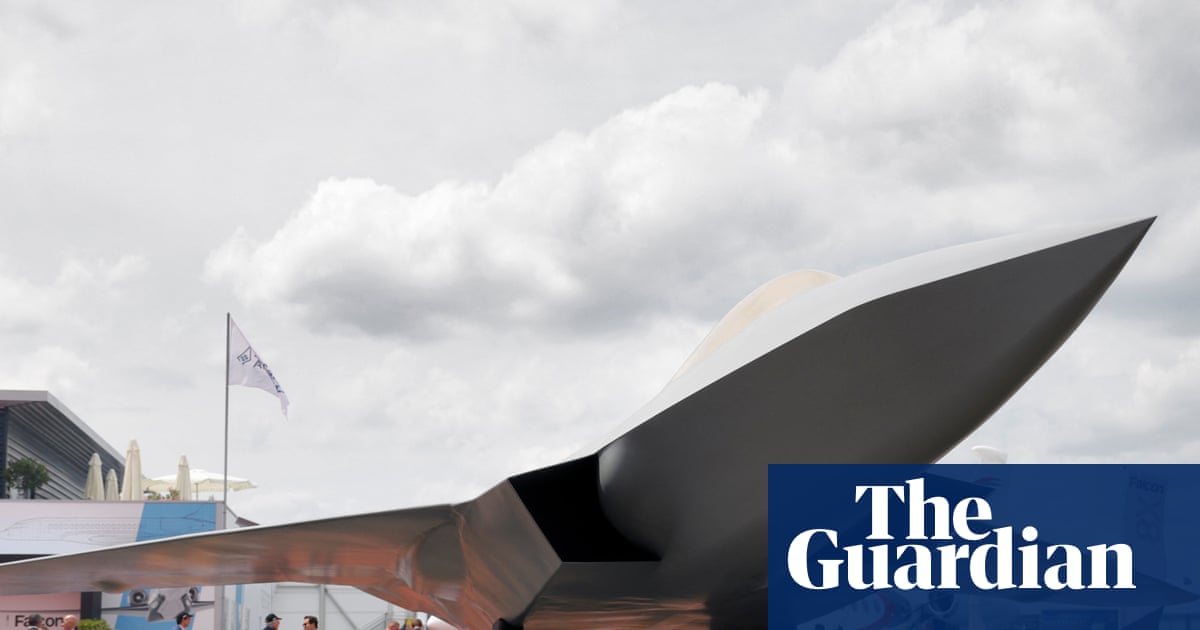
Airbus has suggested splitting Europe’s faltering future fighter jet programme into two separate warplanes, amid a dispute between manufacturers over who leads the €100bn (£87bn) project.The company’s defence arm – which represents Germany and Spain – and the French partner, Dassault Aviation, are locked in a battle over the jet part of the Future Combat Air System (FCAS), a wide-ranging project that will also include autonomous drones and a futuristic “combat communications cloud”.Guillaume Faury, Airbus’s chief executive, said on Thursday that the deadlock over the planned next-generation jet “should not jeopardise the entire future of this hi-tech European capability, which will bolster our collective defence.“If mandated by our customers, we would support a two-fighter solution and are committed to playing a leading role in such a reorganised FCAS delivered through European cooperation.”Earlier this week, the German chancellor, Friedrich Merz, signalled that the planned warplane did not suit Germany’s needs, in the latest blow to the project. The German military does not need a nuclear-capable fighter, while France does, he said on the German political podcast Machtwechsel, insisting it was “not a political dispute” but a technical one between the two countries.Europe’s FCAS, announced in 2017, has faced repeated hurdles amid Airbus and Dassault’s power struggle and, more recently, over what the French and German governments want from the project. Germany, France and Spain are expected to decide soon whether to move to the next stage of the programme as planned, or drop the jet and move forward with the other elements.“We’ve spent a lot of time and energy to support this programme that has a number of pillars. The so-called next-generation fighter is one of those pillars, and it’s important to say that the other pillars are working well and making good progress,” Faury said.He added that while the project was at a “difficult juncture … We continue to believe that the programme as a whole makes sense.“We believe if there is a way forward with two fighters, it could be an opportunity to have other partners with us, but it belongs to our customers to decide with whom they want to join forces.”Airbus said its annual profit jumped 23% to €5.2bn last year, but shares fell 6% on Thursday after supply chain problems forced it to cut ambitious production targets for its passenger jets.The US engine maker Pratt & Whitney had failed to keep up with demand for its bestselling A320 model, Airbus said, adding that it was facing “significant shortages” of engines as a result.The world’s largest planemaker was hoping to ramp up the production of the A320 to 75 planes a month next year, up from 60 currently, but it may now fall short, it said. Airbus plans to deliver about 870 jets to customers this year, up from 793 in 2025.The supply issue compounds Airbus’s issues with the A320 after it found a problem with the fuselage panels that forced it to inspect hundreds of jets in December.Airbus’s deliveries in January sank to their lowest point in any month since 2020, which Faury said was down to the inspections. The drop has helped its rival Boeing, which after years of crises delivered 600 commercial jets, its highest number since 2018.
SRCThe Guardian - World News
LANGEN
LEANCenter-Left
WORDS534
ENT8
THU · 2026-02-19 · 12:37 GMTBRIEF NSR-2026-0219-17565
NSR-2026-0219-17565News Report·EN·Political Strategy
Airbus suggests split solution for Europe’s faltering fighter jet programme
Airbus has proposed splitting Europe's Future Combat Air System (FCAS) fighter jet program into two separate warplane projects due to ongoing disputes between Airbus (representing Germany and Spain) and Dassault Aviation (France) over leadership and differing national needs. The FCAS project, announced in 2017, aims to develop a next-generation fighter jet, autonomous drones, and a combat communications cloud.
Alex DanielThe Guardian - World NewsFiled 2026-02-19 · 12:37 GMTLean · Center-LeftRead · 3 min
The Guardian - World NewsFIG 01
Reading time
3min
Word count
534words
Sources cited
3cited
Entities identified
8entities
Quality score
100%
§ 01
Briefing Summary
AI-generatedNEWSAR · AI
Airbus has proposed splitting Europe's Future Combat Air System (FCAS) fighter jet program into two separate warplane projects due to ongoing disputes between Airbus (representing Germany and Spain) and Dassault Aviation (France) over leadership and differing national needs. The FCAS project, announced in 2017, aims to develop a next-generation fighter jet, autonomous drones, and a combat communications cloud. Airbus CEO Guillaume Faury suggested the split to prevent jeopardizing the entire FCAS program, as Germany requires a non-nuclear capable fighter, unlike France. The future of the jet portion of the project is uncertain, while other elements of FCAS are progressing. Germany, France, and Spain are expected to decide soon whether to proceed as planned or modify the program.
Confidence 0.90Sources 3Claims 5Entities 8
§ 02
Article analysis
Model · rule-basedFraming
Political Strategy
National Security
Tone
Measured
AI-assessed
CalmNeutralAlarmist
Factuality
0.80 / 1.00
Factual
LowHigh
Sources cited
3
Well sourced
FewMany
§ 03
Key claims
5 extracted01
Airbus said its annual profit jumped 23% to €5.2bn last year.
statisticAirbus
Confidence
1.00
02
The German military does not need a nuclear-capable fighter, while France does.
factualFriedrich Merz
Confidence
1.00
03
The company’s defence arm and the French partner, Dassault Aviation, are locked in a battle over the jet part of the Future Combat Air System (FCAS).
factualArticle
Confidence
1.00
04
Airbus suggests splitting Europe’s faltering future fighter jet programme into two separate warplanes.
factualArticle
Confidence
1.00
05
Airbus plans to deliver about 870 jets to customers this year, up from 793 in 2025.
predictionAirbus
Confidence
0.90
§ 04
Full report
3 min read · 534 words§ 05
Entities
8 identifiedKey playerOppositionContextPositiveNeutralNegative
§ 06
Keywords & salience
9 termsfighter jet programme
1.00
fcas
0.90
airbus
0.80
dassault aviation
0.70
next-generation fighter
0.60
european cooperation
0.60
warplane
0.50
defence
0.50
autonomous drones
0.40
§ 07
Topic connections
Interactive graph Network visualization showing 24 related topics
View Full Graph Person Organization Location Event|Click node to navigate|Edge numbers = shared articles