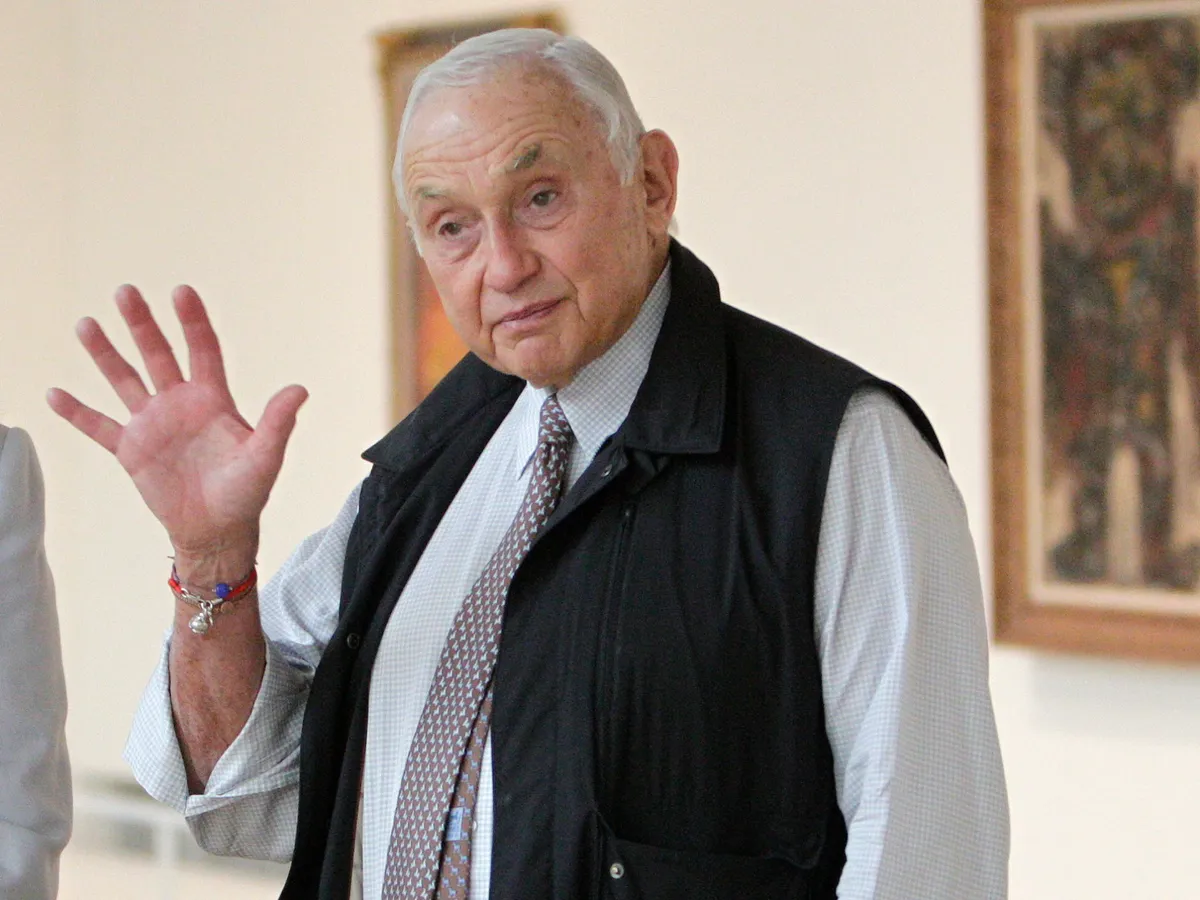
EXPLAINERFormer Israeli Prime Minister Ehud Barak received Wexner Foundation funds. Years later, he partnered with convicted US sex offender Epstein.Les Wexner tours the exhibit at the Wexner Center for the Arts in Columbus, Ohio, the United States [File: Jay LaPrete/AP]Published On 19 Feb 2026In a closed-door session at his Ohio home on Wednesday, billionaire Leslie Wexner faced mounting questions from United States lawmakers about Jeffrey Epstein’s rise to wealth and influence – and the role he may have played in that ascent.Five members of the House Oversight Committee had travelled to depose the 88-year-old after Democrats subpoenaed him in the wake of the latest US Department of Justice release tied to Epstein.Recommended Stories list of 4 itemslist 1 of 4What happened to ISIL?list 2 of 4Slot offers Vinicius support, saying football ‘must do more’ against racismlist 3 of 4Israeli raids in occupied West Bank at start of Ramadanlist 4 of 4Real Madrid send ‘all available’ Vinicius evidence to UEFA in racism rowend of listThe latest tranche of documents, published by the Justice Department on January 30, 2026, is part of a vast wealth of materials amassed during federal investigations into Epstein, who pleaded guilty in 2008 to procuring a minor for prostitution and was later charged in 2019 with sex trafficking of minors before his death by suicide in federal custody. Wexner’s name appears, both redacted and unredacted, on communications and financial documents within these files.“I was naive, foolish, and gullible to put any trust in Jeffrey Epstein,” Wexner said in a statement. “He was a con man. And while I was conned, I have done nothing wrong and have nothing to hide.”For decades, Epstein cultivated relationships with business leaders, politicians and academics.Central among them was Wexner, the founder of L Brands, the retail empire behind Victoria’s Secret, Bath & Body Works and The Limited, whose fortune helped build the foundations for Epstein’s access to global elites, including former Israeli Prime Minister Ehud Barak.The newly released files shed fresh light on how deeply Epstein embedded himself within Wexner’s financial and philanthropic world, a relationship that proved pivotal in transforming him from an obscure money manager into a figure of extraordinary wealth and influence.US Representative David Min, left, speaks during a press conference after the congressional deposition of Les Wexner in the Jeffrey Epstein case, Wednesday, February 18, 2026, in New Albany, Ohio [Joshua A Bickel/AP]Epstein and Wexner’s townhouseEpstein was introduced to Wexner in the mid-1980s. At the time, Epstein was a college dropout who had briefly taught at Manhattan’s elite Dalton School after reportedly exaggerating his academic credentials. He had passed through Bear Stearns under executive Alan “Ace” Greenberg before leaving to set up his own advisory firm.By 1986, he had met Wexner. Five years later, the retail billionaire had granted him full power of attorney, an extraordinary delegation allowing Epstein to sign cheques, hire staff, borrow money, and buy or sell property on Wexner’s behalf.Al Jazeera has reviewed newly released Justice Department records, including a 1998 purchase and sale agreement and related promissory note and guaranty, which detail the mechanics of asset transfers between the two men.The documents show how control of Wexner’s Manhattan townhouse at 9 East 71st Street was formalised through a structured transaction involving a $10m promissory note and a personal guaranty signed by Epstein. The property became Epstein’s New York base and a symbol of his growing stature.By the early 1990s, Epstein was embedded in Wexner’s philanthropic and corporate world, serving as a trustee of the Wexner Foundation and as the president of Wexner-affiliated property companies. In 1996, he relocated his firm to the US Virgin Islands, positioning himself as an offshore financier.The authority Wexner granted him over assets, philanthropy and property did more than elevate his status socially. It conferred institutional legitimacy. With control over substantial wealth and formal roles inside a major foundation, Epstein could present himself as a financier with access to capital and global networks.The Wexner Foundation and the Israel connectionOne of the clearest through-lines from that period runs to former Israeli Prime Minister Ehud Barak, who was introduced to Epstein by former Israeli President Shimon Peres at a large event in Washington in 2003.Between 2004 and 2006, the Wexner Foundation paid Barak approximately $2.3m for two commissioned research studies, one on leadership and another on the Israeli-Palestinian conflict. The foundation later said only one paper was completed, but determined that the work justified the payment.Barak, who served as Israel’s prime minister from 1999 to 2001 and later as defence minister from 2007 to 2013, maintained contact with Epstein for several years.A court filing included in the newly released Epstein records contains an allegation that prominent victim Virginia Giuffre claimed that Wexner and Barak were two of the men Epstein trafficked her to.The filing does not provide supporting evidence for the claim. Neither man has been charged with wrongdoing in connection with Epstein.In February this year, Barak told Israel’s Channel 12 he had been unaware of the full scope of Epstein’s crimes and regretted ever meeting the financier.Wexner has said he severed ties with Epstein around 2007 after he discovered the financier had “misappropriated vast sums of money from me and my family”.But the financial and institutional credibility Epstein accumulated during his years managing Wexner’s wealth did not evaporate when that relationship ended.Epstein ‘editing’ Barak’s op-edEven after his relationship allegedly ended with Wexner, Epstein now had the social prestige, and money, to develop ties with powerful decision-makers, emails newly released by the Justice Department and reviewed by Al Jazeera show.In October 2014, Nili Priel Barak – Barak’s wife – wrote to Epstein about travel plans to New York, suggesting dates when Ehud Barak would be in town and asking whether he would be available to meet.Days later, she forwarded him a draft opinion piece, writing: “Herewith the Op Ed. Please let me know your opinion and your remarks. Thanks.”Epstein replied with what he labelled “beginning edits”, returning a version of the unpublished article. The draft speaks in Barak’s political voice, including the line: “As the Minister of Defence of Israel I’ve met more than once with [US] President [Barack] Obama…” and lays out arguments about the “two states solution” versus a “one state solution”.A year later, in 2015, Epstein invested in Reporty Homeland Security, later rebranded as Carbyne, a startup chaired by Ehud Barak that developed advanced emergency communications technology – further tying their political relationship to a shared commercial venture.The company’s leadership included CEO Amir Elichai, a former special forces officer, and director Pinhas Buchris, a former Israeli Defence Ministry director-general and former commander of Unit 8200, the Israeli military’s cyber intelligence unit.Between 2012 and 2014, documents reportedly indicate Epstein also assisted Barak in exploring security-related business with African world leaders. The documents illustrate how Epstein managed to convert financial credibility into political access, and then reinforced those relationships through shared commercial ventures.Barak has said: “I am responsible for all my actions and decisions. There is room to question whether I should have investigated more thoroughly. I regret not doing so.”Wexner has never been charged with any crime and has said he was unaware of Epstein’s criminal conduct. But his name appears repeatedly throughout the newly released files, a reminder of how central their relationship once was.
SRCAl Jazeera
LANGEN
LEANCenter
WORDS1 207
ENT9
THU · 2026-02-19 · 17:57 GMTBRIEF NSR-2026-0219-17626
NSR-2026-0219-17626News Report·EN·Legal & Judicial
Les Wexner: How the billionaire enabled Jeffrey Epstein’s rise
In February 2026, billionaire Les Wexner was questioned by US lawmakers regarding his relationship with Jeffrey Epstein and his potential role in Epstein's rise to power. The House Oversight Committee's deposition followed the release of Justice Department documents related to Epstein, in which Wexner's name appears.
Caolán MageeAl JazeeraFiled 2026-02-19 · 17:57 GMTLean · CenterRead · 5 min
Al JazeeraFIG 01
Reading time
5min
Word count
1 207words
Sources cited
3cited
Entities identified
9entities
Quality score
100%
§ 01
Briefing Summary
AI-generatedNEWSAR · AI
In February 2026, billionaire Les Wexner was questioned by US lawmakers regarding his relationship with Jeffrey Epstein and his potential role in Epstein's rise to power. The House Oversight Committee's deposition followed the release of Justice Department documents related to Epstein, in which Wexner's name appears. Wexner claims he was "conned" by Epstein, who cultivated relationships with influential figures, including Wexner and former Israeli Prime Minister Ehud Barak. Wexner's wealth and connections were instrumental in transforming Epstein from a money manager into a figure of global influence. The released documents reveal the extent to which Epstein integrated himself into Wexner's financial and philanthropic activities.
Confidence 0.90Sources 3Claims 5Entities 9
§ 02
Article analysis
Model · rule-basedFraming
Legal & Judicial
Political Strategy
Tone
Measured
AI-assessed
CalmNeutralAlarmist
Factuality
0.80 / 1.00
Factual
LowHigh
Sources cited
3
Well sourced
FewMany
§ 03
Key claims
5 extracted01
Wexner's name appears in redacted and unredacted form in documents related to Epstein.
factualArticle
Confidence
1.00
02
Epstein was later charged in 2019 with sex trafficking of minors.
factualArticle
Confidence
1.00
03
Epstein pleaded guilty in 2008 to procuring a minor for prostitution.
factualArticle
Confidence
1.00
04
Wexner said he was 'naive, foolish, and gullible' to trust Jeffrey Epstein.
quoteLes Wexner
Confidence
1.00
05
Les Wexner faced questions from US lawmakers about Jeffrey Epstein’s rise.
factualArticle
Confidence
1.00
§ 04
Full report
5 min read · 1 207 words§ 05
Entities
9 identifiedKey playerOppositionContextPositiveNeutralNegative
People3
Organizations3
§ 06
Keywords & salience
8 termsjeffrey epstein
1.00
les wexner
1.00
sex trafficking
0.70
financial ties
0.60
wealth and influence
0.60
house oversight committee
0.50
ehud barak
0.40
l brands
0.40
§ 07
Topic connections
Interactive graph Network visualization showing 51 related topics
View Full Graph Person Organization Location Event|Click node to navigate|Edge numbers = shared articles