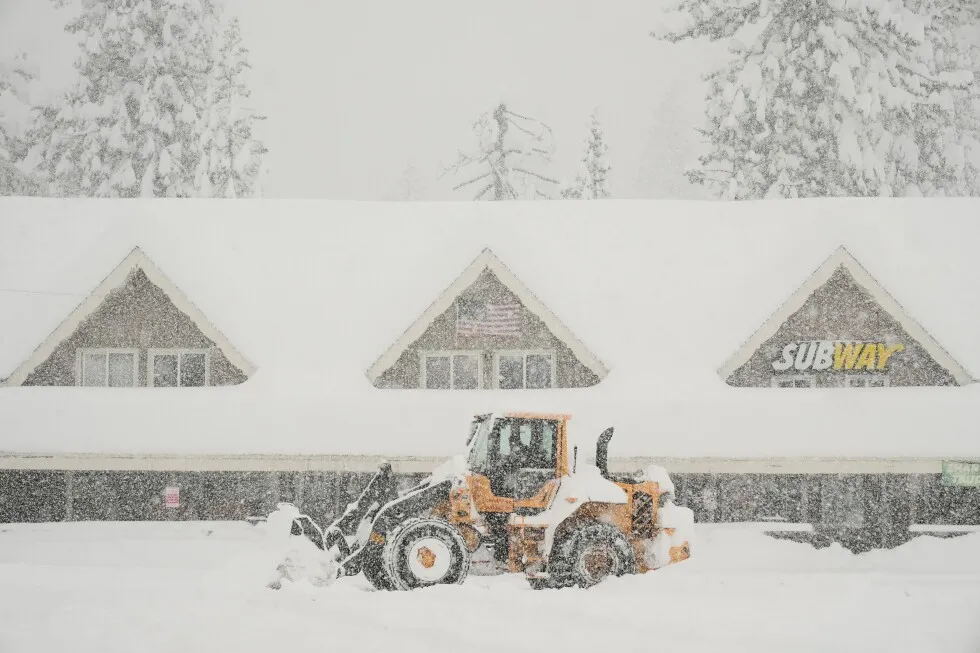
Deadly California Avalanche highlights inherent risks in the backcountry 1 of 5 | California-highway-patrol" class="entity-link entity-organization" data-entity-id="33507" data-entity-type="organization">California Highway Patrol assisted motorists stranded in the snow along Interstate 80 during a storm on Thursday near Camp Spaulding in Placer County, California. (AP Video: Godofredo Vasquez) 2 of 5 | Snow is plowed in front of businesses during a snow storm Thursday, Feb. 19, 2026, in Soda Springs, Calif. (AP Photo/Godofredo A. Vásquez) 3 of 5 | Snow comes down on a dog as traffic is backed up and motorists exit their vehicles along Interstate 80 during a storm Thursday, Feb. 19, 2026, near Soda Springs, Calif. (AP Photo/Godofredo A. Vásquez) 4 of 5 | Adrián Narayan digs his car out of the snow Thursday, Feb. 19, 2026, in Soda Springs, Calif. (AP Photo/Godofredo A. Vásquez) 5 of 5 | A California-highway-patrol" class="entity-link entity-organization" data-entity-id="33507" data-entity-type="organization">California Highway Patrol vehicle is parked along a road during a snow storm Wednesday, Feb. 18, 2026, in Placer County, Calif. (AP Photo/Godofredo A. Vásquez) 1 of 5 California-highway-patrol" class="entity-link entity-organization" data-entity-id="33507" data-entity-type="organization">California Highway Patrol assisted motorists stranded in the snow along Interstate 80 during a storm on Thursday near Camp Spaulding in Placer County, California. (AP Video: Godofredo Vasquez) Add AP News on Google Add AP News as your preferred source to see more of our stories on Google. 2 of 5 Snow is plowed in front of businesses during a snow storm Thursday, Feb. 19, 2026, in Soda Springs, Calif. (AP Photo/Godofredo A. Vásquez) Add AP News on Google Add AP News as your preferred source to see more of our stories on Google. 3 of 5 Snow comes down on a dog as traffic is backed up and motorists exit their vehicles along Interstate 80 during a storm Thursday, Feb. 19, 2026, near Soda Springs, Calif. (AP Photo/Godofredo A. Vásquez) Add AP News on Google Add AP News as your preferred source to see more of our stories on Google. 4 of 5 Adrián Narayan digs his car out of the snow Thursday, Feb. 19, 2026, in Soda Springs, Calif. (AP Photo/Godofredo A. Vásquez) Add AP News on Google Add AP News as your preferred source to see more of our stories on Google. 5 of 5 A California-highway-patrol" class="entity-link entity-organization" data-entity-id="33507" data-entity-type="organization">California Highway Patrol vehicle is parked along a road during a snow storm Wednesday, Feb. 18, 2026, in Placer County, Calif. (AP Photo/Godofredo A. Vásquez) Add AP News on Google Add AP News as your preferred source to see more of our stories on Google. Updated [hour]:[minute] [AMPM] [timezone], [monthFull] [day], [year] The recovery of skiers killed in the deadliest U.S. Avalanche in almost 45 years is dragging out because of what experts say is a prime rule for rescuers: Don’t make yourself a victim.A storm that continued lashing California’s remote Sierra Nevada wilderness Thursday meant more avalanches were possible in the backcountry area where authorities said eight people died and one was still missing two days after their group was caught in the deadly slide. Six people survived.Rescuers faced the same potential perils that killed the backcountry skiers and professional guides, as they pursued a sport with inherent risks that were compounded by several feet of new snow. Recovery efforts were set to resume Friday. Last day of the tripBackcountry winter travelers from skiers and snowboarders to snowmobilers and mountaineers lean on Avalanche forecasts to help them gauge the danger. Yet conditions quickly shift because of turbulent mountain weather.To supplement forecasts or if none is available, experienced skiers and guides will dig a pit in the snow to test how stable it is. They can also search out less-hazardous terrain, such as slopes that are not as steep or that are sheltered from known Avalanche routes. As the snow from the storm system hitting the Sierras this week piled up, the group of 15 skiers caught in Tuesday’s Avalanche were on the last day of a multiday trip and heading for the trailhead. “It was, quite likely, very necessary for them to leave the backcountry so their hazard wasn’t increased further,” said Anthony Pavlantos of Utah-based Prival USA, who makes Avalanche safety equipment and runs mountain safety programs.“What’s really hard to say is like ‘why were they moving?’ You can’t ever start placing blame on events like this because we can all be there.” ‘Luck runs out’It’s not uncommon for people to venture into the backcountry to ski or snowboard during times of heightened danger: A dangerous storm also means lots of fresh snow that many skiers crave.And because fatal accidents are rare, the risk takers most often survive, said Dale Atkins, who has been involved in mountain rescues and Avalanche forecasting and research in Colorado for five decades.“It’s not about not going; it’s about where and when you go,” Atkins said. But Atkins added that coming out of the backcountry unscathed can create a false sense of security in a pursuit where luck – or not enough of it – also plays a role. “It’s really easy to be fooled by the snow and avalanches,” he said. “We keep going out even in the worst of storms because that’s what we did last time, and then our luck runs out.”Typically the best hope for someone to survive burial in an Avalanche is to dig themselves out or be rescued by a companion. That is because slides often occur in remote areas. It took rescuers six hours to reach the victims of Tuesday’s Avalanche after the first report came in. By comparison, the chances of survival for someone buried for an hour is only about one in 10, Atkins said.The surviving skiers in California found three of the victims while they awaited rescue. Authorities haven’t given a detailed account about how they located the other victims. The probe lineA debris field from a major Avalanche like the fatal one in California will stretch over a huge area, making it difficult to figure out where someone ends up if they are caught and dragged beneath the surface.The first thing to look for is clues such as a glove or ski pole that could reveal a victim’s location, said Anthony Stevens, chief adviser for the search and rescue team in Teton County, Wyoming, home to Grand Teton National Park.Skiers in guided groups typically carry transceivers, known as Avalanche beacons, that send out signals showing where they are. The devices can also receive other signals, displaying the direction and approximate distance to a victim.If that doesn’t work, rescuers can line up and use long, slender poles to probe into the snow in hopes of finding someone, said Ethan Greene, director of the Colorado Avalanche Information Center. Time is of the essence throughout a rescue, and once someone is found they have to be dug out. The average depth of burial is roughly a meter, or just over 3 feet, Atkins said. And because snow and ice in an Avalanche get heavily compacted, digging out someone from that depth requires moving at least a ton of material, he said.Rarely will people survive being buried for long. Atkins said he knew of two people who survived being buried 22 and 24 hours respectively following an Avalanche in the 1990s in Washington state. A third member of their party did not survive.“It’s very unusual for a rescue team to find a buried person alive. But it happens, and that gives us hope,” he said.____Associated Press writer Corey Williams in Detroit contributed to this report. Brown is based in Billings, Montana. He covers breaking news, the environment, politics, energy, crime and more.
SRCAssociated Press (AP)
LANGEN
LEANCenter
WORDS1 249
ENT9
FRI · 2026-02-20 · 07:23 GMTBRIEF NSR-2026-0220-17792
NSR-2026-0220-17792News Report·EN·Human Interest
Deadly California avalanche highlights inherent risks in the backcountry
A deadly avalanche in California, the deadliest in the U.S. in almost 45 years, highlights the inherent risks of backcountry activities.
By
MATTHEW BROWNAssociated Press (AP)Filed 2026-02-20 · 07:23 GMTLean · CenterRead · 5 min
Associated Press (AP)FIG 01
Reading time
5min
Word count
1 249words
Sources cited
1cited
Entities identified
9entities
Quality score
100%
§ 01
Briefing Summary
AI-generatedNEWSAR · AI
A deadly avalanche in California, the deadliest in the U.S. in almost 45 years, highlights the inherent risks of backcountry activities. The article focuses on the recovery efforts of the skiers killed in the avalanche. Heavy snowstorms in Placer County, California, have caused significant travel disruptions, stranding motorists on Interstate 80 near Camp Spaulding and Soda Springs on February 18th and 19th, 2026. The California Highway Patrol assisted stranded motorists during the storm. Experts emphasize the importance of safety protocols for rescuers during the recovery process. The recovery is dragging out because of the prime rule for rescuers.
Confidence 0.90Sources 1Claims 5Entities 9
§ 02
Article analysis
Model · rule-basedFraming
Human Interest
Environmental
Tone
Mixed Tone
AI-assessed
CalmNeutralAlarmist
Factuality
0.70 / 1.00
Factual
LowHigh
Sources cited
1
Limited
FewMany
§ 03
Key claims
5 extracted01
Six people survived.
factual
Confidence
1.00
02
Authorities said eight people died and one was still missing two days after their group was caught in the deadly slide.
factualauthorities
Confidence
1.00
03
A storm continued lashing California’s remote Sierra Nevada wilderness Thursday.
factual
Confidence
1.00
04
The recovery of skiers killed in the deadliest U.S. avalanche in almost 45 years is dragging out.
factual
Confidence
0.90
05
Rescuers faced the same potential perils that killed the backcountry skiers and professional guides.
factual
Confidence
0.80
§ 04
Full report
5 min read · 1 249 words§ 05
Entities
9 identifiedKey playerOppositionContextPositiveNeutralNegative
People1
Organizations1
Locations6
Events1
§ 06
Keywords & salience
7 termsavalanche
1.00
backcountry
0.80
risks
0.70
snow storm
0.60
california
0.50
interstate 80
0.50
rescue
0.40
§ 07
Topic connections
Interactive graph Network visualization showing 51 related topics
View Full Graph Person Organization Location Event|Click node to navigate|Edge numbers = shared articles