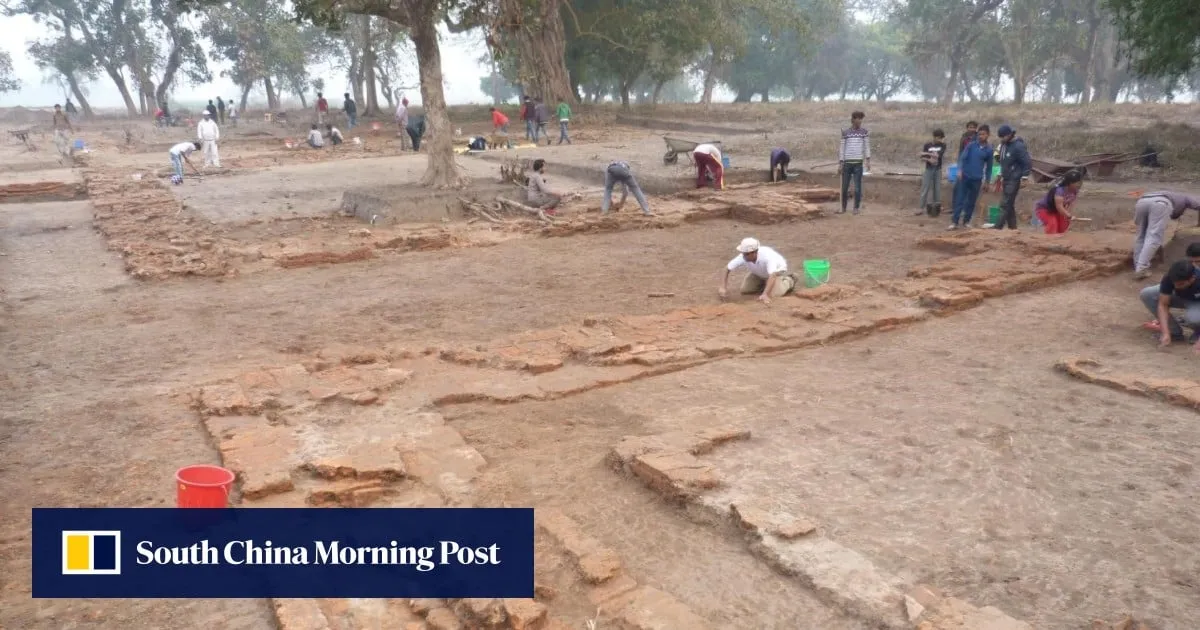
Nepal’s Lumbini has long anchored the Buddhist pilgrimage map as the Buddha’s birthplace. Nearby, however, stand the fortified ruins of Tilaurakot – believed to be the ancient capital where Siddhartha Gautam spent his princely years – a site of profound historical weight that draws only a fraction of the visitors.A newly unearthed temple could change that, archaeologists say, offering fresh evidence that Tilaurakot once held far greater religious significance to Buddhists than its quiet present suggests.The apsidal temple – distinguished by its semicircular rear wall – was uncovered within the ancient citadel and is believed to date from between the third and fifth centuries AD. Researchers say it is the first structure of its kind identified in Nepal.They argue the discovery, announced last week, adds to evidence that Tilaurakot was not only a political centre of the Sakya kingdom but also an active site of Buddhist worship and pilgrimage.Remains of the rare apsidal temple discovered in Nepal’s Tilaurakot where Siddhartha Gautam spent his princely years before becoming the Buddha. Photo: Department of Archaeology, NepalRobin Coningham, a professor at England’s Durham University and co-director of the excavations, told This Week in Asia that the temple was discovered inside a monastery courtyard built over the remains of a palatial complex.
SRCSouth China Morning Post
LANGEN
LEANCenter-Right
WORDS208
ENT7
SAT · 2026-02-21 · 07:00 GMTBRIEF NSR-2026-0221-18069
NSR-2026-0221-18069News Report·EN·Human Interest
Unearthed temple in Nepal sheds new light on Buddha’s early life
Archaeologists in Tilaurakot, Nepal, believed to be the ancient capital where Siddhartha Gautam (the Buddha) spent his early years, have unearthed a temple dating from the third to fifth centuries AD. The apsidal temple, the first of its kind found in Nepal, was discovered within the ancient citadel.
Bibek BhandariSouth China Morning PostFiled 2026-02-21 · 07:00 GMTLean · Center-RightRead · 1 min
South China Morning PostFIG 01
Reading time
1min
Word count
208words
Sources cited
1cited
Entities identified
7entities
Quality score
100%
§ 01
Briefing Summary
AI-generatedNEWSAR · AI
Archaeologists in Tilaurakot, Nepal, believed to be the ancient capital where Siddhartha Gautam (the Buddha) spent his early years, have unearthed a temple dating from the third to fifth centuries AD. The apsidal temple, the first of its kind found in Nepal, was discovered within the ancient citadel. Researchers believe the discovery suggests that Tilaurakot was not only a political center of the Sakya kingdom but also an important site for Buddhist worship and pilgrimage. The temple was found inside a monastery courtyard built over the remains of a palatial complex. This finding offers new evidence of Tilaurakot's religious significance to Buddhists, potentially increasing its importance as a pilgrimage destination.
Confidence 0.90Sources 1Claims 5Entities 7
§ 02
Article analysis
Model · rule-basedFraming
Human Interest
Political Strategy
Tone
Measured
AI-assessed
CalmNeutralAlarmist
Factuality
0.80 / 1.00
Factual
LowHigh
Sources cited
1
Limited
FewMany
§ 03
Key claims
5 extracted01
The temple was discovered inside a monastery courtyard built over the remains of a palatial complex.
factualRobin Coningham
Confidence
0.90
02
It is the first structure of its kind identified in Nepal.
factualResearchers
Confidence
0.90
03
The apsidal temple dates from between the third and fifth centuries AD.
factualResearchers
Confidence
0.80
04
Tilaurakot was not only a political centre of the Sakya kingdom but also an active site of Buddhist worship.
factualResearchers
Confidence
0.70
05
A newly unearthed temple could change that, archaeologists say.
predictionarchaeologists
Confidence
0.70
§ 04
Full report
1 min read · 208 words§ 05
Entities
7 identifiedKey playerOppositionContextPositiveNeutralNegative
Organizations2
§ 06
Keywords & salience
9 termstilaurakot
0.90
buddhism
0.90
buddha's early life
0.80
apsidal temple
0.80
archaeological discovery
0.70
siddhartha gautam
0.70
buddhist pilgrimage
0.60
lumbini
0.60
sakya kingdom
0.50
§ 07
Topic connections
Interactive graph Network visualization showing 37 related topics
View Full Graph Person Organization Location Event|Click node to navigate|Edge numbers = shared articles