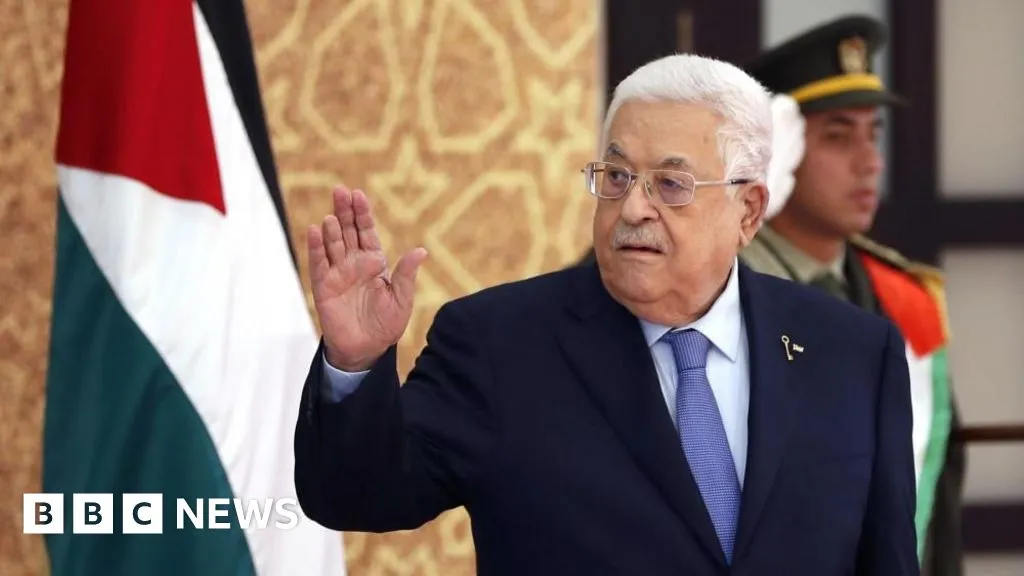
5 hours agoYolande KnellMiddle East correspondent, RamallahEPAThe Palestinian Authority has delivered little improvement to the lives of PalestiniansWith Israeli settler violence surging in the occupied West Bank, al-Mughayyir, north-east of Ramallah, has found itself on the frontline. It faces regular incursions by the Israeli army and has seen farmland seized by settlers who have built new outposts.Marzoq Abu Naim from the village council says the settlers aim to force out Palestinians. "They're doing it silently, not openly, it's true. But this is annexation. We can't reach our lands."Sitting among green rolling hills, studded with olive groves, most homes in al-Mughayir are in an area where Israel's military controls security, but the internationally backed Palestinian Authority (PA) should provide basic services. Increasingly though, it cannot – it is mired in a deep economic crisis."When I go to them, they can't give me the support I need," Abu Naim says. "The Authority has no money!"After the deadly 7 October Hamas-led attacks on Israel, some 100,000 Palestinians lost permits to work in Israel. On top of that, Israel is withholding tax transfers that it collects for the PA because of an ongoing dispute about Palestinian school texts and stipends to the families of those jailed or killed by Israel, including attackers.The PA says it is now owed more than $4bn (£3bn; 3.4bn euros). It has been paying most public sector workers – including doctors, police officers and teachers – just 60% of their salaries. Its schools – where more than 600,000 children study – open just three days a week."It's truly hard," a mother-of-eight in al-Mughayyir tells me, explaining that the schools there also close when settlers or soldiers are nearby because of fears for the children. "There is so much disruption that some children have reached fourth grade and still can't read. We put them in private lessons with a teacher in the village. She starts with the alphabet so that they can learn to read from scratch."Marzoq Abu Naim says the PA does not give him the support which he needsDriving away from al-Mughayyir, there are Israeli military gates used to close off Palestinian villages from each other and restrict movement. I also see Israeli bulldozers transforming the landscape, widening roads to connect settlements and give settlers quicker access to Jerusalem. Settlements – illegal under international law – are growing at a record rate.This all adds to pressure on the PA. When it was set up more than 30 years ago, following on from a breakthrough peace deal with Israel, the Oslo Accords, Palestinians hoped it would quickly become a full government for a Palestinian state in the West Bank and Gaza Strip with East Jerusalem as its capital. The PA was committed to negotiations – non-violent means – to achieve its goal.The direct talks with Israel that underpinned a peace process finally broke down over a decade ago. Now, the PA's failure to prevent Israel's expansion into the West Bank, let alone deliver statehood, is underscoring its weakness and deepening its unpopularity with Palestinians already dismayed by corruption scandals, political stagnation and continued security coordination with Israel.I turn to join a line of traffic queuing to pass an Israeli army checkpoint and enter Ramallah – the sprawling administrative capital of the PA. There are Palestinian police on the streets. This is a pocket of the West Bank where the PA retains full control.But increasingly here, there are warnings that the governing body is close to collapse."It is a turning point in our lives," says Sabri Saidam, a former PA minister and deputy chairman of the president's political party."Palestinian statehood, Palestinian identity, Palestinian existence on this very territory of their ancestors is being now compromised by Israel, and the existence of the Palestinian Authority at large is also questionable."al-Mughayyir has had land taken over by Jewish settlersThis month, new steps by Israel's government are tightening its hold on the West Bank. A top UN official has warned that these amount to "gradual, de facto annexation."A contentious new land registration process could allow Israel to claim large swathes of the territory as Israeli state land, open to future Israeli development. Israeli enforcement of environmental and archaeological regulations is being expanded into parts of the West Bank under PA civil control.Israel's far-right finance minister, Bezalel Smotrich, who has responsibility for settlement policies, has said his aim is "to kill" the idea of a Palestinian state. A settler himself, he claims ideological and biblical rights to the land.At a conference in a settlement near Ramallah on Tuesday, Smotrich pledged to go further if he remains in the Israeli government after elections due this year, saying he would "officially and practically cancel the damn Oslo agreements," and so dismantle the PA. Referring to Palestinians as "the enemy" he promised to promote their emigration.More than 80 UN member states, along with the EU and the Arab League, have strongly condemned "unilateral Israeli decisions and measures" and called for them to be reversed. However, the US has only reiterated that it opposes West Bank annexation.Many Palestinians are frustrated and worried. International studies professor, Ghassan Khatib, calls for global pressure on Israel and financial aid to ensure the survival of the PA."This should be a wake-up call," he tells me. "The outside world invested a lot politically and financially in the idea of a two-state solution, but these new Israeli measures are aimed at killing the future of a two-state solution."Ramallah is the PA's administrative capital but the authority has been seen as weak for yearsThe devastating war in Gaza has precipitated the decline of the PA. Already it had lost control of the territory back in 2007, a year after Hamas won the last parliamentary election. But it was slow to condemn the deadly Hamas attacks on Israel which triggered the conflict and is now being largely excluded from immediate post-war governance, in line with Israeli demands.Unlike Israel, the PA does not sit on the US-led Board of Peace. However, it is expected to oversee some 5,000 police officers in Gaza. President Trump's peace plan also foresees the PA eventually taking control of the territory after completing an unspecified "reform programme," and nods to a future when "the conditions may finally be in place for a credible pathway to Palestinian self-determination and statehood."Israeli leaders have dismissed suggestions that the PA could soon collapse, forcing Israel to take direct responsibility for some 2.7 million Palestinians living in the West Bank as the occupying power.An Israeli government official tells the BBC: "The Palestinian Authority is a corrupt and morally bankrupt entity which has seen considerable resources siphoned off instead of rightfully going to its own people."Back in al-Mughayyir, settlers have already pushed Bedouin shepherds off their land nearby. They are grazing their flocks near new encampments they have set up on the edge of the village.Across the valley, we watch Israeli soldiers park their military jeep and head out on patrol. Soon, they fire tear gas. It has been one month since a 14-year-old Palestinian boy was shot dead by an Israeli soldier here. The army says he threw a rock. On this occasion, the military says stones were thrown at its troops and that they detained the suspects.While little world attention is being paid to daily realities in the West Bank, locals say the risk of widespread unrest is rising. The danger is that the PA's growing impotence will encourage Palestinians to look to those who offer a less moderate approach.
SRCBBC News - World
LANGEN
LEANCenter
WORDS1 243
ENT8
SAT · 2026-02-21 · 06:33 GMTBRIEF NSR-2026-0221-18096
NSR-2026-0221-18096News Report·EN·Political Strategy
Palestinian Authority in dire straits as Israel's hold on West Bank deepens
The Palestinian Authority (PA) is facing a severe economic crisis in the West Bank, impacting its ability to provide basic services. This is happening as Israeli settler violence increases and Israel deepens its hold on the territory, restricting Palestinian movement and expanding settlements.
BBC News - WorldFiled 2026-02-21 · 06:33 GMTLean · CenterRead · 5 min
BBC News - WorldFIG 01
Reading time
5min
Word count
1 243words
Sources cited
1cited
Entities identified
8entities
Quality score
100%
§ 01
Briefing Summary
AI-generatedNEWSAR · AI
The Palestinian Authority (PA) is facing a severe economic crisis in the West Bank, impacting its ability to provide basic services. This is happening as Israeli settler violence increases and Israel deepens its hold on the territory, restricting Palestinian movement and expanding settlements. Israel is withholding tax transfers owed to the PA due to disputes over school texts and stipends to families of those jailed or killed by Israel. The PA is now owed over $4 billion and can only pay partial salaries to public sector workers, leading to school closures and disruptions in education for over 600,000 children. These factors exacerbate the challenges faced by Palestinians, such as those in al-Mughayyir, who are losing access to their lands.
Confidence 0.90Sources 1Claims 5Entities 8
§ 02
Article analysis
Model · rule-basedFraming
Political Strategy
Economic Impact
Tone
Measured
AI-assessed
CalmNeutralAlarmist
Factuality
0.70 / 1.00
Factual
LowHigh
Sources cited
1
Limited
FewMany
§ 03
Key claims
5 extracted01
The PA says it is now owed more than $4bn.
statisticPalestinian Authority
Confidence
1.00
02
Israel is withholding tax transfers that it collects for the PA.
factualYolande Knell (Middle East correspondent)
Confidence
1.00
03
The PA is mired in a deep economic crisis and cannot provide basic services.
factualYolande Knell (Middle East correspondent)
Confidence
0.90
04
Israeli settler violence is surging in the occupied West Bank.
factualYolande Knell (Middle East correspondent)
Confidence
0.90
05
Settlers aim to force out Palestinians.
quoteMarzoq Abu Naim (village council)
Confidence
0.80
§ 04
Full report
5 min read · 1 243 words§ 05
Entities
8 identifiedKey playerOppositionContextPositiveNeutralNegative
People1
§ 06
Keywords & salience
9 termspalestinian authority
1.00
west bank
0.90
israeli settlements
0.80
economic crisis
0.70
settler violence
0.70
tax transfers
0.60
israeli army
0.50
land seizure
0.40
public sector workers
0.40
§ 07
Topic connections
Interactive graph Network visualization showing 13 related topics
View Full Graph Person Organization Location Event|Click node to navigate|Edge numbers = shared articles