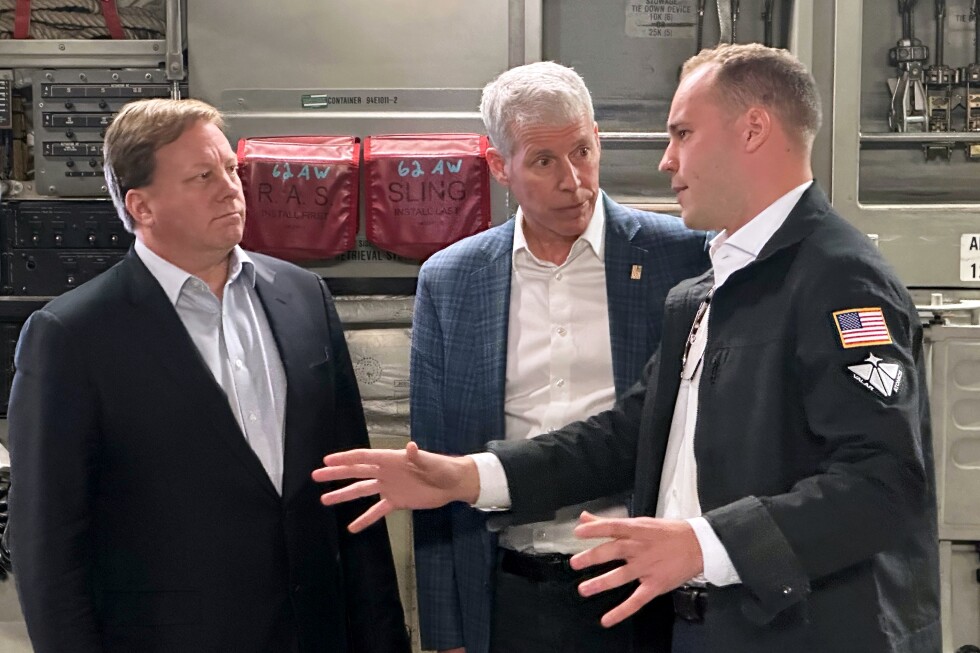
US military airlifts small reactor as Trump pushes to quickly deploy nuclear power 1 of 6 | Energy Secretary Chris Wright, center, and Under Secretary of Defense Michael Duffey, left, listen as Isaiah Taylor, CEO of Valar Atomics, discusses a microreactor developed by Valar to generate nuclear power for the military and commercial customers, Sunday, Feb. 15, 2026, in-flight, on board a C-17. (AP Photo/Matthew Daly) 2 of 6 | Energy Secretary Chris Wright speaks at a news conference at March Air Reserve Base, Calif., Sunday Feb. 15, 2026. (AP Photo/Matthew Daly) 3 of 6 | A Valar Atomics microreactor is seen on a C-17 aircraft, without nuclear fuel, at March Air Reserve Base, Calif., Sunday, Feb. 15, 2026. The reactor was transported from March Air Reserve Base to Hill Air Force Base in Utah. (AP Photo/Matthew Daly) 4 of 6 | Isaiah Taylor, CEO of Valar Atomics, left, speaks as Utah Gov. Spencer Cox, center, and Energy Secretary Chris Wright, listen, at Hill Air Force Base, Utah, Sunday, Feb. 15, 2026. (AP Photo/Matthew Daly) 5 of 6 | Energy Secretary Chris Wright, center, tours a C-17 military aircraft as a microreactor was transported from March Air Reserve Base, Calif., to Hill Air Force Base in Utah, Sunday ,Feb. 15, 2026. (AP Photo/Matthew Daly) 6 of 6 | Energy Secretary Chris Wright, right, speaks as Utah Gov. Spencer Cox listens, following a news conference at Hill Air Force Base, Utah. Wright and other officials were onboard as a Valar Atomics microreactor, without nuclear fuel, was transported from March Air Reserve Base in California to Hill Air Force Base. Cox met the plane in Utah. (AP Photo/Matthew Daly) 1 of 6 Energy Secretary Chris Wright, center, and Under Secretary of Defense Michael Duffey, left, listen as Isaiah Taylor, CEO of Valar Atomics, discusses a microreactor developed by Valar to generate nuclear power for the military and commercial customers, Sunday, Feb. 15, 2026, in-flight, on board a C-17. (AP Photo/Matthew Daly) Add AP News on Google Add AP News as your preferred source to see more of our stories on Google. 2 of 6 Energy Secretary Chris Wright speaks at a news conference at March Air Reserve Base, Calif., Sunday Feb. 15, 2026. (AP Photo/Matthew Daly) Add AP News on Google Add AP News as your preferred source to see more of our stories on Google. 3 of 6 A Valar Atomics microreactor is seen on a C-17 aircraft, without nuclear fuel, at March Air Reserve Base, Calif., Sunday, Feb. 15, 2026. The reactor was transported from March Air Reserve Base to Hill Air Force Base in Utah. (AP Photo/Matthew Daly) Add AP News on Google Add AP News as your preferred source to see more of our stories on Google. 4 of 6 Isaiah Taylor, CEO of Valar Atomics, left, speaks as Utah Gov. Spencer Cox, center, and Energy Secretary Chris Wright, listen, at Hill Air Force Base, Utah, Sunday, Feb. 15, 2026. (AP Photo/Matthew Daly) Add AP News on Google Add AP News as your preferred source to see more of our stories on Google. 5 of 6 Energy Secretary Chris Wright, center, tours a C-17 military aircraft as a microreactor was transported from March Air Reserve Base, Calif., to Hill Air Force Base in Utah, Sunday ,Feb. 15, 2026. (AP Photo/Matthew Daly) Add AP News on Google Add AP News as your preferred source to see more of our stories on Google. 6 of 6 Energy Secretary Chris Wright, right, speaks as Utah Gov. Spencer Cox listens, following a news conference at Hill Air Force Base, Utah. Wright and other officials were onboard as a Valar Atomics microreactor, without nuclear fuel, was transported from March Air Reserve Base in California to Hill Air Force Base. Cox met the plane in Utah. (AP Photo/Matthew Daly) Add AP News on Google Add AP News as your preferred source to see more of our stories on Google. Updated [hour]:[minute] [AMPM] [timezone], [monthFull] [day], [year] HILL AIR FORCE BASE, Utah (AP) — The Pentagon and the Energy Department for the first time airlifted a small nuclear reactor from California to Utah, demonstrating what they say is U.S. potential to quickly deploy nuclear power for military and civilian use. The nearly 700-mile flight last weekend — which transported a 5-megawatt microreactor without nuclear fuel — highlights the Trump administration’s drive to promote nuclear energy to help meet skyrocketing demand for power from artificial intelligence and data centers, as well for use by the military.Energy Secretary Chris Wright and Undersecretary of Defense Michael Duffey, who traveled with the privately built reactor, hailed the Feb. 15 trip on a C-17 military aircraft as a breakthrough for U.S. efforts to fast-track commercial licensing for the microreactors, part of a broader effort by the Trump administration to reshape the country’s energy landscape. A new emphasis on nuclear energyPresident Donald Trump supports nuclear power — a carbon-free source of electricity — as a reliable energy source, even as he has been broadly hostile to renewable energy and prioritizes coal and other fossil fuels to produce electricity.Skeptics warn that nuclear energy poses risks and say microreactors may not be safe or feasible and have not proved they can meet demand for a reasonable price.Wright brushed those concerns aside as he touted progress on Trump’s push for a quick escalation of nuclear power. Trump signed a series of executive orders last year that allow Wright to approve some advanced reactor designs and projects, taking authority away from the independent safety agency that has regulated the U.S. nuclear industry for five decades. “Today is history. A multi-megawatt, next-generation nuclear power plant is loaded in the C-17 behind us,” Wright said before the two-hour flight from March Air Reserve Base in California to Hill Air Force base in Utah. The minivan-sized reactor transported by the military is one of at least three that will reach “criticality” — when a nuclear reaction can sustain an ongoing series of reactions — by July 4, as Trump has promised, Wright said.“That’s speed, that’s innovation, that’s the start of a nuclear renaissance,” he said. Microreactors would be for civilian and military useCurrently, there are 94 operable nuclear reactors in the U.S. that generate about 19% of the country’s electricity, according to the U.S. Energy Information Administration. That’s down from 104 reactors in 2013 and includes two new commercial reactors in Georgia that were the nation’s first large reactors built from scratch in a generation.Recognizing delays inherent to deployment of new, full-scale reactors, the industry and government have focused in recent years on more efficient designs, including a small modular reactor proposed by the nation’s largest public power company, the Tennessee Valley Authority.Microreactors, designed to be portable, can take that a step further and “accelerate the delivery of resilient power to where it’s needed,” Duffey said. Eventually, the mobile reactors could provide energy security on a military base without the civilian grid, he and other officials said. The demonstration flight “gets us closer to deploy nuclear power when and where it is needed to give our nation’s warfighters the tools to win in battle,” Duffey said.The reactor transported to Utah will be able to generate up to 5 megawatts of electricity, enough to power 5,000 homes, said Isaiah Taylor, CEO of Valar Atomics, the California startup that produced the reactor. The company hopes to start selling power on a test basis next year and become fully commercial in 2028. Some safety concerns haven’t been addressed, experts sayEdwin Lyman, director of nuclear power safety at the Union of Concerned Scientists, said the transport flight — which included a throng of reporters, photographers and TV news crews — was little more than “a dog-and-pony show” that merely demonstrated the Pentagon’s ability to ship a piece of heavy equipment.The flight “doesn’t answer any questions about whether the project is feasible, economic, workable or safe — for the military and the public,” Lyman said in an interview.The Trump administration “hasn’t made the safety case” for how microreactors, once loaded with nuclear fuel, can be transported securely to data centers or military bases, Lyman said. Officials also have not resolved how nuclear waste will be disposed, although Wright said the Energy Department is in talks with Utah and other states to host sites that could reprocess fuel or handle permanent disposal.The microreactor flown to Utah will be sent to the Utah San Rafael Energy Lab for testing and evaluation, Wright said. Fuel will be provided by the Nevada National Security site, Taylor said.“The answer to energy is always more,” Wright said. After four years of restrictions on more polluting forms of energy under the Biden administration, he said, “now we’re trying to set everything free. And nuclear will be flying soon.” Daly covers climate, environment and energy policy for The Associated Press. He is based in Washington, D.C.
SRCAssociated Press (AP)
LANGEN
LEANCenter
WORDS1 475
ENT6
SAT · 2026-02-21 · 13:53 GMTBRIEF NSR-2026-0221-18125
NSR-2026-0221-18125News Report·EN·Technology
US military airlifts small reactor as Trump pushes to quickly deploy nuclear power
On February 15, 2026, the US military airlifted a microreactor, developed by Valar Atomics, from March Air Reserve Base in California to Hill Air Force Base in Utah. The reactor, transported without nuclear fuel, is intended for potential military and commercial use under a push from the Trump administration to quickly deploy nuclear power.
By
MATTHEW DALYAssociated Press (AP)Filed 2026-02-21 · 13:53 GMTLean · CenterRead · 6 min
Associated Press (AP)FIG 01
Reading time
6min
Word count
1 475words
Sources cited
4cited
Entities identified
6entities
Quality score
100%
§ 01
Briefing Summary
AI-generatedNEWSAR · AI
On February 15, 2026, the US military airlifted a microreactor, developed by Valar Atomics, from March Air Reserve Base in California to Hill Air Force Base in Utah. The reactor, transported without nuclear fuel, is intended for potential military and commercial use under a push from the Trump administration to quickly deploy nuclear power. Energy Secretary Chris Wright and Utah Governor Spencer Cox were present at events surrounding the transportation. Wright discussed the project at press conferences in both California and Utah, while Valar Atomics CEO Isaiah Taylor explained the microreactor's capabilities. The initiative reflects a broader effort to advance nuclear energy technology.
Confidence 0.90Sources 4Claims 5Entities 6
§ 02
Article analysis
Model · rule-basedFraming
Technology
National Security
Tone
Measured
AI-assessed
CalmNeutralAlarmist
Factuality
0.90 / 1.00
Factual
LowHigh
Sources cited
4
Well sourced
FewMany
§ 03
Key claims
5 extracted01
Isaiah Taylor discusses a microreactor developed by Valar to generate nuclear power for the military and commercial customers.
quoteIsaiah Taylor, CEO of Valar Atomics
Confidence
1.00
02
The reactor was transported without nuclear fuel.
factual
Confidence
1.00
03
A Valar Atomics microreactor was transported from March Air Reserve Base to Hill Air Force Base in Utah.
factual
Confidence
1.00
04
Trump pushes to quickly deploy nuclear power.
factual
Confidence
1.00
05
US military airlifts small reactor.
factual
Confidence
1.00
§ 04
Full report
6 min read · 1 475 words§ 05
Entities
6 identifiedKey playerOppositionContextPositiveNeutralNegative
Organizations1
Locations2
§ 06
Keywords & salience
8 termsnuclear power
0.90
microreactor
0.80
us military
0.70
airlift
0.60
valar atomics
0.60
c-17 aircraft
0.50
energy secretary
0.50
deployment
0.40
§ 07
Topic connections
Interactive graph Network visualization showing 11 related topics
View Full Graph Person Organization Location Event|Click node to navigate|Edge numbers = shared articles