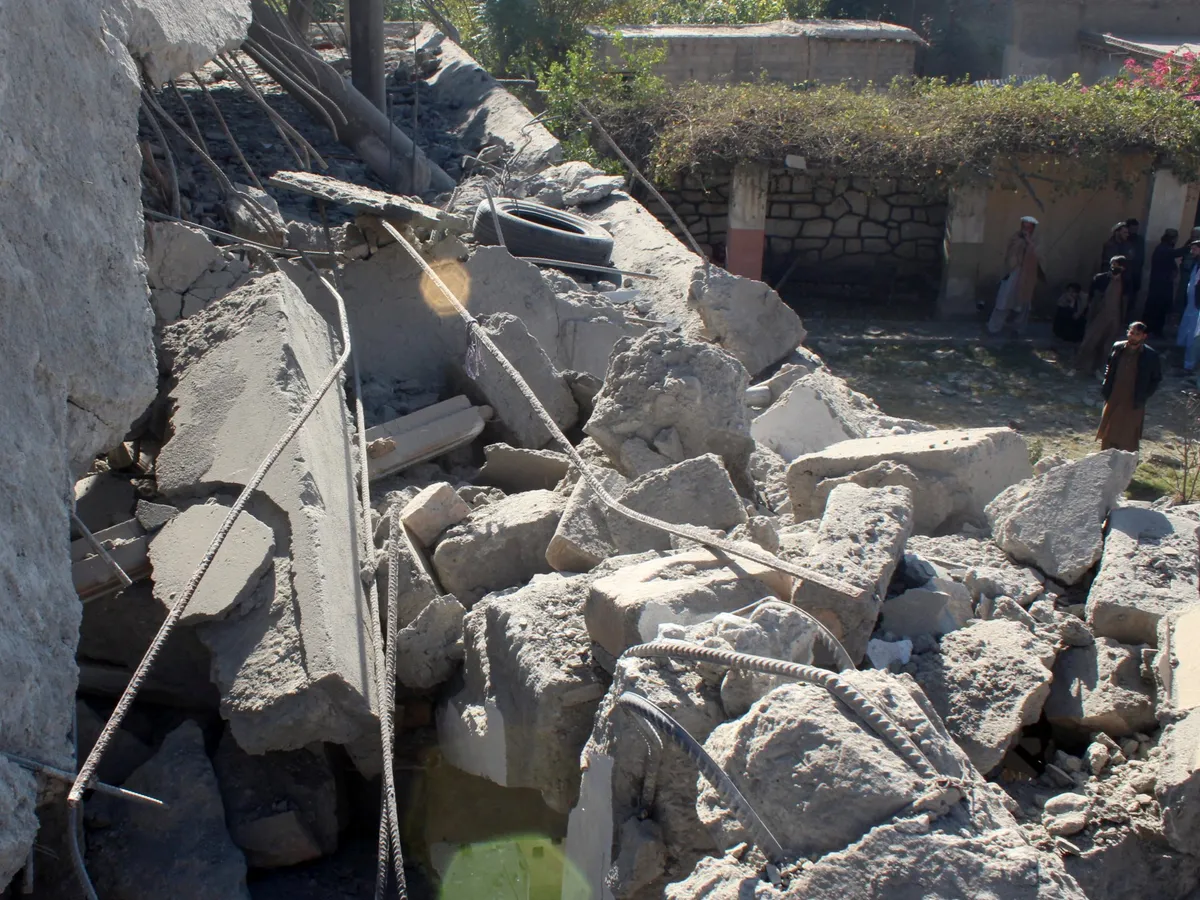
Afghan sources say the Pakistani strikes hit the border provinces of Paktika and Nangarhar.People stand in front of a damaged house that the Afghan Taliban government said was damaged after Pakistan carried out raids, in Asadabad, Kunar province, Afghanistan, November 25, 2025 [Stringer/ Reuters]Published On 22 Feb 2026Pakistan’s military has carried out air strikes in Afghanistan, targeting what it called “camps and hideouts” belonging to armed groups behind a spate of recent attacks, including a suicide bombing that killed dozens of worshippers at a Shia mosque in Islamabad.There was no immediate comment from Afghanistan’s Taliban government, but Afghan sources told Al Jazeera the strikes on Sunday hit two border provinces.Recommended Stories list of 4 itemslist 1 of 4Two soldiers killed during military operation in Pakistan’s northwest: Armylist 2 of 4Gas explosion kills 16 in Pakistan’s Karachi, collapsing buildinglist 3 of 4Trump’s Board of Peace meets: Who’s in, who’s out, what’s on the agenda?list 4 of 4Diplomats slam Israel’s Gaza ‘ceasefire’ violations, West Bank push at UNSCend of listThe sources said a drone strike hit a religious school in the Paktika province, and that attacks also took place in Nangarhar province.Pakistan’s Ministry of Information and Broadcasting, in a statement on X, said the country’s military conducted “intelligence-based, selective operations” against seven camps and hideouts belonging to the Pakistan Taliban, also known as Tehrik-e-Taliban Pakistan (TTP), and its affiliates.An affiliate of the Islamic State group was also targeted in the border region, it said.The ministry said it had “conclusive evidence” that recent attacks in Islamabad, as well as in the northwestern Bajaur and Bannu districts, were perpetrated by fighters “on behest of their Afghanistan-based leadership and handlers”.It said Pakistan has repeatedly urged the Taliban government to take action to prevent armed groups from using Afghan territory to launch attacks, but that Kabul has failed to “undertake any substantive action”.Pakistan “has always strived to maintain peace and stability in the region”, it added, but said the safety and security of Pakistani citizens remained its top priority.The Pakistani air strikes on Afghanistan came hours after a suicide bomber targeted a security convoy in the Bannu district of the northwestern Khyber Pakhtunkhwa province, killing two soldiers, including a lieutenant colonel.On Monday, a suicide bomber, backed by gunmen, rammed an explosives-laden vehicle into the wall of a security post in the nearby Bajaur, killing 11 soldiers and a child. Authorities later said the attacker was an Afghan national.On February 6, another suicide bomber detonated his explosives during noon prayers at the Khadija Tul Kubra mosque in Islamabad’s Tarlai Kalan area, killing at least 31 worshippers and wounding 170 others.The Islamic State group claimed responsibility for the attack.While bombings are rare in the heavily guarded capital, the attack on Khadija Tul Kubra was the second such attack in three months, raising fears of a return to violence in Pakistan’s major urban centres.At the time, the Pakistani military said the “planning, training, and indoctrination for the attack took place in Afghanistan”.In its statement on Sunday, the Pakistani Information Ministry reiterated a call on the international community to press the Taliban to uphold its commitments under the agreement it signed with the United States, in the Qatari capital, Doha, in 2020, to prevent the use of Afghan territory for attacks against other countries.The ministry said the move was “vital for regional and global peace and security”.Pakistan has seen a surge in violence in recent years, much of it blamed on the TTP and outlawed Baloch separatist groups. Islamabad accuses the TTP of operating from inside Afghanistan, a charge the group denies.The Taliban government has also consistently denied sheltering anti-Pakistan armed groups.Relations between the neighbouring countries have remained tense since October, when deadly border clashes killed dozens of soldiers, civilians and suspected fighters.The violence followed explosions in Kabul, which Afghan officials blamed on Pakistan.A ceasefire mediated by Qatar on October 19 has largely held, but subsequent talks in Turkiye’s Istanbul failed to produce a formal agreement.
SRCAl Jazeera
LANGEN
LEANCenter
WORDS656
ENT11
SUN · 2026-02-22 · 01:04 GMTBRIEF NSR-2026-0222-18202
NSR-2026-0222-18202News Report·EN·National Security
Pakistan carries out strikes in Afghanistan after spate of suicide attacks
Pakistan's military conducted air strikes in Afghanistan on Sunday, February 22, 2026, targeting alleged camps and hideouts of armed groups. The strikes, hitting the border provinces of Paktika and Nangarhar, were in response to a series of attacks in Pakistan, including a suicide bombing at a Shia mosque in Islamabad.
Al Jazeera StaffAl JazeeraFiled 2026-02-22 · 01:04 GMTLean · CenterRead · 3 min
Al JazeeraFIG 01
Reading time
3min
Word count
656words
Sources cited
2cited
Entities identified
11entities
Quality score
100%
§ 01
Briefing Summary
AI-generatedNEWSAR · AI
Pakistan's military conducted air strikes in Afghanistan on Sunday, February 22, 2026, targeting alleged camps and hideouts of armed groups. The strikes, hitting the border provinces of Paktika and Nangarhar, were in response to a series of attacks in Pakistan, including a suicide bombing at a Shia mosque in Islamabad. Pakistan claims the attacks were orchestrated by militants based in Afghanistan, specifically the Pakistan Taliban (TTP) and an affiliate of the Islamic State group. The Pakistani government stated it has repeatedly urged the Taliban government in Kabul to prevent armed groups from using Afghan territory to launch attacks, but claims no action has been taken. The strikes occurred hours after a suicide bombing targeted a security convoy in Pakistan, killing two soldiers.
Confidence 0.90Sources 2Claims 5Entities 11
§ 02
Article analysis
Model · rule-basedFraming
National Security
Conflict
Tone
Measured
AI-assessed
CalmNeutralAlarmist
Factuality
0.80 / 1.00
Factual
LowHigh
Sources cited
2
Limited
FewMany
§ 03
Key claims
5 extracted01
On February 6, a suicide bomber detonated his explosives during noon prayers at a mosque in Islamabad, killing at least 31 worshippers.
factualAl Jazeera
Confidence
1.00
02
Pakistan has repeatedly urged the Taliban government to take action to prevent armed groups from using Afghan territory to launch attacks.
factualPakistan’s Ministry of Information and Broadcasting
Confidence
1.00
03
Pakistan conducted “intelligence-based, selective operations” against seven camps and hideouts belonging to the Pakistan Taliban and its affiliates.
quotePakistan’s Ministry of Information and Broadcasting
Confidence
1.00
04
Pakistan’s military has carried out air strikes in Afghanistan, targeting what it called “camps and hideouts” belonging to armed groups.
factualAl Jazeera
Confidence
1.00
05
A drone strike hit a religious school in the Paktika province, and that attacks also took place in Nangarhar province.
factualAfghan sources
Confidence
0.90
§ 04
Full report
3 min read · 656 words§ 05
Entities
11 identifiedKey playerOppositionContextPositiveNeutralNegative
Organizations3
§ 06
Keywords & salience
10 termsafghanistan
1.00
pakistan
1.00
air strikes
0.90
armed groups
0.80
suicide attacks
0.80
taliban
0.70
ttp
0.60
border region
0.60
security
0.50
military operation
0.40
§ 07
Topic connections
Interactive graph Network visualization showing 51 related topics
View Full Graph Person Organization Location Event|Click node to navigate|Edge numbers = shared articles