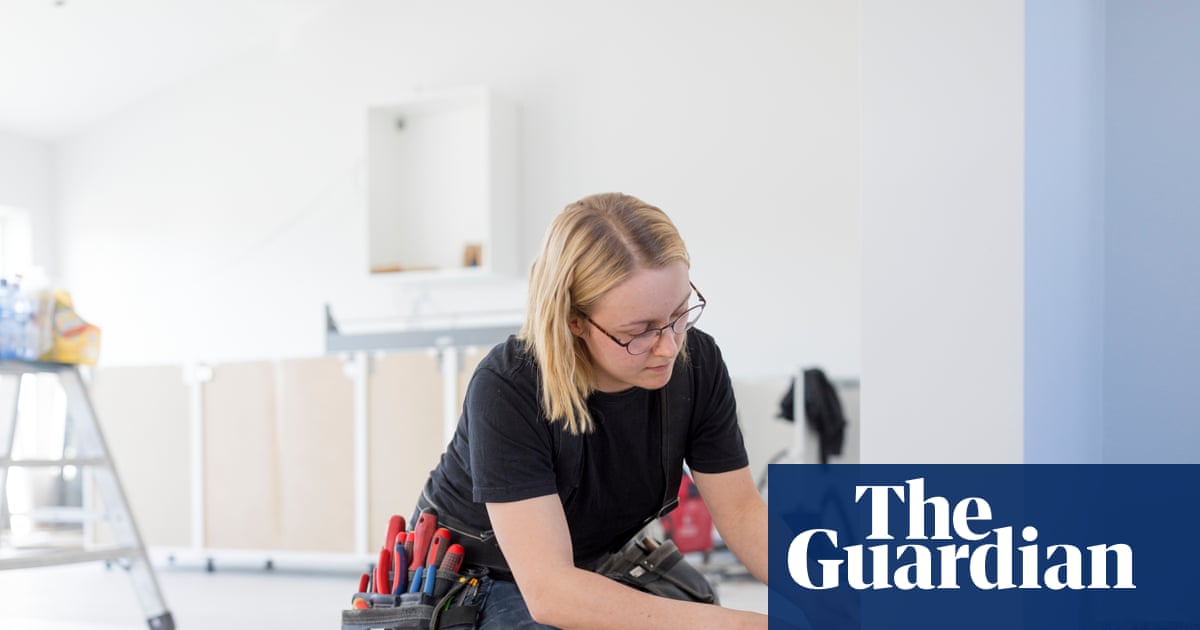
One of the main challenges in maintaining the 64 homes for domestic abuse survivors run by Refuge is the reliance on a male-dominated workforce of electricians, plumbers and decorators.“The presence of men can be distressing and could trigger past traumas for our survivors,” said Lisa Cantwell-Hope, the head of property services at the charity. “Male contractors need an escort to make our survivors feel more comfortable, and we always put a notice out to all our residents saying there will be a male presence in the building today. So it can be challenging and takes up more time.”Data from the Office for National Statistics shows there were 48,000 tradeswomen in the UK in 2021, a growth of 41% from 2006, but it is thought this is still only about 4% of the total trades workforce, and construction is consistently ranked as the most male-dominated industry in the country.Regionally, the West Midlands has the highest number of tradeswomen (who make up 4.4% of all tradespeople, above London (2.98%) and the south-west (2.24%). In the East Midlands, north-east, Northern Ireland, Scotland, south-east and Wales, they make up less than 1% of tradespeople, according to 2023 data from My Local Toolbox.But there are clear signs that things are shifting and women are increasingly moving into the sector – the number of women taking construction and engineering apprenticeships rose by 73% between 2019 and 2022.This is welcome news for domestic abuse charities such as Refuge, which are slowly starting to shift from handymen to handywomen.“If we could just use female contractors, I’d be a happy woman, but there isn’t enough currently,” said Cantwell-Hope. “But having them makes our jobs a lot easier, and it makes it easier to get people in the refuges, because there’s that common understanding of the sensitivity. They say they feel much more relaxed having a female in the property.“We’ve got to remember our refuges are people’s homes, and as much as we need to maintain the building, we also have to make it therapeutically pleasing and comfortable.”The number of women taking construction and engineering apprenticeships rose by 73% between 2019 and 2022. Photograph: monkeybusinessimages/Getty Images/iStockphotoThe charity is working with TaskHer, an online directory of tradeswoman, to source female workers. The service was set up by Anna Moynihan and her husband in 2021, due to the difficulty in finding tradeswomen when renovating their home.“I found that every time a tradesperson came to our house, they were a man and they would always speak to my husband and not me,” said Moynihan. “It was really frustrating.”After doing some research, they found there was huge unmet demand from consumers for tradeswomen – particularly from single women living alone, the LGBT community and women who for religious reasons did not want men in their home.They then started getting inquiries from domestic abuse charities. “We realised that they were having essentially the same issues that we had from a personal perspective, but on a larger scale,” said Moynihan. “It wasn’t necessarily about convenience, it was about creating an environment that the women who are living in their refuges would still feel safe in.”They’re now working with Refuge, and other domestic abuse charities, to supply female workers in London, with an aim to expanding outside the capital in the near future.Erin, a 26-year-old electrician in London, has been working with Refuge for the past few months doing everything from odd jobs to replacing consumer units in their safe houses.She said taking on the job was a no-brainer as it is rewarding to be able to put her skills to good use in a scenario where a tradesman might cause some apprehension.“If you can make anyone feel more comfortable in a situation, why wouldn’t you want to do that anyway?” she said. “You can feel it in the air, the anxieties just lift slightly when you go in and they can see who you are.”She said she’s met very few fellow tradeswomen in her work, although numbers have started to increase in recent years. “I was the only girl on my course at the time and I don’t think they had another one for at least a couple years after that,” she said. “Every day on the job and going around different sites, I never encountered any tradeswomen, never mind an electrician.”She also said there’s still a degree of sexism she encounters when doing jobs. “You get the older gents watching over and making sure you’re doing it right. I’ve got a baby face and I’m only five foot two so that doesn’t help things,” she said. “But it does feel like things are starting to change. I know a fair few female gas engineers now as well as plumbers, and painters and decorators.”
SRCThe Guardian - World News
LANGEN
LEANCenter-Left
WORDS788
ENT5
SUN · 2026-02-22 · 06:00 GMTBRIEF NSR-2026-0222-18225
NSR-2026-0222-18225News Report·EN·Human Interest
‘The anxieties just lift’: why domestic abuse refuges are turning to female tradespeople
Domestic abuse refuges, like those run by the charity Refuge, are increasingly seeking female tradespeople for maintenance and repairs. The presence of male contractors can be distressing for survivors and trigger past traumas, requiring escorts and resident notifications.
Jessica Murray Social affairs correspondentThe Guardian - World NewsFiled 2026-02-22 · 06:00 GMTLean · Center-LeftRead · 4 min
The Guardian - World NewsFIG 01
Reading time
4min
Word count
788words
Sources cited
3cited
Entities identified
5entities
Quality score
100%
§ 01
Briefing Summary
AI-generatedNEWSAR · AI
Domestic abuse refuges, like those run by the charity Refuge, are increasingly seeking female tradespeople for maintenance and repairs. The presence of male contractors can be distressing for survivors and trigger past traumas, requiring escorts and resident notifications. While women remain underrepresented in the trades, comprising only about 4% of the workforce, their numbers are growing, with a 73% increase in construction and engineering apprenticeships between 2019 and 2022. Refuge is partnering with TaskHer, an online directory of tradeswomen, to find female contractors. Employing tradeswomen creates a more comfortable and therapeutically beneficial environment for residents, easing anxieties and promoting a sense of safety in their temporary homes.
Confidence 0.90Sources 3Claims 5Entities 5
§ 02
Article analysis
Model · rule-basedFraming
Human Interest
Social Justice
Tone
Measured
AI-assessed
CalmNeutralAlarmist
Factuality
0.70 / 1.00
Factual
LowHigh
Sources cited
3
Well sourced
FewMany
§ 03
Key claims
5 extracted01
The number of women taking construction and engineering apprenticeships rose by 73% between 2019 and 2022.
statisticnull
Confidence
1.00
02
There were 48,000 tradeswomen in the UK in 2021, a growth of 41% from 2006.
statisticOffice for National Statistics
Confidence
1.00
03
Construction is consistently ranked as the most male-dominated industry in the country.
factualnull
Confidence
0.90
04
The presence of men can be distressing and could trigger past traumas for our survivors.
quoteLisa Cantwell-Hope, head of property services at Refuge
Confidence
0.90
05
There was huge unmet demand from consumers for tradeswomen.
quoteAnna Moynihan
Confidence
0.80
§ 04
Full report
4 min read · 788 words§ 05
Entities
5 identifiedKey playerOppositionContextPositiveNeutralNegative
§ 06
Keywords & salience
10 termsfemale tradespeople
1.00
domestic abuse refuges
1.00
tradeswomen
0.80
trauma
0.70
male-dominated workforce
0.60
refuge
0.50
apprenticeships
0.50
construction industry
0.50
property maintenance
0.40
taskher
0.40
§ 07
Topic connections
Interactive graph No topic relationship data available yet. This graph will appear once topic relationships have been computed.