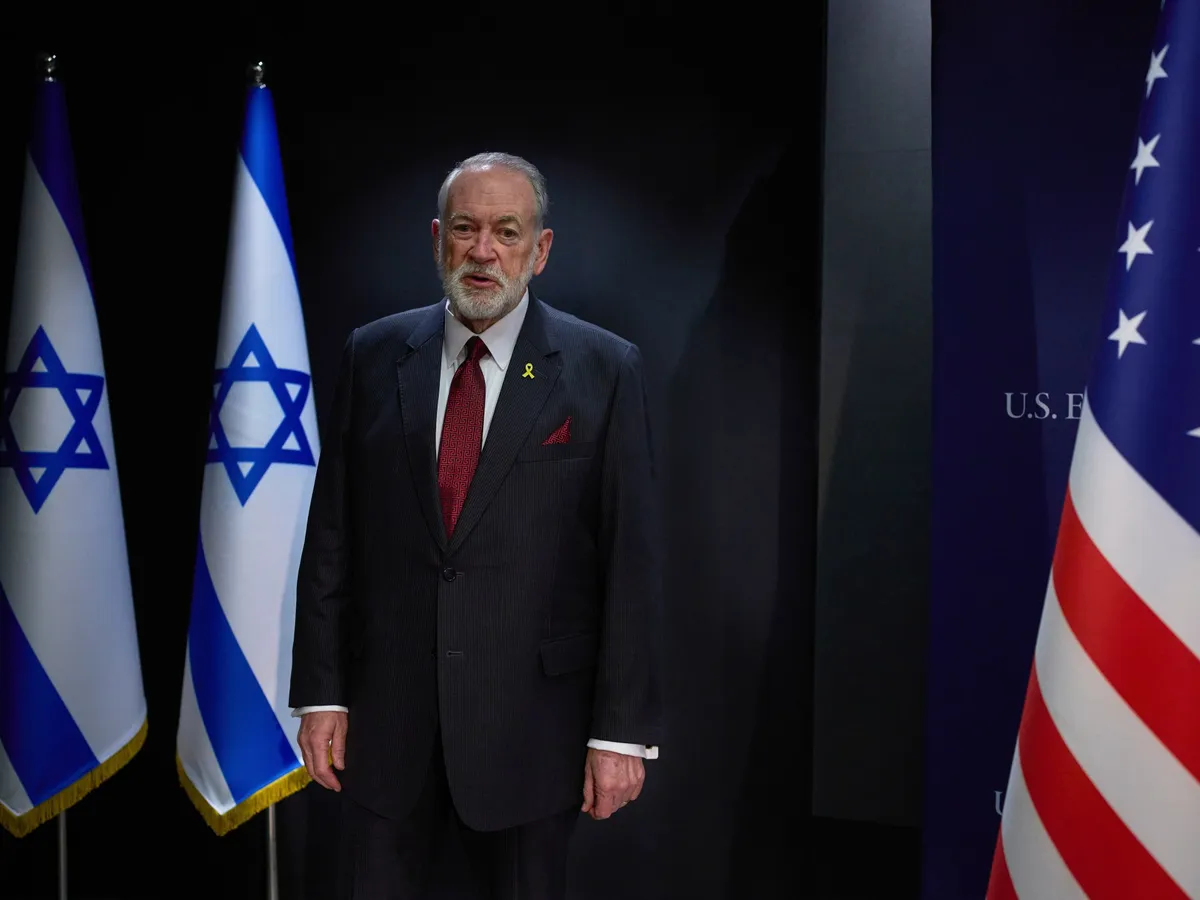
The interview brought the ‘Israel first vs America first’ debate to heart of the American right.US Ambassador to Israel Mike Huckabee poses for a photo during an interview in Jerusalem on August 20, 2025 [Ohad Zwigenberg/AP]Professor in the Media Studies program at the Doha Institute for Graduate Studies.Published On 22 Feb 2026Prominent American conservative journalist Tucker Carlson’s interview with US Ambassador to Israel Mike Huckabee has caused quite a stir. Since it was released on Friday, observers from across the political spectrum in the United States have taken to social media to comment.Indeed, the interview highlighted — perhaps more than any other political or media spectacle — the growing suspicion that American officials may be more loyal to a foreign country than they are to the US. This may well turn out to be a defining moment for how Americans view their government’s relationship with Israel.Israel’s ‘true friend’Huckabee, who is also a Baptist minister and former governor of Arkansas, was confirmed as US ambassador to Israel in April 2025. The news of his appointment was welcomed by the Israeli government and various pro-Israel groups, and he was hailed as a “true friend of Israel”.That Israel is quite close to Huckabee’s heart was made clear throughout his interview with Carlson, as he repeatedly parroted Israeli talking points.He spoke of Israel’s “biblical right” to the land; referred to the occupied West Bank as “Judea and Samaria”; and even appeared to approve of Israel expanding its territory to other parts of the Middle East.He repeatedly spoke of Israeli interests as US interests, often used “we” seemingly including Israel, and even insisted that the “problem on the border with Lebanon” was an issue Americans should care about. He defended his meeting with Jonathan Pollard, the former American intelligence analyst convicted of spying on the US for Israel, and for advocating for his early release from prison.Huckabee went as far as taking a jab at the US Army in his effort to defend the violations of the Israeli military in Gaza.When Carlson pressed him about Israel’s killing of Palestinian civilians in Gaza, he appeared to suggest that the Israeli military is more careful about avoiding civilian casualties than the US military.After Huckabee argued that Israel’s war on Gaza produced a “lower number of civilians killed” than any modern urban war, Carlson pressed him for a reference point.The ambassador offered two US wars — in Iraq and Afghanistan — as comparisons, suggesting that Israeli military commanders have been more concerned about protecting civilian life than their American counterparts.A US ambassador publicly arguing that a foreign military is more humane than his own country’s armed forces inevitably raises questions about where his primary loyalty lies.But Huckabee is, of course, not the only “true friend of Israel” within the US political elite.The US Congress, on both sides of the aisle, has been known to give boisterous standing applause to Israeli Prime Minister Benjamin Netanyahu every time he visits.Huckabee’s boss, US President Donald Trump, has repeatedly claimed he is “the best friend to Israel… they’ve ever had”.Trump’s predecessor, President Joe Biden, has proudly declared he is a Zionist and ensured full support and impunity for Israel as it carried out genocide in Gaza.South Carolina Senator Lindsey Graham has boasted that he goes to Israel every two weeks “whether I need to or not”.Eric Adams, former New York City mayor, chose to visit Israel at the end of his tenure and said that as mayor of America’s largest city, he had been serving Israel.And the list goes on.For the longest time, declarations of loyalty to Israel were seen as a political advantage in US politics. But this may well be changing.A wake-up callAmerican academics have long been interested in Israel’s oversized influence on US politics. Scholars like John Mearsheimer and Stephen Walt have written extensively about the issue.But for many years, this scrutiny was largely confined to academia or left-wing activist circles. Conservatives and liberals labelled such critics as conspiracy theorists or anti-Semites.The Carlson-Huckabee interview has perhaps let the cat out of the bag on the American right.What makes the interview important is not simply the substance of Huckabee’s remarks, but the interviewer, venue, audience, and underlying message of the line of questioning.A hugely popular conservative media figure travelled to Israel and publicly pressed a sitting US ambassador on whether American interests are being subordinated to Israeli interests. He questioned the theological and historical underpinnings of Zionism, criticised Israel’s treatment of Palestinian Christians, and asked why US tax dollars are sent to Israel.In his responses, the ambassador appeared to speak more as a representative of the Israeli government than the United States government.Judging by Huckabee’s defensive reaction after the interview and its social media fallout, he is learning an important lesson: appearing to put Israel first and America second is no longer an asset, but a liability, for American politicians.Elected American officials will be watching the public reaction carefully — especially in light of polling data showing that American public opinion towards Israel has shifted dramatically in recent years.The political incentive that has driven decades of unconditional support for Israel has now been weakened. The political calculus, too, is changing — it may be politically advantageous for American officials to adopt more evenhanded, even openly critical, approaches to Israel.This alone marks a significant shift.Carlson’s interview with Huckabee did not create that shift, but it brought it into the heart of the American right. If the question “America first or Israel first” can now be asked openly in conservative circles, then important political boundaries have already been broken.The Carlson-Huckabee interview could be the wake-up call that American politics needed to break free from the outsized influence of a Middle Eastern country that has long undermined US interests.The views expressed in this article are the author’s own and do not necessarily reflect Al Jazeera’s editorial stance.
SRCAl Jazeera
LANGEN
LEANCenter
WORDS974
ENT11
SUN · 2026-02-22 · 20:09 GMTBRIEF NSR-2026-0222-18391
NSR-2026-0222-18391Analysis·EN·Political Strategy
The Carlson-Huckabee interview may be the wake-up call Americans needed
A recent interview between Tucker Carlson and US Ambassador to Israel Mike Huckabee has sparked debate in the US regarding the relationship between American officials and Israel. The interview, conducted in February 2026, highlighted concerns about whether US officials prioritize Israeli interests over those of the United States.
Mohamad ElmasryAl JazeeraFiled 2026-02-22 · 20:09 GMTLean · CenterRead · 4 min
Al JazeeraFIG 01
Reading time
4min
Word count
974words
Sources cited
2cited
Entities identified
11entities
Quality score
100%
§ 01
Briefing Summary
AI-generatedNEWSAR · AI
A recent interview between Tucker Carlson and US Ambassador to Israel Mike Huckabee has sparked debate in the US regarding the relationship between American officials and Israel. The interview, conducted in February 2026, highlighted concerns about whether US officials prioritize Israeli interests over those of the United States. Huckabee repeatedly echoed Israeli viewpoints, referring to Israel's "biblical right" to the land and seemingly endorsing Israeli territorial expansion. He also defended his meeting with Jonathan Pollard, who was convicted of spying on the US for Israel. Carlson questioned Huckabee about civilian casualties in Gaza, leading Huckabee to suggest the Israeli military is more careful than the US military. The interview has ignited discussion about the loyalty of American officials and the US government's relationship with Israel.
Confidence 0.90Sources 2Claims 5Entities 11
§ 02
Article analysis
Model · rule-basedFraming
Political Strategy
Diplomatic
Tone
Mixed Tone
AI-assessed
CalmNeutralAlarmist
Factuality
0.40 / 1.00
Mixed
LowHigh
Sources cited
2
Limited
FewMany
§ 03
Key claims
5 extracted01
Huckabee defended his meeting with Jonathan Pollard, who was convicted of spying on the US for Israel.
factualArticle's own claim
Confidence
1.00
02
Huckabee spoke of Israel’s “biblical right” to the land.
quoteArticle's description of Huckabee's statements
Confidence
1.00
03
Tucker Carlson’s interview with US Ambassador to Israel Mike Huckabee has caused quite a stir.
factualArticle's own claim
Confidence
0.90
04
Huckabee suggested that the Israeli military is more careful about avoiding civilian casualties than the US military.
factualArticle's interpretation of Huckabee's argument
Confidence
0.80
05
Huckabee repeatedly parroted Israeli talking points.
factualArticle's own claim
Confidence
0.70
§ 04
Full report
4 min read · 974 words§ 05
Entities
11 identifiedKey playerOppositionContextPositiveNeutralNegative
Organizations3
§ 06
Keywords & salience
10 termsisrael first vs america first
0.90
mike huckabee
0.80
us ambassador to israel
0.80
israeli interests
0.70
tucker carlson
0.70
israel
0.60
us interests
0.60
american right
0.50
gaza
0.50
jonathan pollard
0.40
§ 07
Topic connections
Interactive graph No topic relationship data available yet. This graph will appear once topic relationships have been computed.