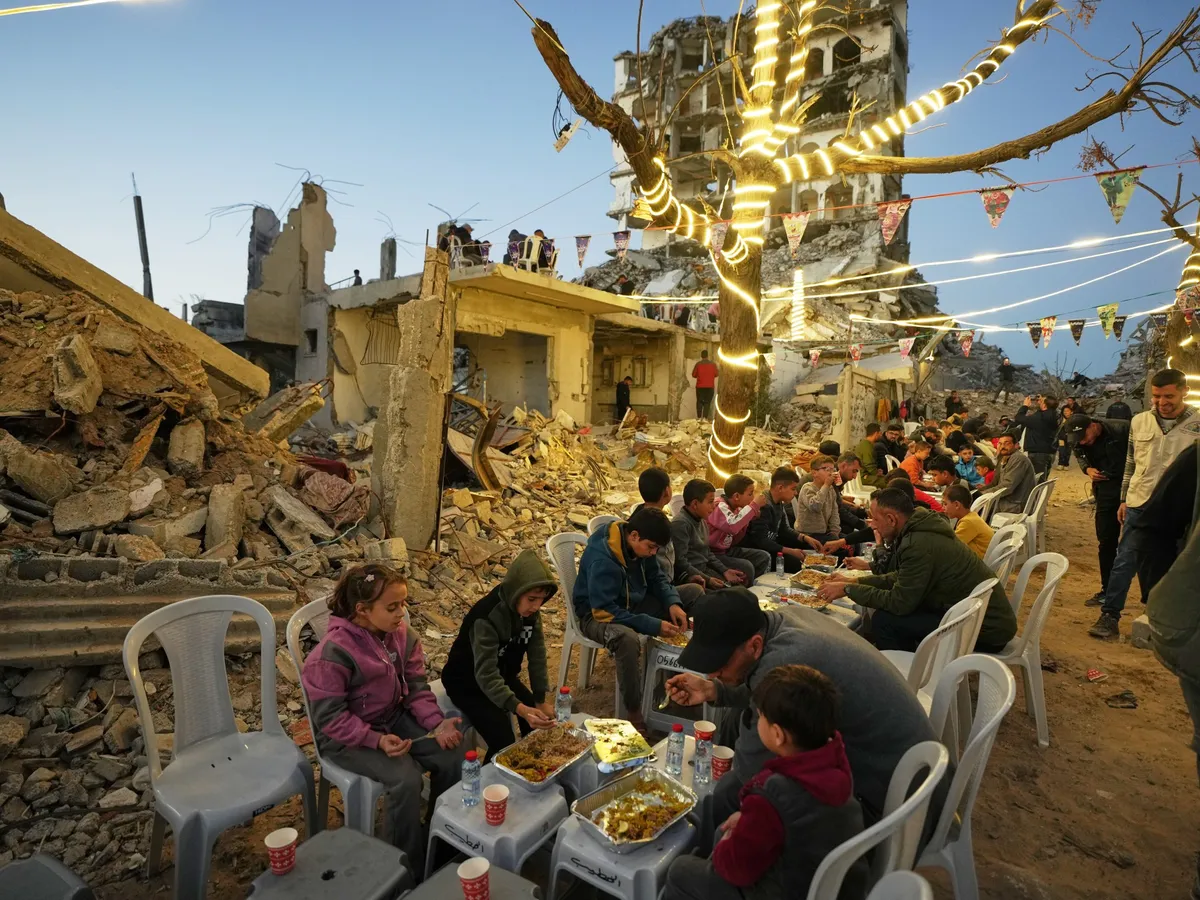
Al Jazeera analysis shows cost of basic meals nearly doubles after two years of Israel’s genocidal war.Palestinians gather for iftar, the fast-breaking meal during the Muslim holy month of Ramadan, in the rubble of destroyed buildings in Gaza City on February 22, 2026 [Jehad Alshrafi/AP Photo]Published On 23 Feb 2026After two years of a grinding war, Palestinians in the Gaza Strip are observing the holy month of Ramadan during an unabating economic catastrophe as Israel continues to impose restrictions on the entry of food and other supplies despite a “ceasefire” reached in October.For most families, the daily struggle to secure a mere loaf of bread has replaced the traditional festive atmosphere before the war. An analysis by Al Jazeera, based on official data, reveals that skyrocketing prices for basic commodities have made a complete iftar meal to break the daily fast a distant dream for the vast majority of the population.Skyrocketing costsDuring periods when Israel tightened its siege or completely closed the crossings into Gaza, food prices spiked by more than 700 percent. While prices have retreated slightly since the “ceasefire” began in October, they remain significantly higher than pre-war levels.According to Mohammed Barbakh, director general of policy and planning at the Ministry of Economy in Gaza, official data tracking prices from before the war began on October 7, 2023, to the first days of this Ramadan show staggering increases.Al Jazeera’s analysis of the ministry’s price data reveals the following hikes: Chicken: Prices rose from 14 shekels ($4.49) to 25 shekels ($8.01) per kilogramme (2.2lb), an 80 percent increase. Frozen fish: Prices jumped from 8 shekels ($2.56) to 23 shekels ($7.37) per kilo, a 190 percent increase. Frozen red meat: Prices rose from 23 shekels ($7.37) to 40 shekels ($12.82) per kilo, a 75 percent difference. Eggs: A tray of 30 eggs now costs 35 shekels ($11.22) compared with 13 shekels ($4.17), a 170 percent increase. Vegetables, a staple of the Palestinian diet, have also seen dramatic surges. Tomatoes have doubled in price while cucumbers have jumped by 300 percent, rising from 3 shekels ($0.96) per kilo to 12 shekels ($3.85). Cheese prices have increased by up to 110 percent, directly impacting the cost of suhoor, the predawn meal before the daily fasting during Ramadan begins.(Al Jazeera)The cost of a mealBased on data from the Palestinian Central Bureau of Statistics, Al Jazeera estimated the cost of a basic iftar for a family of six. The meal includes two chickens, rice, salad, appetisers, a soft drink, cooking gas and oil.The price of the meal has risen to about 150 shekels ($48), up from 79 shekels ($25.32) before the war, an increase of 90 percent.For suhoor, a simple meal of cheese, hummus, falafel and bread now costs 31.5 shekels ($10.10), compared with 18.6 shekels ($5.96) previously.The combined daily cost to feed a medium-sized family now stands at 181.5 shekels ($58.17), an 88 percent jump from pre-war figures.Economic obliterationThese price hikes coincide with a collapse in purchasing power. A United Nations report released in late 2025 indicated that the annual per capita income in Gaza plummeted to $161 (503 shekels) in 2024, down from $1,250 (3,900 shekels) in 2022.The labour market has essentially vanished. In a statement issued in October, Sami al-Amsi, head of the General Federation of Palestinian Trade Unions, said unemployment stood then at more than 95 percent as workshops, farmland and fishing fleets were destroyed.“The worker is no longer looking for a job because there is no work at all,” al-Amsi said. “Today, the Palestinian worker is looking for a food parcel to survive.”Blockade and monopolyEconomic researcher Ahmed Abu Qamar attributed the inflation to Israel’s restrictive entry policies and “coordination fees” imposed on trucks.“The humanitarian protocol stipulates the entry of 600 trucks daily, yet the Israeli occupation effectively allows only between 200 and 250 trucks,” Abu Qamar told Al Jazeera, noting that the Strip actually requires 1,000 trucks daily to meet minimum demand.He also highlighted a monopoly system under which only about 10 merchants are authorised to import goods through four Israeli companies, restricting competition and keeping prices artificially high. He called for a return to a free market system and the full opening of crossings to alleviate the burden on a population already crushed by conflict.
SRCAl Jazeera
LANGEN
LEANCenter
WORDS707
ENT6
MON · 2026-02-23 · 10:37 GMTBRIEF NSR-2026-0223-18480
NSR-2026-0223-18480Analysis·EN·Economic Impact
Ramadan in Gaza: Cost of iftar doubles as genocidal war devastates economy
During Ramadan in 2026, Palestinians in Gaza face a severe economic crisis after two years of war. An Al Jazeera analysis reveals that the cost of basic food items has drastically increased, making iftar meals unaffordable for many.
Al Jazeera StaffAl JazeeraFiled 2026-02-23 · 10:37 GMTLean · CenterRead · 3 min
Al JazeeraFIG 01
Reading time
3min
Word count
707words
Sources cited
1cited
Entities identified
6entities
Quality score
100%
§ 01
Briefing Summary
AI-generatedNEWSAR · AI
During Ramadan in 2026, Palestinians in Gaza face a severe economic crisis after two years of war. An Al Jazeera analysis reveals that the cost of basic food items has drastically increased, making iftar meals unaffordable for many. Official data shows prices for chicken, fish, meat, eggs, and vegetables have risen significantly since the start of the war in October 2023. The increased cost is attributed to restrictions on the entry of food and supplies into Gaza, despite a ceasefire. The price hikes impact both iftar and suhoor meals, exacerbating the daily struggle for families to secure food.
Confidence 0.90Sources 1Claims 5Entities 6
§ 02
Article analysis
Model · rule-basedFraming
Economic Impact
Human Interest
Tone
Mixed Tone
AI-assessed
CalmNeutralAlarmist
Factuality
0.70 / 1.00
Factual
LowHigh
Sources cited
1
Limited
FewMany
§ 03
Key claims
5 extracted01
The price of a basic iftar meal has risen to about 150 shekels, up from 79 shekels before the war.
statisticAl Jazeera
Confidence
1.00
02
Chicken prices rose from 14 shekels to 25 shekels per kilogramme, an 80 percent increase.
statisticAl Jazeera
Confidence
1.00
03
Official data tracking prices from before the war began on October 7, 2023, to the first days of this Ramadan show staggering increases.
factualMohammed Barbakh, director general of policy and planning at the Ministry of Economy in Gaza
Confidence
0.90
04
Cost of basic meals nearly doubles in Gaza after two years of war.
statisticAl Jazeera
Confidence
0.90
05
Food prices spiked by more than 700 percent during periods when Israel tightened its siege.
statisticAl Jazeera
Confidence
0.80
§ 04
Full report
3 min read · 707 words§ 05
Entities
6 identifiedKey playerOppositionContextPositiveNeutralNegative
Events1
§ 06
Keywords & salience
10 termsgaza
0.90
ramadan
0.90
economic catastrophe
0.80
iftar
0.80
food prices
0.70
war
0.70
cost of living
0.60
siege
0.60
palestinians
0.50
food supplies
0.50
§ 07
Topic connections
Interactive graph Network visualization showing 51 related topics
View Full Graph Person Organization Location Event|Click node to navigate|Edge numbers = shared articles