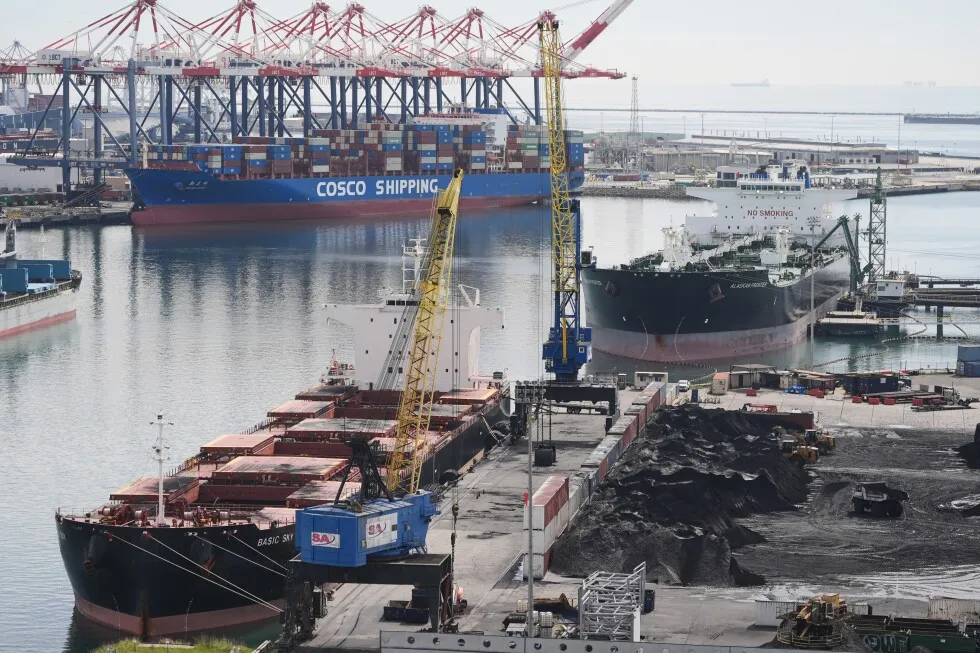
Supreme Court decision against Trump’s tariffs raises uncertainty, but markets stay calm 1 of 5 | Ships are docked at the Port of Long Beach Friday, Feb. 20, 2026, in Long Beach, Calif. (AP Photo/Damian Dovarganes) 2 of 5 | South Korean Trade Minister Kim Jung-kwan, third from right, attends a public-private joint meeting to discuss response to U.S. tariff policies in Seoul, South Korea, Monday, Feb. 23, 2026. (AP Photo/Ahn Young-joon) 3 of 5 | South Korean Trade Minister Kim Jung-kwan speaks during a public-private joint meeting to discuss response to U.S. tariff policies at the headquarters of the Korea Chamber of Commerce and Industry in Seoul, South Korea, Monday, Feb. 23, 2026. (AP Photo/Ahn Young-joon) 4 of 5 | A ship is docked at the Port of Long Beach Friday, Feb. 20, 2026, in Long Beach, Calif. (AP Photo/Damian Dovarganes) 5 of 5 | A U.S. flag files at the Port of Long Beach Friday, Feb. 20, 2026, in Long Beach, Calif. (AP Photo/Damian Dovarganes) 1 of 5 Ships are docked at the Port of Long Beach Friday, Feb. 20, 2026, in Long Beach, Calif. (AP Photo/Damian Dovarganes) Add AP News on Google Add AP News as your preferred source to see more of our stories on Google. 2 of 5 South Korean Trade Minister Kim Jung-kwan, third from right, attends a public-private joint meeting to discuss response to U.S. tariff policies in Seoul, South Korea, Monday, Feb. 23, 2026. (AP Photo/Ahn Young-joon) Add AP News on Google Add AP News as your preferred source to see more of our stories on Google. 3 of 5 South Korean Trade Minister Kim Jung-kwan speaks during a public-private joint meeting to discuss response to U.S. tariff policies at the headquarters of the Korea Chamber of Commerce and Industry in Seoul, South Korea, Monday, Feb. 23, 2026. (AP Photo/Ahn Young-joon) Add AP News on Google Add AP News as your preferred source to see more of our stories on Google. 4 of 5 A ship is docked at the Port of Long Beach Friday, Feb. 20, 2026, in Long Beach, Calif. (AP Photo/Damian Dovarganes) Add AP News on Google Add AP News as your preferred source to see more of our stories on Google. 5 of 5 A U.S. flag files at the Port of Long Beach Friday, Feb. 20, 2026, in Long Beach, Calif. (AP Photo/Damian Dovarganes) Add AP News on Google Add AP News as your preferred source to see more of our stories on Google. Updated [hour]:[minute] [AMPM] [timezone], [monthFull] [day], [year] BANGKOK (AP) — The Supreme Court’s ruling against U.S. President Donald Trump’s tariffs has countries like China and South Korea watching for Washington’s next steps, while financial markets took the news in stride.The decision announced Friday could potentially disrupt arrangements worked out in trade negotiations since Trump announced sweeping tariffs on dozens of countries in April 2025. China’s Commerce Ministry said it was conducting a “comprehensive assessment of ” the ruling against the tariffs Trump imposed under the International Emergency Economic Powers Act, or IEEPA. “China urges the United States to lift the unilateral tariffs imposed on trading partners,” an unnamed ministry spokesman said in a statement. The statement reiterated Beijing’s stance that there are no winners in a trade war and that the measures Trump had announced “not only violate international economic and trade rules but also contravene domestic laws of the United States, and are not in the interests of any party,” the official Xinhua News Agency cited the spokesperson as saying. Trump responded to the Supreme Court decision by proposing a new 10% global tariff under an alternative law, Section 122 of the 1974 Trade Act, and later increased it to 15%. For China and some other countries in Asia that were subject to higher import duties on their exports, that could potentially bring some relief. But for others such as Japan, the United Kingdom and other U.S. allies, tariffs could rise. The U.S. plans to stand by its trade deals and expects its partners to do the same, U.S. Trade Representative Jamieson Greer said in a CBS News interview Sunday.“The deals were not premised on whether or not the emergency tariff litigation would rise or fall,” said Greer, Trump’s top trade negotiator. “I haven’t heard anyone yet come to me and say the deal’s off. They want to see how this plays out.” Uncertainty may worsen if the Trump administration continues imposing new tariffs under alternative laws, South Korea’s trade minister, Kim Jung-kwan, said Monday.The South Koreans have agreed to hold “amicable” discussions with U.S. officials in order to minimize any negative impact on South Korean companies, he said. Major South Korean exports such as autos and steel are subject to tariffs under other trade laws. “Given the uncertainty over future U.S. tariff measures, the public and private sectors must work together to strengthen our companies’ export competitiveness and diversify their markets,” Kim said.U.S. Treasury Secretary Scott Bessent also said Sunday that he believed trading partners would abide by existing deals and that tariff revenues will remain steady.“Tariff revenues will be unchanged this year and will be unchanged in the future,” Bessent said in a Fox News interview, pointing to the new 15% global tariffs Trump has said he wants as a replacement.The administration would defer to the courts on whether to give companies refunds for the import taxes already collected under the tariffs now declared unlawful, Bessent said. “It’s out of our hands and we will follow the court’s orders,” he said.U.S. futures sank early Monday, with the contract for the S&P 500 down 0.6% and that for the Dow Jones Industrial Average falling 0.5%. Oil prices fell and the U.S. dollar weakened against the Japanese yen and the euro. But share prices in Asia mostly advanced, with Hong Kong’s Hang Seng gaining 2.4%.Kim Tong-hyung in Seoul, South Korea, contributed. Based in Bangkok, Kurtenbach is the AP’s business editor for Asia, helping to improve and expand our coverage of regional economies, climate change and the transition toward carbon-free energy. She has been covering economic, social, environmental and political trends in China, Japan and Southeast Asia throughout her career.
SRCAssociated Press (AP)
LANGEN
LEANCenter
WORDS1 027
ENT8
MON · 2026-02-23 · 08:53 GMTBRIEF NSR-2026-0223-18505
NSR-2026-0223-18505News Report·EN·Economic Impact
Supreme Court decision against Trump’s tariffs raises uncertainty, but markets stay calm
The U.S. Supreme Court has ruled against tariffs imposed by former President Donald Trump.
By
ELAINE KURTENBACHAssociated Press (AP)Filed 2026-02-23 · 08:53 GMTLean · CenterRead · 5 min
Associated Press (AP)FIG 01
Reading time
5min
Word count
1 027words
Sources cited
2cited
Entities identified
8entities
Quality score
100%
§ 01
Briefing Summary
AI-generatedNEWSAR · AI
The U.S. Supreme Court has ruled against tariffs imposed by former President Donald Trump. The decision introduces uncertainty into international trade relations, specifically regarding the legality and future of these tariffs. The ruling's impact is being closely watched by countries like South Korea, where officials held meetings to discuss responses to U.S. tariff policies. Despite the potential economic disruption, markets have remained relatively calm in the immediate aftermath of the Supreme Court decision. The case highlights the ongoing legal challenges and global implications stemming from the trade policies enacted during the Trump administration.
Confidence 0.90Sources 2Claims 5Entities 8
§ 02
Article analysis
Model · rule-basedFraming
Economic Impact
Legal & Judicial
Tone
Measured
AI-assessed
CalmNeutralAlarmist
Factuality
0.80 / 1.00
Factual
LowHigh
Sources cited
2
Limited
FewMany
§ 03
Key claims
5 extracted01
Trump imposed tariffs under the International Emergency Economic Powers Act, or IEEPA.
factualArticle itself
Confidence
1.00
02
China’s Commerce Ministry said it was conducting a “comprehensive assessment of ” the ruling.
quoteChina’s Commerce Ministry
Confidence
1.00
03
Supreme Court decision against Trump’s tariffs raises uncertainty.
factualArticle itself
Confidence
0.90
04
Financial markets took the news in stride.
factualArticle itself
Confidence
0.80
05
The decision announced Friday could potentially disrupt arrangements worked out in trade negotiations.
predictionArticle itself
Confidence
0.70
§ 04
Full report
5 min read · 1 027 words§ 05
Entities
8 identifiedKey playerOppositionContextPositiveNeutralNegative
§ 06
Keywords & salience
7 termstariffs
1.00
supreme court decision
0.90
u.s. tariff policies
0.80
trade
0.70
uncertainty
0.60
markets
0.60
international trade
0.50
§ 07
Topic connections
Interactive graph Network visualization showing 51 related topics
View Full Graph Person Organization Location Event|Click node to navigate|Edge numbers = shared articles