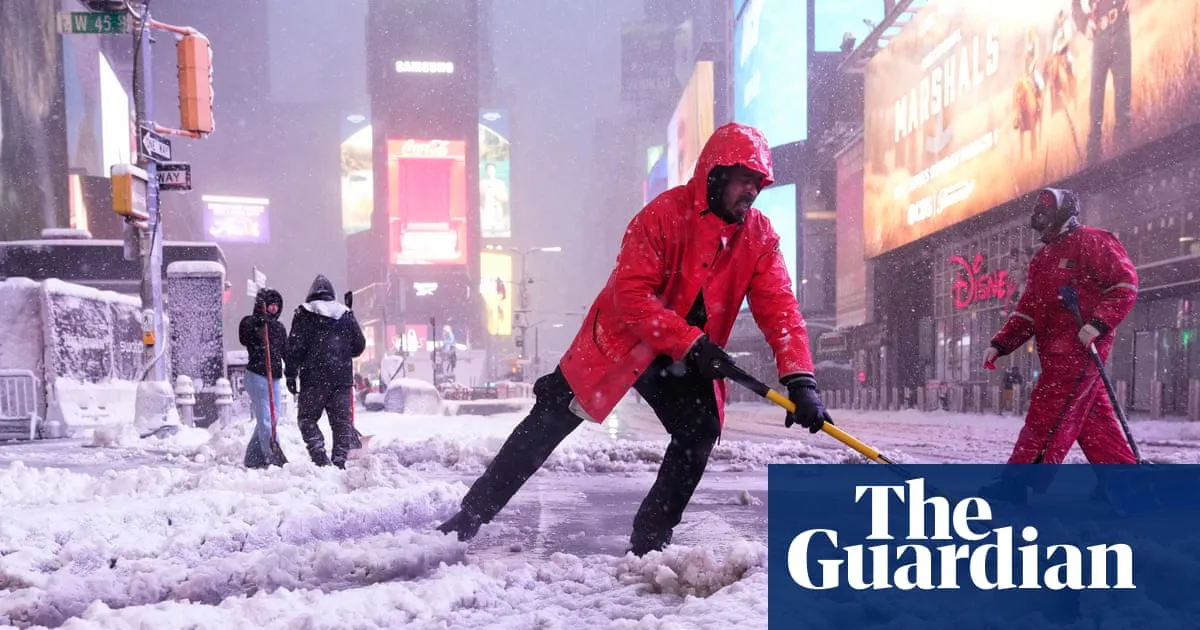
Millions of people in New York City and a large swath of the north-eastern US were stuck at home under road travel bans and blizzard warnings on Monday as heavy snow and strong winds intensified, creating whiteout conditions in the densely populated region.Snow fell at a rate of 2-3in (5-7.6cm) an hour early on Monday from New York through Massachusetts. Some areas have received well over a foot (30cm) of snow since Sunday, along with wind gusts of over 30mph (48km/h) and low visibility.Long Island’s MacArthur airport reported 20in of snow as of Monday morning. Freehold, New Jersey, had 19in.The National Weather Service (NWS) called travel conditions “nearly impossible”.Blizzard warnings stretched from Maryland to Maine. Cellphones across New York City received wailing push alerts on Sunday night announcing a ban on non-emergency travel on all streets through noon Monday because of “dangerous blizzard conditions”. Rhode Island and New Jersey implemented similar restrictions.A woman crosses a street near Manhattan’s Grand Central during a snowfall in New York City, on 22 February 2026. Photograph: Charly Triballeau/AFP/Getty ImagesMore than 5,000 flights in and out of the United States were canceled for Monday, according to the flight tracking website FlightAware. Most were canceled in New York, New Jersey and Boston.Public transit was suspended in some areas. Even DoorDash announced it was suspending deliveries in New York City overnight.The storm caused power outages that left more than 300,000 customers in the dark along the east coast early on Monday, including about 115,000 customers without power in New Jersey, according to PowerOutage.us, which tracks outages nationwide.Emergencies were declared in New York, Philadelphia and other cities, as well as several states stretching from Delaware to Massachusetts as officials mobilized readiness efforts.“The combination of heavy snowfall and strong winds will continue to produce blizzard conditions along the Northeastern Seaboard,” the NWS said on Monday. “Sharply reduced visibility will make travel extremely treacherous across these areas.”Snow blows around the Old Massachusetts statehouse as whiteout conditions and high winds arrive in Boston on Monday. Photograph: Scott Eisen/Getty ImagesThe NWS meteorologist Frank Pereira said the storm could possibly become a bomb cyclone, which is when a storm drops at least 24 millibars in pressure in 24 hours.The NWS said the snow was expected to taper off by Monday afternoon.Philadelphia will switch to online learning. Boston and New York City canceled public school classes for Monday.“To kids across New York City, you have a very serious mission if you choose to accept it: stay cozy,” Mayor Zohran Mamdani said.Meanwhile, outreach workers worked to coax homeless New Yorkers off the street and into shelters and warming centers.Various landmarks and cultural institutions announced closures on Monday, from New York’s Museum of Modern Art to Arlington national cemetery in Washington DC. Broadway shows were canceled on Sunday evening.The NWS said the storm’s strong wind gusts could cause whiteout conditions. It also warned of a “potentially historic/destructive storm” south-east of the Boston-Providence corridor.Pedestrians walk in Times Square while heavy snow falls in Manhattan amid a major winter snowstorm in New York City on 22 February 2026. Photograph: John Angelillo/UPI/Shutterstock“Winds like that, combined with heavy, wet snow, are a recipe for damaged trees and prolonged power outages,” said Bryce Williams, a meteorologist with the NWS’s Boston office. “That’s what we’re most concerned with, is the combination of those extreme snow amounts with that wind.”In addition to their robust plow operations, New York City officials recruited people to shovel snow, with some beginning work on Sunday night to get an early start on the first wave of snowfall, Mamdani said.John Berlingieri scrapped plans for a family trip to Puerto Rico. Instead, he was preparing his company, Berrington Snow Management, for what could well be a mammoth task: clearing snow from millions of square feet of asphalt surrounding shopping malls and industrial parks across Long Island.Employees spent the last few days recharging batteries on the company’s 40 front-end loaders and replacing windshield wipers on snow-removal vehicles.“I’m anticipating at least one week of work around the clock,” Berlingieri said. “We’re going to work 24 to 36 hours straight, sleep for a few hours and then go back.”
SRCThe Guardian - World News
LANGEN
LEANCenter-Left
WORDS687
ENT10
MON · 2026-02-23 · 13:05 GMTBRIEF NSR-2026-0223-18571
NSR-2026-0223-18571News Report·EN·Public Health
Millions face road travel bans as snow blankets New York and north-east US
A major winter storm blanketed the northeastern US on Monday, bringing heavy snow, strong winds, and whiteout conditions from Maryland to Maine. Millions faced road travel bans in New York, New Jersey, and Rhode Island, with blizzard warnings issued across the region.
Associated PressThe Guardian - World NewsFiled 2026-02-23 · 13:05 GMTLean · Center-LeftRead · 3 min
The Guardian - World NewsFIG 01
Reading time
3min
Word count
687words
Sources cited
4cited
Entities identified
10entities
Quality score
100%
§ 01
Briefing Summary
AI-generatedNEWSAR · AI
A major winter storm blanketed the northeastern US on Monday, bringing heavy snow, strong winds, and whiteout conditions from Maryland to Maine. Millions faced road travel bans in New York, New Jersey, and Rhode Island, with blizzard warnings issued across the region. Over 5,000 flights were canceled, and public transit was suspended in some areas. The storm caused power outages for over 300,000 customers along the east coast. Emergencies were declared in multiple cities and states as officials mobilized resources. The National Weather Service warned of "nearly impossible" travel conditions and the potential for the storm to become a bomb cyclone.
Confidence 0.90Sources 4Claims 5Entities 10
§ 02
Article analysis
Model · rule-basedFraming
Public Health
Human Interest
Tone
Measured
AI-assessed
CalmNeutralAlarmist
Factuality
0.90 / 1.00
Factual
LowHigh
Sources cited
4
Well sourced
FewMany
§ 03
Key claims
5 extracted01
More than 5,000 flights in and out of the United States were canceled for Monday.
statisticFlightAware
Confidence
1.00
02
Long Island’s MacArthur airport reported 20in of snow as of Monday morning.
factual
Confidence
1.00
03
Snow fell at a rate of 2-3in (5-7.6cm) an hour early on Monday from New York through Massachusetts.
factual
Confidence
1.00
04
Millions of people in New York City and the north-eastern US were stuck at home under road travel bans and blizzard warnings.
factual
Confidence
1.00
05
The storm could possibly become a bomb cyclone.
predictionFrank Pereira, NWS meteorologist
Confidence
0.70
§ 04
Full report
3 min read · 687 words§ 05
Entities
10 identifiedKey playerOppositionContextPositiveNeutralNegative
Organizations1
§ 06
Keywords & salience
10 termssnow
0.90
blizzard
0.80
travel bans
0.80
road travel
0.70
power outages
0.60
strong winds
0.60
northeast us
0.50
whiteout conditions
0.50
flight cancellations
0.50
bomb cyclone
0.40
§ 07
Topic connections
Interactive graph Network visualization showing 51 related topics
View Full Graph Person Organization Location Event|Click node to navigate|Edge numbers = shared articles