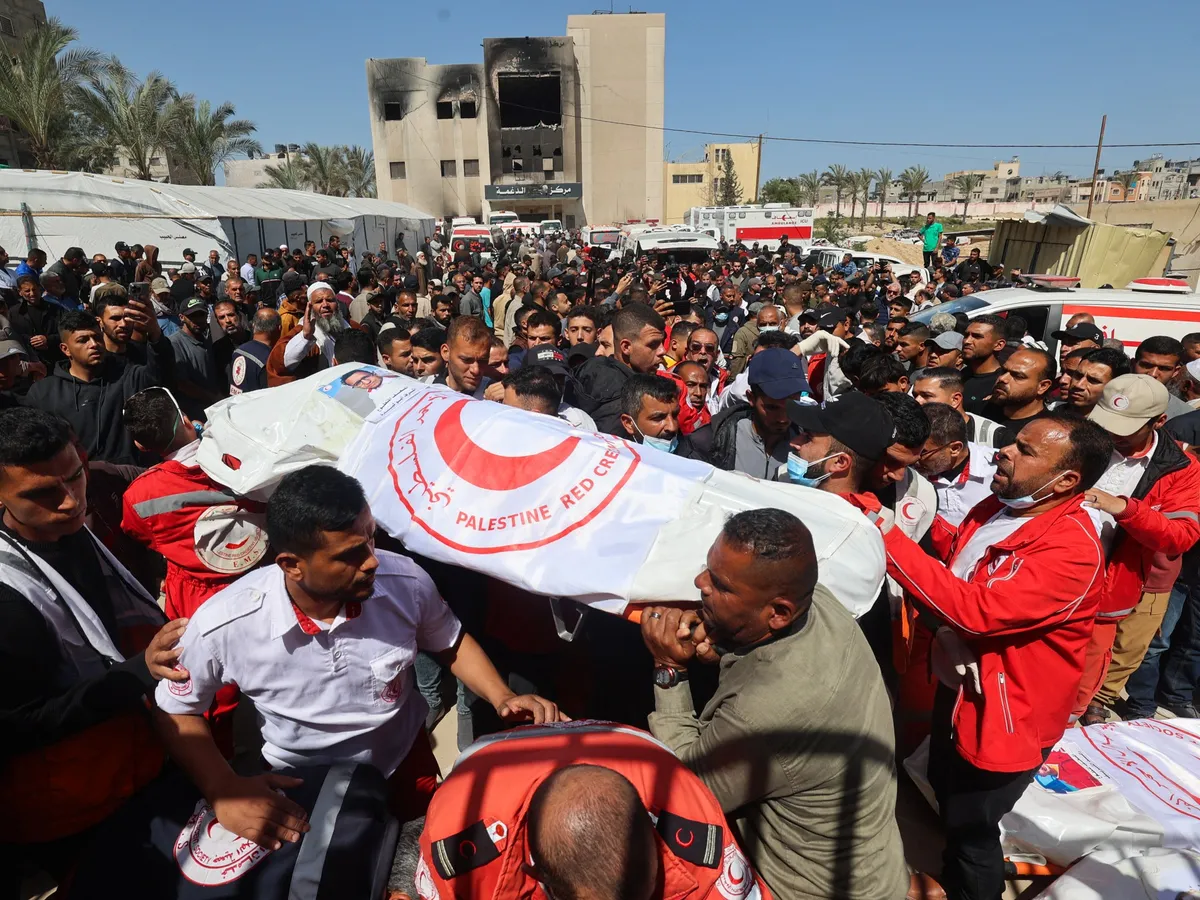
New investigation by Forensic Architecture and Earshot shows Israeli soldiers fired hundreds of rounds during massacre of aid workers in Gaza.Members of the Palestine Red Crescent Society and other emergency services carry bodies of fellow rescuers killed by Israeli forces, during a funeral procession at Nasser hospital in Khan Younis in the southern Gaza Strip on March 31, 2025 [Eyad Baba/AFP]Published On 24 Feb 2026Israeli soldiers fired more than 900 bullets at a convoy of clearly marked Palestinian emergency vehicles in Gaza before advancing to kill the surviving aid workers, some of whom were shot “execution-style” at close range, last March, a new joint investigation has revealed.The report released on Monday by independent research agency Forensic Architecture and audio investigation group Earshot offers the most detailed reconstruction to date of the massacre in Tal as-Sultan, a neighbourhood west of Rafah in the southern Gaza Strip, on March 23, 2025.Recommended Stories list of 4 itemslist 1 of 4Yet another Israeli war crime is buried in the sand as the world looks awaylist 2 of 4‘Even the dead were not spared’: Israel’s Gaza desecration compounds grieflist 3 of 4Israel’s exploding robots still terrorise Gaza neighbourhoodslist 4 of 4‘Unprecedented’: Video shows last moments of Gaza medics killed by Israelend of listFifteen aid workers were killed in the attack, including paramedics from the Palestine Red Crescent Society (PRCS), firefighters from the Palestinian Civil Defence (PCD) and a staff member of the United Nations agency for Palestinian refugees (UNRWA). The slain aid workers were then buried along with their vehicles.The Israeli military initially claimed the vehicles were “uncoordinated” and later admitted a “professional error”. But the forensic analysis paints a different picture: a coordinated ambush, an absence of return fire and a calculated move to eliminate survivors.The science of the massacreThe investigation relies heavily on a “situated testimony” technique and advanced audio ballistics to analyse the sound of gunfire to determine the shooter’s distance, weapon type and direction.Investigators analysed footage recovered from the phone of slain paramedic Rifaat Radwan, a PRCS paramedic who began recording at 5:09am, when the ambush began. In a video lasting five and a half minutes, at least 844 gunshots were recorded. Combined with other recordings, the total documented count reached at least 910 gunshots.In the video, filmed from inside one of the last two ambulances, Radwan can be heard asking his mother for forgiveness and reciting the Islamic declaration of faith, the shahada, before he dies.According to Earshot’s analysis, 93 percent of these shots featured a specific acoustic signature: a “supersonic shockwave”, followed by a muzzle blast. This combination confirms that the camera – and the aid workers huddled around it – were directly in the line of fire.“The density of gunfire … frequently exceeds 900 rounds per minute,” the report states, noting that, at one point, five shots were fired in just 67 milliseconds. This rate of fire confirms that at least five shooters, likely many more, were firing simultaneously from an elevated sandbank approximately 40 metres away.“Israeli soldiers ambushed and subjected Palestinian aid workers to continuous assault by gunfire for over two hours”, between 5:09am and 7:13am, the report says.From ambush to executionThe report challenges the Israeli narrative of a chaotic “combat zone”. Instead, it describes a methodical massacre of Palestinian aid workers on their way to help people injured in Israeli strikes.“There was no exchange of fire in the area, and no tangible threat to the safety of those soldiers. These attacks did not happen in ‘a hostile and dangerous combat zone’, as was claimed by Israeli spokespersons,” the report says.By analysing the time delay between the sound of the gunshots and their echoes bouncing off a nearby concrete wall, investigators tracked the movement of the soldiers.For the first four minutes, the soldiers held a fixed position on a sandbank. Then, the audio data shows the echo interval increasing, indicating the soldiers were moving down the hill, advancing roughly 50 metres towards the convoy while continuing to fire.This corroborates the testimony of survivor Assaad al-Nassasra, a PRCS worker, who told investigators: “They were walking between [the aid workers] and shooting.”The most chilling findings concern the final moments of the attack. Analysis of a subsequent phone call made by paramedic Ashraf Abu Libda to dispatchers captures the soldiers arriving at the vehicles.The audio analysis identifies specific gunshots where the distinct “supersonic crack” of the bullet disappears, leaving only the muzzle blast. Ballistically, this indicates the shooter was within 1 to 4 metres (3 feet to 13 feet) of the victim.These shots coincide with the final sounds of movement from Abu Libda, suggesting he was shot while lying on the ground. A doctor who later examined the bodies confirmed the wounds were consistent with “execution-style” killings.Israeli forces have repeatedly been accused of crimes against humanity and war crimes during their genocidal war in Gaza that killed more than 72,000 Palestinians. A recent report by the medical journal The Lancet says the death toll in the first 16 months was much higher than the official figures. Despite a “ceasefire” in place since October, Israel has killed more than 600 Palestinians.Rights groups and scholars have said the Israeli military offensive that turned Gaza into ruins is genocide. The International Court of Justice (ICJ) is hearing a case of genocide against Israel, while the International Criminal Court (ICC) has issued an arrest warrant for war crimes against Prime Minister Benjamin Netanyahu.The brutal killing of the 15 aid workers in March 2025 caused outrage, but Israel faced no legal or political consequences as it continued to receive backing from its Western allies, including the United States.Hiding the evidenceThe report details a systematic attempt by Israeli forces to conceal the massacre in the hours that followed.Satellite imagery from that morning revealed that bulldozers were deployed to the site. The emergency vehicles were crushed and buried, and earth berms were constructed over the scene to block visibility.These forensic findings align with exclusive satellite imagery obtained by Al Jazeera’s Sanad fact-checking agency last year. In a report published on March 30, 2025, Sanad revealed imagery taken on March 25 showing that at least five rescue vehicles had been “completely destroyed” and buried in sand by Israeli forces on al-Muharrarat Street – the site of the massacre.Exclusive satellite imagery obtained by the Sanad agency reveals the destruction and burial of Palestine Red Crescent Society and Civil Defence vehicles in Rafah [Sanad/Al Jazeera]At the time, the Palestinian Civil Defence condemned the act as a “crime of extermination”, stating that Israeli forces deliberately “altered the landmarks of the place” and used heavy machinery to hide the bodies of the victims.“Israeli military personnel acted intentionally to conceal and disrupt evidence … by burying the bodies of the victims [and] burying the mobile phones,” the Forensic Architecture report says.Survivor al-Nassasra was detained, taken to Israel’s notorious Sde Teiman detention camp, and tortured for 37 days. He testified that soldiers confiscated and buried his phone, likely to hide evidence.One of the two PRCS survivors of the attack was later used as a “human tool” at an Israeli military checkpoint near the incident site, the report says.Lalas, Yotam and AmatziaIn a rare instance of identification, the audio analysis was able to isolate and enhance the voices of the Israeli soldiers speaking Hebrew during the attack.The investigation identifies three soldiers by name – Elias (referred to as Lalas), Yotam, and Amatzia – based on their conversations as they moved among the bodies.In one recording, a soldier is heard asking, “Lalas, did you finish?” before receiving an order to “put the guns on them”.The report concludes that there was “no exchange of fire in the area, and no tangible threat to the safety of those soldiers”, debunking Israeli claims of a battle. Instead, it documents a deliberate attack on a humanitarian convoy that ended in the calculated execution of those who survived the initial barrage.
SRCAl Jazeera
LANGEN
LEANCenter
WORDS1 310
ENT8
TUE · 2026-02-24 · 12:52 GMTBRIEF NSR-2026-0224-18872
NSR-2026-0224-18872News Report·EN·Human Rights
Israeli forces fired over 900 bullets to kill Gaza medics in 2025: Report
A joint investigation by Forensic Architecture and Earshot, released on February 24, 2026, details the killing of 15 aid workers in Tal as-Sultan, Gaza on March 23, 2025. The report states that Israeli soldiers fired over 900 bullets at clearly marked emergency vehicles belonging to the Palestine Red Crescent Society, Palestinian Civil Defence, and UNRWA.
Mohammad MansourAl JazeeraFiled 2026-02-24 · 12:52 GMTLean · CenterRead · 6 min
Al JazeeraFIG 01
Reading time
6min
Word count
1 310words
Sources cited
2cited
Entities identified
8entities
Quality score
100%
§ 01
Briefing Summary
AI-generatedNEWSAR · AI
A joint investigation by Forensic Architecture and Earshot, released on February 24, 2026, details the killing of 15 aid workers in Tal as-Sultan, Gaza on March 23, 2025. The report states that Israeli soldiers fired over 900 bullets at clearly marked emergency vehicles belonging to the Palestine Red Crescent Society, Palestinian Civil Defence, and UNRWA. Audio analysis suggests a coordinated ambush with survivors allegedly killed at close range. The investigation used audio ballistics and footage from a slain paramedic's phone to reconstruct the event. While the Israeli military initially cited a "professional error," the report indicates a calculated effort to eliminate the aid workers.
Confidence 0.90Sources 2Claims 5Entities 8
§ 02
Article analysis
Model · rule-basedFraming
Human Rights
Conflict
Tone
Mixed Tone
AI-assessed
CalmNeutralAlarmist
Factuality
0.70 / 1.00
Factual
LowHigh
Sources cited
2
Limited
FewMany
§ 03
Key claims
5 extracted01
The investigation relies heavily on a “situated testimony” technique and advanced audio ballistics.
factualArticle
Confidence
1.00
02
The Israeli military initially claimed the vehicles were “uncoordinated” and later admitted a “professional error”.
quoteArticle referencing Israeli military statements
Confidence
1.00
03
Fifteen aid workers were killed in the attack.
factualArticle
Confidence
1.00
04
93 percent of shots fired featured a supersonic shockwave followed by a muzzle blast, indicating direct line of fire.
statisticEarshot's analysis
Confidence
0.90
05
Israeli soldiers fired more than 900 bullets at a convoy of clearly marked Palestinian emergency vehicles in Gaza.
statisticForensic Architecture and Earshot investigation
Confidence
0.90
§ 04
Full report
6 min read · 1 310 words§ 05
Entities
8 identifiedKey playerOppositionContextPositiveNeutralNegative
Organizations5
§ 06
Keywords & salience
9 termsisraeli forces
0.90
gaza
0.90
aid workers
0.80
massacre
0.80
forensic architecture
0.70
palestine red crescent society
0.60
war crime
0.60
audio ballistics
0.50
emergency vehicles
0.50
§ 07
Topic connections
Interactive graph Network visualization showing 34 related topics
View Full Graph Person Organization Location Event|Click node to navigate|Edge numbers = shared articles