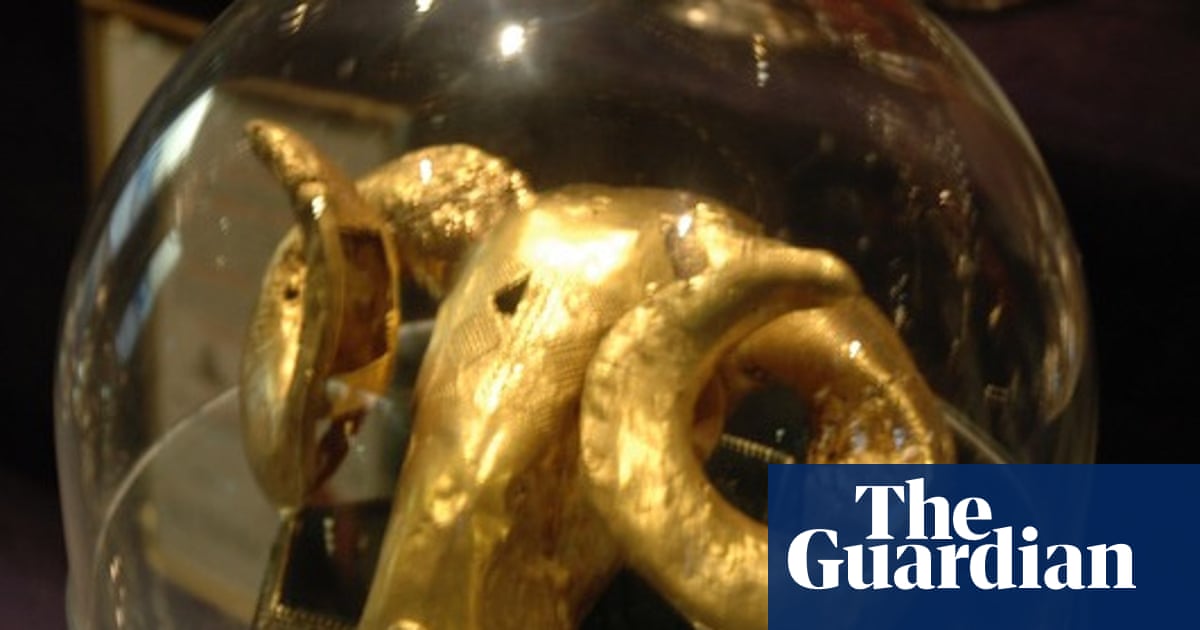
The Royal Artillery is facing criticism after it emerged they are refusing public access to an “extraordinary object” looted by the British Army in the 19th century from the Asante people in modern-day Ghana.The glistening golden ram’s head would seemingly be worthy of any museum, but it remains hidden within the regiment’s mess at Larkhill in Wiltshire.The artefact is among treasures pillaged by the British Army from the sprawling old royal palace in the Asante state capital, Kumasi, in 1874, before soldiers set fire to the city and blew up the palace. The British returned in 1896 and looted the rebuilt palace. Their commander later recalled: “I had shown the power of England.”The spoils of the Anglo-Asante wars were sold and dispersed among private and public collections, including to the Victoria and Albert Museum and the British Museum, which, in 2024, together made the historic decision to return 32 pieces of gold court regalia to the Manhyia Palace Museum in Ghana – although only on long-term loan.The most impressive of the looted objects is arguably the beautifully cast ram’s head with spiralling horns, about 19cm in width.Among newspaper reports of 1874, the Shipping and Mercantile Gazette reported: “The best trophy is a ram’s head … This is very valuable.”Barnaby Phillips, a former BBC correspondent who reported for over a decade from Mozambique, Angola, Nigeria and South Africa, was taken aback when his request to see it in researching his forthcoming book was turned down for security reasons.He said: “It’s an army institution holding the spoils of war, but they say it’s not safe to show it to me. That’s somewhat ironic.”He added: “The letter from the Royal Artillery’s regimental secretary was curt and categorical. The regiment was ‘unable to agree’ to my request to see its Asante gold ram’s head, held in the officers’ mess room at their barracks in Larkhill … ‘It has long been our policy, primarily on security grounds, not to allow public access to items held in the regiment’s private collection,’ wrote the secretary. He clarified that it was for insurance reasons.”Ivor Agyeman-Duah, a Kumasi-born historian, diplomat and director of the Manhyia Palace Museum, has been asked by the Asante king, Otumfuo Osei Tutu II, to help negotiate the return of Asante regalia with British institutions.“We are interested in negotiating with the Royal Artillery,” Agyeman-Duah said. “I hope to go to the officer’s mess when I’m next in England and I shall be writing to them. This piece is iconic evidence of Asante prowess over two centuries.”The Anglo-Asante wars ended in 1901 with the formal annexation of its territory into the Gold Coast British crown colony. They were caused partly by Britain’s interests in west Africa’s natural resources, resisted by the Asante people, for whom such gold objects are imbued with the spirits of their ancestors. The British campaign was further justified by their determination at that stage to end slavery.Phillips believes that the Royal Artillery may be “embarrassed” by a stand that was commissioned for the ram’s head in 1875, as it depicts three black boys in loincloths, as if holding the object aloft, while its base is engraved with words commemorating the battles and capture of the city.He said: “The stand transformed the ram’s head into a trophy and cemented its ceremonial role in the officer’s mess. It is also, from the perspective of the 21st century, in shockingly bad taste.”He added that there was further embarrassment over another piece in the same mess. The soldier who took the ram’s head, William Knox, also looted a magnificent silver cross from a church on the controversial 1868 military expedition to Abyssinia.Phillips said: “Two of the most extraordinary objects that were looted by the British Army are in this mess and nobody can see them, except for the regiment’s invited guests.”He argued that such important objects could at least be loaned to public museums rather than being seen by a select few.Phillips’s latest research features in his forthcoming book, titled The African Kingdom of Gold: Britain and the Asante Treasure, which will be published next month.He quotes an unnamed director of a major national museum, who had been allowed to visit the objects at Larkhill, telling him: “When you see those things, and you realise no one else can see them, and they will never leave this place, it’s like a punch in the stomach.”An army spokesperson said: “Whilst we don’t comment on individual cases, access to military locations is controlled for security, operational and safety reasons.”
SRCThe Guardian - World News
LANGEN
LEANCenter-Left
WORDS751
ENT6
TUE · 2026-02-24 · 13:45 GMTBRIEF NSR-2026-0224-18880
NSR-2026-0224-18880News Report·EN·Human Rights
Royal Artillery under fire after denying access to looted Asante treasure
The Royal Artillery is facing criticism for denying public access to a golden ram's head looted from the Asante people of Ghana in 1874. The artifact, taken during the Anglo-Asante wars, is held in the regiment's mess at Larkhill in Wiltshire.
Dalya AlbergeThe Guardian - World NewsFiled 2026-02-24 · 13:45 GMTLean · Center-LeftRead · 4 min
The Guardian - World NewsFIG 01
Reading time
4min
Word count
751words
Sources cited
4cited
Entities identified
6entities
Quality score
100%
§ 01
Briefing Summary
AI-generatedNEWSAR · AI
The Royal Artillery is facing criticism for denying public access to a golden ram's head looted from the Asante people of Ghana in 1874. The artifact, taken during the Anglo-Asante wars, is held in the regiment's mess at Larkhill in Wiltshire. The regiment cites security and insurance reasons for refusing access, even to researchers. This comes after the British Museum and the Victoria and Albert Museum agreed to loan 32 pieces of Asante gold regalia to Ghana's Manhyia Palace Museum. A historian representing the Asante king has expressed interest in negotiating with the Royal Artillery for the return of the ram's head.
Confidence 0.90Sources 4Claims 5Entities 6
§ 02
Article analysis
Model · rule-basedFraming
Human Rights
Conflict
Tone
Measured
AI-assessed
CalmNeutralAlarmist
Factuality
0.80 / 1.00
Factual
LowHigh
Sources cited
4
Well sourced
FewMany
§ 03
Key claims
5 extracted01
We are interested in negotiating with the Royal Artillery.
quoteIvor Agyeman-Duah
Confidence
1.00
02
The Victoria and Albert Museum and the British Museum returned 32 pieces of gold court regalia to Ghana on long-term loan in 2024.
factualArticle's own claim
Confidence
1.00
03
The regiment was ‘unable to agree’ to my request to see its Asante gold ram’s head due to security reasons.
quoteRoyal Artillery's regimental secretary
Confidence
1.00
04
The artefact is among treasures pillaged by the British army from the Asante state capital, Kumasi, in 1874.
factualArticle's own claim
Confidence
1.00
05
Royal Artillery is refusing public access to a golden ram’s head looted from the Asante people.
factualArticle's own claim
Confidence
1.00
§ 04
Full report
4 min read · 751 words§ 05
Entities
6 identifiedKey playerOppositionContextPositiveNeutralNegative
Organizations4
§ 06
Keywords & salience
9 termslooted treasure
0.90
asante
0.80
royal artillery
0.80
restitution
0.70
ram's head
0.60
cultural heritage
0.60
museum access
0.50
anglo-asante wars
0.50
officer's mess
0.40
§ 07
Topic connections
Interactive graph No topic relationship data available yet. This graph will appear once topic relationships have been computed.