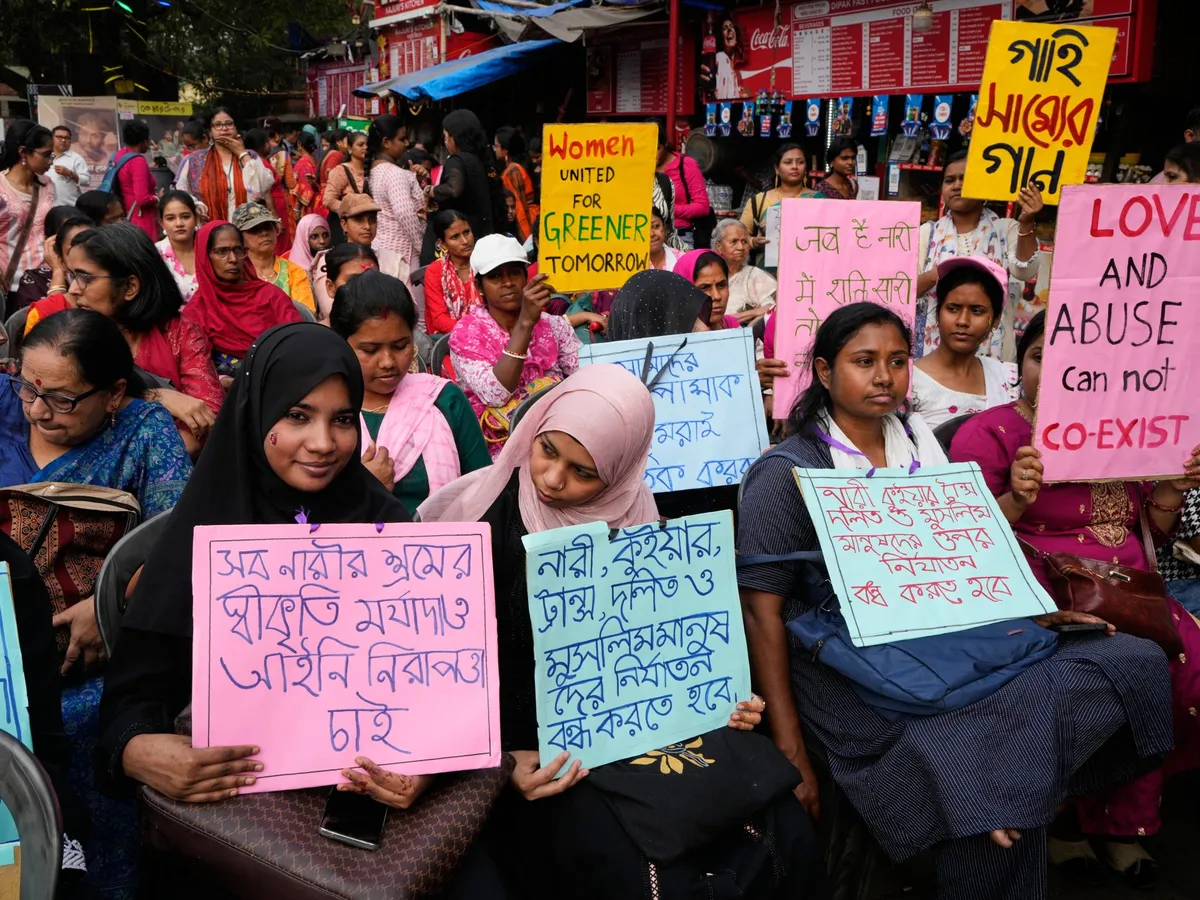
The government’s performed outrage over Bill Gates’s Epstein links only underlined its indifference to the routine violence faced by women in India.Activists with posters attend a rally during a "One Billion Rising" event calling for an end to violence against women and girls, in Kolkata, India, Tuesday, Feb. 24, 2026. [AP Photo/Bikas Das]Investigative journalist.Published On 25 Feb 2026As court documents tied to the late financier Jeffrey Epstein continue to surface, the scandal has become an international embarrassment, exposing how quickly powerful men can turn into reputational liabilities. That discomfort reached Delhi" class="entity-link entity-location" data-entity-id="623" data-entity-type="location">New Delhi, where Microsoft cofounder Bill Gates was expected to deliver the keynote address at the AI Impact Summit but ultimately did not attend amid criticism and apparent unease within the Modi government over his past meetings with Epstein. The spectacle was revealing. Public moral outrage travels swiftly when scandal threatens reputations and diplomatic optics. Yet that sensitivity to association sits uneasily beside a domestic reality in which sexual violence against women unfolds with brutal regularity, drawing neither comparable embarrassment nor consequence. The contrast is grotesque. A political culture capable of signalling discomfort towards a global scandal remains strikingly untroubled by the everyday brutality faced by women at home.Under the Modi administration, the news cycle churns with reports of gang rapes like factory output — steady, relentless, and numbing in repetition. The rapes have become so common that they are reported like the weather. Heatwave deaths. Flash flood. Five-year-old abducted, raped, murdered. And like the weather, only God is responsible. Not the rapist. Not the court. Not the police. Definitely not the prime minister.Between the time this piece was commissioned and published, a five-year-old was gang-raped in Meerut, a 26-year-old was gang-raped in Faridabad, and a 17-year-old was gang-raped in Odisha. A 42-year-old was gang-raped in Delhi’s suburbs. A 12-year-old girl was kidnapped and gang-raped in Bikaner. There were more gang rapes in Bihar, Chhattisgarh, Rajasthan, and Kanpur. I could give you statistics, but numbers could never convey the larger, all-encompassing terror of living with predators. The threat of sexual violence is as constant as gravity. The cases are gruesome — intestines pulled out, rods inserted, tongues cut out, acid thrown, decapitation, strangulation, and burning. When I look at government data about rape — an average of 86 women are raped every day — it feels as grisly as stumbling upon a mass grave in Excel sheets.Prime Minister Narendra Modi and his home minister, Amit Shah, ostensibly obsessed with restoring law and order at any cost, seem entirely unconcerned that India is the gang rape capital of the world on their watch.The most alarming instance of this was when convicted rapist and Bharatiya Janata Party politician Kuldeep Singh Sengar, found guilty of raping a minor in 2017 and a native of Makhi village in Unnao district of Uttar Pradesh, was granted bail by a high court, raising the possibility of his reintegration into the very social and political landscape that had once enabled his impunity. A high court granted him bail in December. Thankfully, it was stayed by the Supreme Court, but only after infuriated women gathered in Delhi to protest. Sengar had raped a teenager, who was also gang-raped by his associates. Her father was murdered in police custody. A case was registered only after she threatened to burn herself in front of the chief minister’s residence. Her tragic story showcases how Indian men, like the Modi administration, remain remarkably unembarrassed about the state of affairs.Sadly, this is not an aberration; it is the system speaking in its mother tongue.Public memory matters because each new case unfolds against the residue of the ones we were told would change everything. In 2012, I read about the “Nirbhaya” gang rape three days after the incident, on my way from the airport. I had been deliberately avoiding the news until she ended up at Safdarjung Hospital, and my editor needed a health update from me. After I learned all the details of what men had done to this young woman, I thought the world would stand still. A threshold had been crossed. Something told me the world would start anew. There were protests, and people everywhere would know her name, and something like this would never happen again.All of my naivety was drowned in a chorus of “Not All Men”, as the gang rape was turned into something viral to hang a hashtag on. The refrain did not defend innocence so much as redirect attention away from accountability and back towards male comfort.It is impossible for me to hear of such cases and not think: What if it were me? My body. That rod. Those men. The suffering and mutilation of women’s bodies is so reliable that there is now a market to help ease our fear. Security apps. Pepper sprays and wearable panic alarms. Every time I write about this subject, I sit with the absolute inadequacy of the written word in the face of men who film the rapes, brag about them, and get rehabilitated nevertheless.It wouldn’t be out of place to call this moment unprecedented, but it is beyond that. It is existential. Whether it is the United States or India, women are watching the same choreography of power protecting itself, as men of consequence close ranks and wait out the storm. The similarity lies not in scale or context, but in the recurring spectacle of institutions cushioning powerful men while survivors fight alone. For a while now, both countries — allegedly the biggest and the oldest democracies — have been on a trajectory of self-destruction, with men leading the way. Under Modi as well as Trump, rape has become an extension of politics. Women are violated no longer by men alone, but by courts, hospitals, and newsrooms, too. It is the age of monsters. It did not begin with Epstein, Gates, or Sengar, of course, but they are the symbols of it.While the middle class was busy buying into the dream of upward mobility, careerism, and two bedrooms in a gated suburb, we let thugs cultivate a wholesale misogynist empire that runs on hate for women. I do not know what to do with the rage I feel. What do you do when you are constantly told that your body, your people, your gender are disposable? I don’t know.What I do know is that the teenager who survived Sengar is still fighting for justice. I know that the survivors of Epstein’s sex trafficking network are fighting for justice, too. These women are fighting with heart and soul and sweat and muscle. I know that I have no right to be despondent while they stand tall, looking every inch the hero they are. I also know that nobody puts up a fight like that unless you love your sisters.At this dark hour, it feels important to place on record that as the Modi administration recoils theatrically from the shadow of the Epstein scandal at the summit stage, the satire writes itself. A government that cannot, or will not, protect its women should be far more ashamed of what is ordinary than of what is scandalous.The views expressed in this article are the author’s own and do not necessarily reflect Al Jazeera’s editorial stance.
SRCAl Jazeera
LANGEN
LEANCenter
WORDS1 204
ENT10
WED · 2026-02-25 · 10:44 GMTBRIEF NSR-2026-0225-19115
NSR-2026-0225-19115Analysis·EN·Human Rights
In Modi’s India, scandal still embarrasses but rape has become ordinary
The article discusses the Indian government's reaction to Bill Gates' association with Jeffrey Epstein and contrasts it with the government's perceived indifference to sexual violence against women in India. While the Modi administration showed concern over the potential reputational damage from the Epstein scandal, the article argues that it has failed to address the routine and brutal sexual violence faced by women within the country.
Vidya KrishnanAl JazeeraFiled 2026-02-25 · 10:44 GMTLean · CenterRead · 5 min
Al JazeeraFIG 01
Reading time
5min
Word count
1 204words
Sources cited
0cited
Entities identified
10entities
Quality score
100%
§ 01
Briefing Summary
AI-generatedNEWSAR · AI
The article discusses the Indian government's reaction to Bill Gates' association with Jeffrey Epstein and contrasts it with the government's perceived indifference to sexual violence against women in India. While the Modi administration showed concern over the potential reputational damage from the Epstein scandal, the article argues that it has failed to address the routine and brutal sexual violence faced by women within the country. The author cites numerous recent gang rape cases across India, highlighting a pattern of violence that has become commonplace. The article suggests that this indifference reveals a political culture more concerned with international optics than with the safety and well-being of its female citizens. The author argues that sexual violence has become normalized under the Modi administration.
Confidence 0.90Claims 5Entities 10
§ 02
Article analysis
Model · rule-basedFraming
Human Rights
Political Strategy
Tone
Sensational
AI-assessed
CalmNeutralAlarmist
Factuality
0.30 / 1.00
Opinion-Heavy
LowHigh
Sources cited
0
No named sources
FewMany
§ 03
Key claims
5 extracted01
Convicted rapist Kuldeep Singh Sengar is a Bharatiya Janata Party politician.
factualArticle's own claim
Confidence
1.00
02
Bill Gates did not attend the AI Impact Summit amid criticism over his past meetings with Jeffrey Epstein.
factualArticle's own claim
Confidence
0.90
03
An average of 86 women are raped every day in India.
statisticGovernment data (implied)
Confidence
0.80
04
Under the Modi administration, reports of gang rapes are frequent.
factualArticle's own claim
Confidence
0.70
05
India is the gang rape capital of the world on Modi's watch.
factualArticle's own claim
Confidence
0.60
§ 04
Full report
5 min read · 1 204 words§ 05
Entities
10 identifiedKey playerOppositionContextPositiveNeutralNegative
People3
Organizations1
§ 06
Keywords & salience
9 termssexual violence
1.00
rape
0.90
violence against women
0.90
india
0.80
gang rape
0.80
modi administration
0.70
jeffrey epstein
0.60
bill gates
0.60
political culture
0.50
§ 07
Topic connections
Interactive graph Network visualization showing 51 related topics
View Full Graph Person Organization Location Event|Click node to navigate|Edge numbers = shared articles