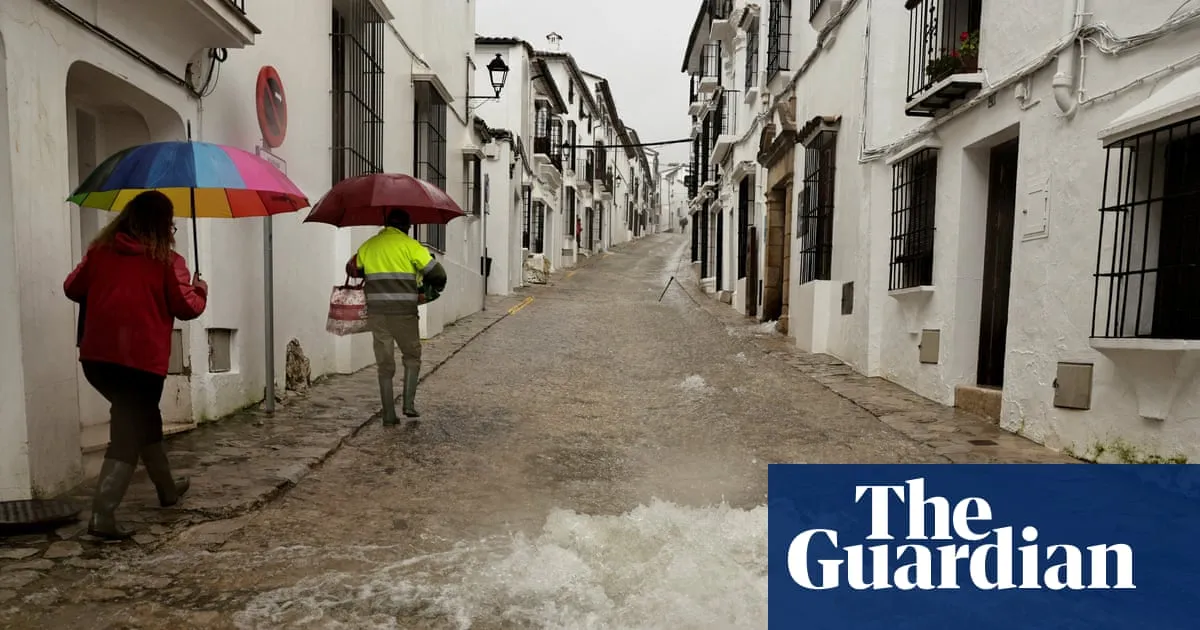
For Andrés Sánchez Barea, in Spain, it was the fear that arose when water started to spurt from plug sockets. For Nelson Duarte, in Portugal, it was the helplessness that hit as violent winds smacked down trees and tore tiles from roofs. For Amal Essuide, in Morocco, it was the reality that dawned when a corpse was pulled onboard a boat in the flooded medina.Each moment of horror is a fragment of the destruction wrought by an atmospheric machine-gun that in recent weeks has fired storm after storm at the western Mediterranean. Scientists do not know if climate breakdown helped pull the trigger, but research suggests it loaded the chamber with bigger bullets.Debris after Storm Kristin in Leiria, Portugal, in early February. The storm took out electricity, telephone and internet services in the region. Photograph: Pedro Nunes/ReutersIn Grazalema, Spain’s wettest town, a year’s-worth of rain fell in a fortnight and overloaded the karst aquifer beneath it. Water rushed into homes through floors, walls and even electricity sockets. Authorities ordered everyone to evacuate.“I felt a lot of fear,” said Sánchez Barea, a guesthouse owner whose home is one of hundreds still in an exclusion zone. “At first we tried to get rid of the water. Lots of people came to help, but we realised it was impossible.”Grazalema rainfall graphIn Leiria, one of four regions in Portugal where extreme rain broke records in January, powerful winds added to the damage. Monte Real airbase logged a top wind speed of 109mph (176km/h) before the station was hit and measurements stopped. Storm Kristin took out electricity, internet, and telephone service in the early hours of a morning that would soon turn deadly.“It was around this time that everything seemed to be falling apart,” said Duarte, a beekeeper in Monte Real who lost half his hives. The house-rattling wind trapped him and his family indoors, where they could do nothing but avoid balconies and windows as they waited it out.“The wind became deafening and relentless, mixed with the sound of collapsing structures, flying tiles, breaking trees and violently banging metal sheets,” Duarte said. “The atmosphere was terrifying and conveyed the feeling the house might not hold up.”Duarte’s house held, but others’ did not. Ricardo Teodósio, an industrial painter in neighbouring Carvide, was fixing a garage roof with his father when it collapsed on them. Injured, the older man walked 1.8 miles to a fire station to get help for his son, who was trapped under the rubble. He was dead by the time they arrived.João Lavos, the commander of the volunteer firefighters of Vieira de Leiria, said Teodósio was one of two people to die in the Carvide-Leiria region that day. In the space of 24 hours, the firefighters were deployed to 50 storm-related events, 15 of which involved victims of accidents. “It was an unprecedented situation that caused immense damage.”Flooding in Portugal this year. Early analysis from Climate Central has found the climate crisis made a marine heatwave that supercharged the storms in early February 10 times more likely. Photograph: Sergio Azenha/APWestern Europe has been battered by 16 rapid-fire storms this season due to a shift in atmospheric currents that some scientists suggest will become more common as the planet heats up.While the role that the climate crisis played in the formation of the storms is still uncertain, early analysis from Climate Central found it made a marine heatwave that supercharged the storms in early February 10 times more likely. On Thursday, a study by World Weather Attribution (WWA), which uses established methods but has not yet been sent for peer review, found carbon pollution made the rains stronger and the floods worse.In Safi, the ceramics capital of Morocco, explosive mud waves shattered fragile pottery stores when rain swamped the souk at the end of last year. Most of the 43 people killed in storms across the country since mid-December died in the narrow, winding streets of its medina as water surged through.“At first, we didn’t think there would be big damages,” said Essuide, who watched the chaos play out from the roof of the hotel she runs in the old town, and who was picked up by a rescue team. “But after we entered the small boat, and they found someone dead, then we realised it was a very hard thing. It was scary.”Drone footage shows severe flooding in Morocco after heavy rain – videoObservational data show the most extreme rainfall days in Spain, Portugal and Morocco unleash one-third more water than they did in the 1950s, according to the WWA study, though climate models paint a more mixed picture. The researchers attributed an 11% increase in rain in the northern study region to global heating, but the effect on the southern study region was too uncertain to quantify using probabilistic methods.Clair Barnes, a scientist at Imperial College London and co-author of the study, said: “Trends in the region are mixed and are not represented by the climate models. However, other lines of evidence do suggest that climate change has increased the amount of water available in that weather system to fall as rain.”Last week, the EU’s official science advisers said Europe was failing to adapt to a hotter planet and the more extreme weather it brings. In Portugal, Duarte said emergency warnings failed to generate the necessary level of public alarm.Military and civil authorities work in a flooded street in the aftermath of a storm in Ksar El Kebir, Morocco, in January. Photograph: Moroccan authorities/Reuters“Nobody was prepared for such a devastating force,” he said, adding that the death toll could have easily reached hundreds if the storm had struck during the day, rather than at night. “It caught us all completely by surprise.”In Spain, meanwhile, people in Grazalema praised authorities for a timely evacuation. The centre-left leadership of the centre-left town came to a swift agreement with the centre-right authorities in Ronda, the town next door, which opened its doors to neighbours seeking shelter.“They did the right thing,” said Mario Sánchez Coronel, who runs a textile shop in Grazalema that flooded. “They acted under pressure, and it’s not easy to act like that.”In what Sánchez Coronel described as a “miracle”, his wool blanket factory suffered only minor flooding. He said he hoped to never see such rains again.“It was hard, because you think about what might happen next,” he said. “After the ‘bad’, will the ‘worst’ come?”
SRCThe Guardian - World News
LANGEN
LEANCenter-Left
WORDS1 065
ENT6
THU · 2026-02-26 · 05:00 GMTBRIEF NSR-2026-0226-19386
NSR-2026-0226-19386News Report·EN·Environmental
‘A devastating force’: how recent Mediterranean storms turned to tragedies
Recent storms across the western Mediterranean have caused widespread devastation in Spain, Portugal, and Morocco. In Spain's wettest town, Grazalema, a year's worth of rain fell in two weeks, flooding homes and forcing evacuations.
Ajit NiranjanThe Guardian - World NewsFiled 2026-02-26 · 05:00 GMTLean · Center-LeftRead · 5 min
The Guardian - World NewsFIG 01
Reading time
5min
Word count
1 065words
Sources cited
6cited
Entities identified
6entities
Quality score
75%
§ 01
Briefing Summary
AI-generatedNEWSAR · AI
Recent storms across the western Mediterranean have caused widespread devastation in Spain, Portugal, and Morocco. In Spain's wettest town, Grazalema, a year's worth of rain fell in two weeks, flooding homes and forcing evacuations. Portugal experienced record-breaking rainfall and winds up to 109 mph, causing power outages, infrastructure damage, and at least one fatality when a garage roof collapsed. In Morocco, the storms contributed to flooding and the discovery of bodies, highlighting the tragic human cost. While scientists are unsure if climate change triggered the storms, research suggests it may have intensified their impact. The storms, occurring in recent weeks, have left residents with feelings of fear, helplessness, and loss.
Confidence 0.90Sources 6Claims 10Entities 6
§ 02
Article analysis
Model · rule-basedFraming
Environmental
Human Interest
Tone
Mixed Tone
AI-assessed
CalmNeutralAlarmist
Factuality
0.70 / 1.00
Factual
LowHigh
Sources cited
6
Well sourced
FewMany
§ 03
Key claims
10 extracted01
Monte Real airbase logged a top wind speed of 109mph (176km/h) before the station was hit.
factualArticle
Confidence
1.00
02
It was an unprecedented situation that caused immense damage.
quoteJoão Lavos, the commander of the volunteer firefighters of Vieira de Leiria
Confidence
1.00
03
A year’s-worth of rain fell in a fortnight in Grazalema, Spain.
factualArticle
Confidence
1.00
04
Ricardo Teodósio...was fixing a garage roof with his father when it collapsed on them. He was dead by the time they arrived.
factualArticle's own claim
Confidence
1.00
05
Monte Real airbase logged a top wind speed of 109mph (176km/h) before the station was hit and measurements stopped.
statisticArticle's own claim
Confidence
1.00
06
In Grazalema, Spain’s wettest town, a year’s-worth of rain fell in a fortnight.
factualArticle's own claim
Confidence
1.00
07
Ricardo Teodósio died after a garage roof collapsed on him during the storm.
factualArticle
Confidence
1.00
08
Storm Kristin took out electricity, internet, and telephone service in the early hours.
factualArticle
Confidence
1.00
09
Scientists do not know if climate breakdown helped pull the trigger, but research suggests it loaded the chamber with bigger bullets.
factualArticle's own claim based on research
Confidence
0.80
10
Early analysis from Climate Central has found the climate...
factualArticle
Confidence
0.80
§ 04
Full report
5 min read · 1 065 words§ 05
Entities
6 identifiedKey playerOppositionContextPositiveNeutralNegative
Locations5