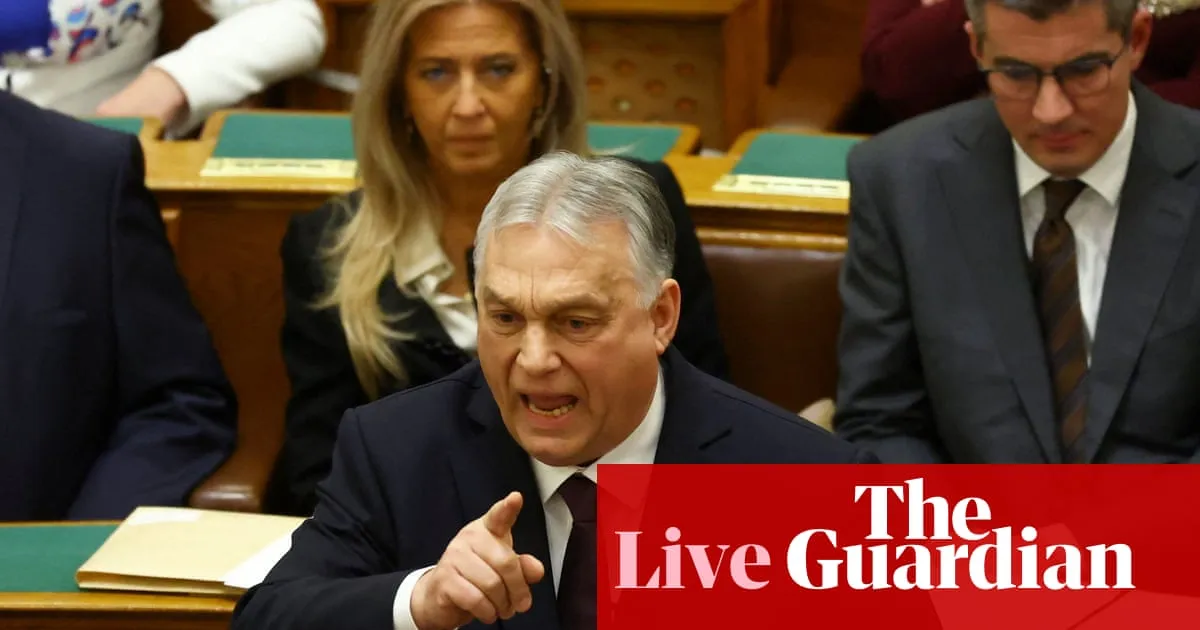
From 25m agoHungary's Orbán calls for EU 'fact-finding mission' to inspect Druzhba pipelineMeanwhile, Hungary’s prime minister Viktor Orbán has urged the European Union to form a “fact-finding mission” to inspect the Druzhba pipeline amid escalating tension with Ukraine.Hungarian prime minister Viktor Orbán speaks during the spring session of parliament in Budapest. Photograph: Bernadett Szabó/ReutersIn a letter to European Council president António Costa, Orbán insisted that his initiative seeks to “facilitate the timely resolution of this issue,” which held up the payment of the EU’s €90bn loan to Ukraine and the adoption of the 20th package of sanctions against Russia (9:47).He asked that the mission included experts from Hungary and Slovakia, which also continues to be affected by the disrupted oil transit via the pipeline.He assured Costa that Hungary would accept the findings of such mission, whatever they will be.Key events11m agoNordic region on high alert over alleged threat against energy infrastructure - media report25m agoHungary's Orbán calls for EU 'fact-finding mission' to inspect Druzhba pipeline36m agoKeeping close eye on Denmark amid election speculation53m agoUS-Ukraine Geneva talks to focus on postwar reconstruction plans2h agoDefending Nato's eastern flank from Russia would cost €1.2tn, Poland says2h agoMorning openingShow key events onlyPlease turn on JavaScript to use this featureNordic region on high alert over alleged threat against energy infrastructure - media reportMeanwhile, the Nordic countries are on high alert amid concerns about a potential strike against their energy infrastructure, Sweden’s TV4 reported.The broadcaster claimed that “an actor, believed to be linked to a foreign power, has threatened the energy network throughout the Nordic region, including Sweden.”In response, a number of authorities and police units have been put on high alert and ordered to closely monitor the critical infrastructure, TV4 said.It claimed that the potential incident could take place in “near future.”The report was widely picked up by other Swedish media outlets.The Guardian has not been able independently verify the report. We have approached Sweden’s signal intelligence agency for comment.Hungary's Orbán calls for EU 'fact-finding mission' to inspect Druzhba pipelineMeanwhile, Hungary’s prime minister Viktor Orbán has urged the European Union to form a “fact-finding mission” to inspect the Druzhba pipeline amid escalating tension with Ukraine.Hungarian prime minister Viktor Orbán speaks during the spring session of parliament in Budapest. Photograph: Bernadett Szabó/ReutersIn a letter to European Council president António Costa, Orbán insisted that his initiative seeks to “facilitate the timely resolution of this issue,” which held up the payment of the EU’s €90bn loan to Ukraine and the adoption of the 20th package of sanctions against Russia (9:47).He asked that the mission included experts from Hungary and Slovakia, which also continues to be affected by the disrupted oil transit via the pipeline.He assured Costa that Hungary would accept the findings of such mission, whatever they will be.Keeping close eye on Denmark amid election speculationMiranda BryantNordic correspondentWe are keeping a close eye on developments in Copenhagen today amid speculation that today could potentially be the day that Mette Frederiksen calls a general election.Denmark's prime minister Mette Frederiksen Photograph: Mads Claus Rasmussen/EPAToday was already a date that had been tipped as a potential one for the election to be called – it must be held by 31 October this year at the latest – but when the Danish prime minister arrived at Folketinget, the Danish parliament, a little while ago, it prompted much excitement among politicians and journalists. On her way, she posted on Instagram that she was on her way to vote for food support legislation “amongst other things” and entered Folketingshallen smiling with a red folder under her arm.Since then, she has been doing a lot of embracing of colleagues around the chamberSocial Democrat Yildiz Akdogan has just shared a picture of the PM on X with the question: “Is the election coming?”US-Ukraine Geneva talks to focus on postwar reconstruction plansMeanwhile, back in Geneva, the US and Ukrainian negotiators are expected to hold talks which will focus on postwar reconstruction as part of a broader push to end the Russian invasion of Ukraine, Reuters reported.The discussions, revolving around the so-called “prosperity package” for Ukraine, were expected to begin around lunchtime.This stream of talks is separate from the trilateral negotiations that involve Russia and seek to find a way forward to end the conflict.The US delegation is also separately holding Iran talks, also in Geneva.Continuing his speech, Sikorski also told Polish parliament that while Washington remains Poland’s most important partner in military cooperation and Warsaw has been and will remain a loyal ally of the US, it cannot be “a sucker”.In a lengthy passage responding to the changing US defence and foreign policy, he said: “We view the shifts in the US with understanding, but also with unease. We remember the history of support for Poland from presidents like Woodrow Wilson and Ronald Reagan during the various eras when we fought for our independence. But we also remember Yalta. After the fall of Nazi Germany, president Franklin Roosevelt sought Stalin’s help in the war against Japan. He secured it, but at the expense of freedom for this part of Europe. The American national interest was served; we were the ones who paid the price. I submit this for the consideration of those who want international relations to be based solely on a ruthless struggle for narrowly defined interests. It is not for us to define the US national interest. I ask the right side of this chamber: has it not dawned on you that the day before yesterday, the United States – just like China – abstained from the UN general assembly vote on the inviolability of Ukraine’s borders? If we replace 1945 Japan with today’s China, can we be certain that American interests will remain aligned with Polish ones? We have been, and will remain, a loyal ally of America – but we cannot afford to be suckers.” Instead, he stressed that Poland has been radically ramping up its defence spending and is leading the European part of Nato in taking more and more responsibility for defending the continent, while also spending billions on defence purchases, including from the US.Nato spending dataSikorski also pointedly referenced the Polish victims of military operations in Iran and Afghanistan in an indirect response to Trump’s comment belittling non-US army contributions last month.He also acknowledged the shifting public attitudes to the US as a result, pointing to a recent poll which showed that 54% of Poles do not consider the US a reliable ally, with only 35% saying they do.Defending Nato's eastern flank from Russia would cost €1.2tn, Poland saysDefending Nato’s eastern flank in case of a potential Russian aggression would cost at least €1.2tn ($1.42 trillion), Polish foreign minister Radosław Sikorski said in a speech to parliament, Reuters reported.Poland's foreign minister Radosław Sikorski speaks to the press earlier this week. Photograph: Olivier Matthys/EPA“Defending the countries of Nato’s eastern flank in the event of a potential Russian aggression would cost at least twelve hundred billion euros - twenty-four times more than the Polish defence budget,” he warned.He compared that to just under €200bn that the EU and its member states have paid to Ukraine since 2022.“A free Ukraine, as part of the West, is our chance to render Russian imperialism toothless,” he said.He added: “Despite what its propaganda claims, Russia is by no means winning. Don’t fall for it. Russia is not, and never has been, invincible.” Sikorski also paid tribute to the economic contribution of Ukrainian migrants and refugees resident in Poland, adding PLN 100bn (€24bn) to Poland’s GDP, the equivalent of half of the annual budget of Poland’s healthcare system.Morning openingJakub KrupaUS and Ukrainian negotiators meet in Geneva, Switzerland for further talks about ending the Russian invasion of Ukraine amid continuing attacks on Ukrainian cities.At least 23 people were injured in overnight strikes, with 420 drones and 39 missiles used by Russia to target Ukraine in the latest round of attacks.“When the whole world demands Moscow to finally stop this senseless war, Putin bets on more terror, attacks, and aggression,” Ukrainian foreign minister Andrii Sybiha said.The interior of the damaged flat in an apartment building hit by a Russian drone strike, amid Russia's attack on Ukraine, in Zaporizhzhia, Ukraine. Photograph: ReutersMeanwhile, Hungary’s Viktor Orbán appears to be escalating his rhetoric against Ukraine even further, making unsubstantiated allegations that the wartorn country could be planning to disrupt Hungarian energy system.This morning he posted an “open letter” to Ukraine’s Volodymyr Zelenskyy, alleging that for years he “had been working to force Hungary into the war between your country and Russia,” with alleged support from Brussels and the Hungarian opposition forces.In a separate clip from a radio interview, Orbán said he had always expected Ukraine to engage in “dirty tricks” alleging a conspiracy to “create chaos and supply insecurity” in Hungary’s energy sector.Kyiv continues to strongly deny all of Orbán’s allegations and says the disruption to oil transit via the Druzhba pipeline is solely related to damage from Russian strikes.The Hungarian prime minister’s language appears to be increasingly toughening as we get closer to the 12 April parliamentary election, which could see him ousted from power after 16 years, with the latest polls showing him trailing the opposition party Tisza led by Péter Magyar by as much as 20 percentage points among decided voters.“It is unacceptable when certain blackmailers in the EU not only block decisions needed for collective defence, but also threaten to halt some energy supplies to Ukraine at a time when our country’s energy system is being brutally bombed,” Ukraine’s Sybiha responded this morning.It’s Thursday, 26 February 2026, it’s Jakub Krupa here, and this is Europe Live.Good morning.
SRCThe Guardian - World News
LANGEN
LEANCenter-Left
WORDS1 599
ENT11
THU · 2026-02-26 · 10:37 GMTBRIEF NSR-2026-0226-19436
NSR-2026-0226-19436News Report·EN·National Security
Defending Nato’s eastern flank from Russia would cost Poland 24 times its current defence budget, minister warns – Europe live
The article reports on several European developments. Firstly, Poland estimates that defending NATO's eastern flank from Russia would cost €1.2 trillion, 24 times its current defense budget.
Jakub KrupaThe Guardian - World NewsFiled 2026-02-26 · 10:37 GMTLean · Center-LeftRead · 7 min
The Guardian - World NewsFIG 01
Reading time
7min
Word count
1 599words
Sources cited
5cited
Entities identified
11entities
Quality score
100%
§ 01
Briefing Summary
AI-generatedNEWSAR · AI
The article reports on several European developments. Firstly, Poland estimates that defending NATO's eastern flank from Russia would cost €1.2 trillion, 24 times its current defense budget. Secondly, Hungary's Prime Minister Viktor Orbán has requested the EU establish a fact-finding mission to inspect the Druzhba pipeline, citing escalating tensions with Ukraine and disruptions to oil transit affecting Hungary and Slovakia. Orbán assured the EU that Hungary would accept the mission's findings. Finally, Nordic countries are on high alert due to a potential threat against their energy infrastructure, allegedly linked to a foreign power. Authorities and police units are closely monitoring critical infrastructure in response to the reported threat.
Confidence 0.90Sources 5Claims 5Entities 11
§ 02
Article analysis
Model · rule-basedFraming
National Security
Political Strategy
Tone
Measured
AI-assessed
CalmNeutralAlarmist
Factuality
0.70 / 1.00
Factual
LowHigh
Sources cited
5
Well sourced
FewMany
§ 03
Key claims
5 extracted01
Hungary’s prime minister Viktor Orbán has urged the European Union to form a “fact-finding mission” to inspect the Druzhba pipeline.
factualViktor Orbán
Confidence
1.00
02
The initiative seeks to “facilitate the timely resolution of this issue,” which held up the payment of the EU’s €90bn loan to Ukraine.
quoteViktor Orbán
Confidence
0.90
03
Defending Nato's eastern flank from Russia would cost €1.2tn, Poland says.
statisticPoland
Confidence
0.90
04
Nordic countries are on high alert amid concerns about a potential strike against their energy infrastructure.
factualSweden’s TV4
Confidence
0.70
05
An actor, believed to be linked to a foreign power, has threatened the energy network throughout the Nordic region, including Sweden.
factualSweden’s TV4
Confidence
0.60
§ 04
Full report
7 min read · 1 599 words§ 05
Entities
11 identifiedKey playerOppositionContextPositiveNeutralNegative
§ 06
Keywords & salience
9 termsnato eastern flank defense
0.90
russia
0.80
energy infrastructure threat
0.70
druzhba pipeline
0.70
viktor orbán
0.60
eu fact-finding mission
0.60
ukraine
0.50
nordic region
0.50
sanctions against russia
0.40
§ 07
Topic connections
Interactive graph Network visualization showing 7 related topics
View Full Graph Person Organization Location Event|Click node to navigate|Edge numbers = shared articles