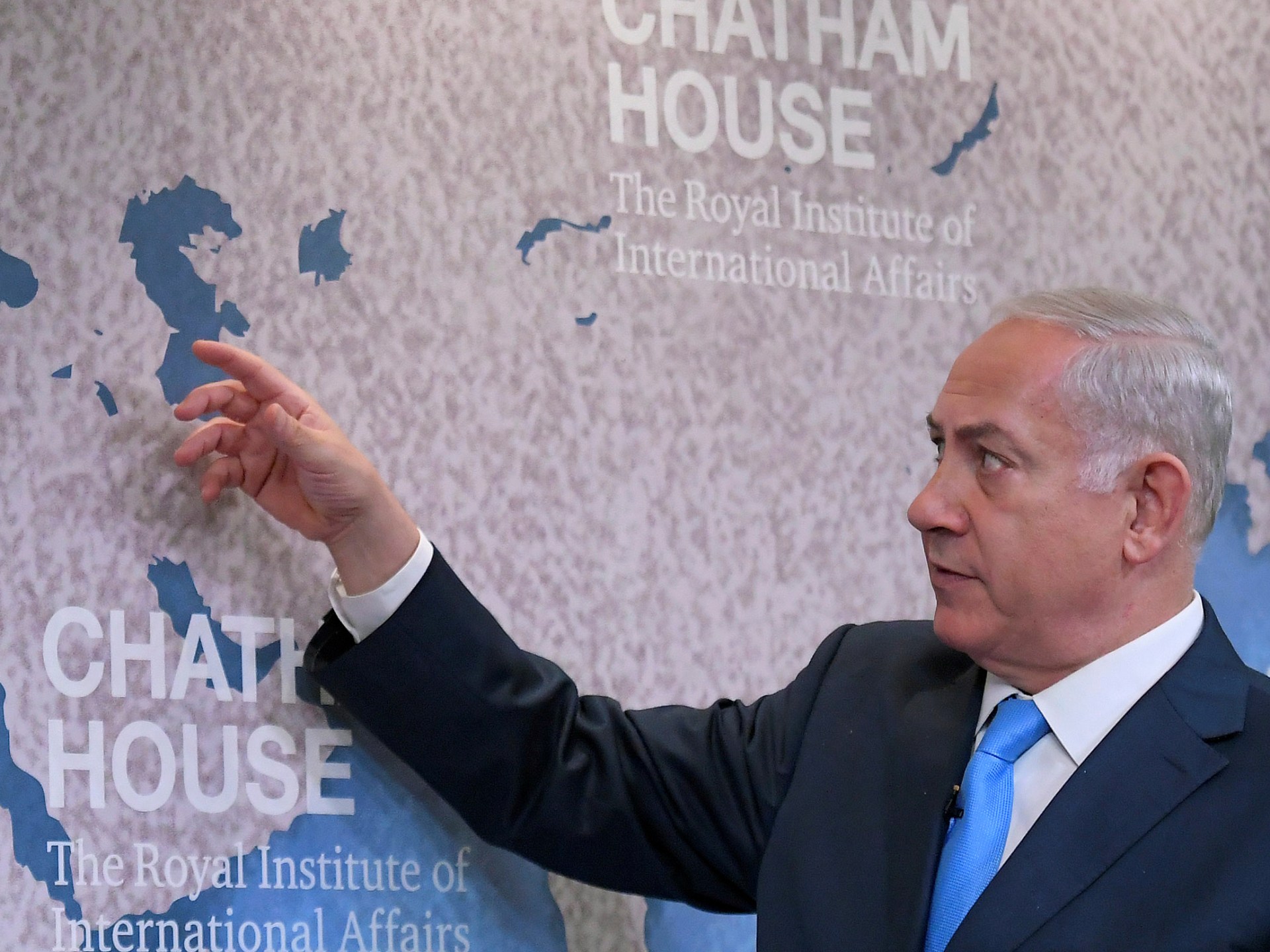
EXPLAINERRecent US and Israeli comments on ‘Israel" class="entity-link entity-location" data-entity-id="36836" data-entity-type="location">Greater Israel’ trigger regional concerns over sovereignty and territorial expansion.Israel's Prime Minister Benjamin Netanyahu has shown little respect for the sovereignty of Israel's neighbours. [File: Toby Melville/Reuters]Published On 26 Feb 2026Recent comments by United States and Israeli officials supporting the concept of a “Israel" class="entity-link entity-location" data-entity-id="36836" data-entity-type="location">Greater Israel” have raised alarm bells across the region and shed light on a vision once only rarely publicly spoken about.An interview aired last week by the American right-wing podcaster Tucker Carlson with US ambassador to Israel Mike Huckabee started the current furore. Carlson, an influential figure who has been vocally critical of Israel over the past year, repeatedly asked Huckabee whether he supported Israel controlling all the land between the Nile River in Egypt and the Euphrates River in Iraq.Recommended Stories list of 3 itemslist 1 of 3Will Mexico’s Jalisco cartel’s violent biz model survive El Mencho’s death?list 2 of 3Poland charges ex-intel chiefs for using Israel’s Pegasus spywarelist 3 of 3India’s Modi tells Israel’s Knesset: ‘No cause justifies killing civilians’end of listHuckabee, a Christian Zionist, would not disavow the belief that the Bible promised that land to Israel – even though it now encompasses all or part of Egypt, Iraq, Jordan, Lebanon, Saudi Arabia and Syria.“It would be fine if they took it all,” Huckabee said, leading to anger from those countries and others in the region, many of which are close US allies.Then, speaking on Monday, Israeli opposition leader Yair Lapid said that he would support “anything that will allow the Jews a large, broad, strong land and a safe haven for us”.“Zionism is based on the Bible. Our mandate over the land of Israel is biblical, [and] the biblical borders of the land of Israel are clear … Therefore, the borders are the borders of the Bible,” the apparently secular Israeli politician said.So what is Israel" class="entity-link entity-location" data-entity-id="36836" data-entity-type="location">Greater Israel exactly? And is it really an ultimate goal for some Israeli politicians?Defining Greater IsraelThe most expansionist claim for a Israel" class="entity-link entity-location" data-entity-id="36836" data-entity-type="location">Greater Israel is based on a biblical verse (Genesis 15:18-21), which narrates God making a covenant with Abraham that promises his descendants the land between the Nile and the Euphrates.That would include the Jewish people, with the tribes of Israel believed to be descended through Abraham’s son, Isaac. But it would also include the children of another of Abraham’s sons, Ishmael (Ismail), regarded as the forefather of the Arabs.Other definitions based on different biblical verses are narrower in their territorial scope and specify that the land of Israel would be promised to the tribes of Israel descended from Isaac.How has Israel worked to achieve expansion?The current state of Israel emerged from the British Mandate for Palestine in 1948. The mandate, created by the League of Nations in the wake of World War I and the occupation of Palestine by the British, geographically limited Israel upon its creation.The 1948 war that followed the end of the mandate led to Israel taking control of all of Mandatory Palestine, with the exception of the West Bank and the Gaza Strip.But Israel soon expanded by force – in 1967 it defeated Arab forces and took control of the West Bank and Gaza, as well as Egypt’s Sinai Peninsula, and Syria’s occupied Golan Heights. Israel continues to occupy all of those regions, with the exception of the Sinai, which it returned to Egypt in 1982.Since then, Israel has ignored international law and continued occupying Palestinian and Syrian land, and has shown little respect for its neighbours’ sovereignty, occupying more land in Syria, as well as in Lebanon.How popular is the idea of Israel" class="entity-link entity-location" data-entity-id="36836" data-entity-type="location">Greater Israel?This needs to be broken down into two separate concepts – the expansion of Israel into the territory that immediately borders it, and the most extreme definition of Israel" class="entity-link entity-location" data-entity-id="36836" data-entity-type="location">Greater Israel: between the Nile and the Euphrates.In terms of expansion into its immediate surroundings, Israeli Jews by and large support the annexation of East Jerusalem, which is occupied Palestinian territory, and the Golan Heights.The Israeli government continues to move towards the de facto annexation of the occupied West Bank. Israeli politicians vary in how open they are in their support for the formal annexation of the West Bank, but most mainstream Israeli politicians are supportive of the illegal Israeli settlements in the territory.An expansion of Israeli settlements into Gaza is not as popular, but is supported by far-right Israeli parties.A Israel" class="entity-link entity-location" data-entity-id="36836" data-entity-type="location">Greater Israel, including parts of Jordan, or the most irredentist definition between the Euphrates and the Nile, is more controversial. Pre-1948, many Zionists sought not just Palestine but also Jordan for their future state – one of the most important Zionist armed groups at the time, the Irgun, even included the map of both Palestine and Jordan in its emblem.But after the foundation of Israel this took a back seat, and open calls for a vastly expanded Israel were largely restricted to the fringes. But those fringes – far-right figures like Bezalel Smotrich and Itamar Ben-Gvir – are now in government, reflecting a wider radicalisation within Israeli society itself.That means the Israeli ‘mainstream’, politicians such as Prime Minister Benjamin Netanyahu and centrists like Lapid, are either more open in their support for some form of Israel" class="entity-link entity-location" data-entity-id="36836" data-entity-type="location">Greater Israel beyond the West Bank, or less willing to publicly oppose it.How threatened do regional countries feel?Regional states have said that the annexation of the West Bank would be a red line, but have been unable to reverse Israel’s occupation.Hints at a wider expansion have led to an angry reaction from Arab countries. This goes further back than Huckabee’s recent comments. For example, Jordan condemned Smotrich – Israel’s finance minister – when he gave a speech in 2023 at a podium that displayed a map that showed Jordan as part of Israel.And Huckabee’s support for Israel" class="entity-link entity-location" data-entity-id="36836" data-entity-type="location">Greater Israel was roundly condemned by more than a dozen states, including Saudi Arabia, Egypt and Turkiye.For Arab and Muslim states, the anger at the comments partially emanates from the sense of a lack of respect towards the sovereignty of regional states by a US official. But it also highlights fears that the balance of power in the region is weighted towards an Israel that is increasingly willing to attack across the Middle East, and has little interest in peace.Even if the takeover of the land between the Nile and the Euphrates is not feasible, a region where Israel is the primary hegemon will likely lead to more attacks, more wars, and, if Israel determines it necessary, more occupation of land.
SRCAl Jazeera
LANGEN
LEANCenter
WORDS1 078
ENT12
THU · 2026-02-26 · 14:56 GMTBRIEF NSR-2026-0226-19563
NSR-2026-0226-19563Analysis·EN·Political Strategy
What is Greater Israel, and how popular is it among Israelis?
Recent comments by U.S. and Israeli officials regarding a "Greater Israel" have sparked regional concerns.
Al Jazeera StaffAl JazeeraFiled 2026-02-26 · 14:56 GMTLean · CenterRead · 5 min
Al JazeeraFIG 01
Reading time
5min
Word count
1 078words
Sources cited
2cited
Entities identified
12entities
Quality score
100%
§ 01
Briefing Summary
AI-generatedNEWSAR · AI
Recent comments by U.S. and Israeli officials regarding a "Greater Israel" have sparked regional concerns. The controversy began with U.S. Ambassador Mike Huckabee's interview where he didn't dismiss the idea of Israel controlling land from the Nile to the Euphrates, encompassing parts of several neighboring countries. Israeli opposition leader Yair Lapid then stated his support for a large, strong land for Jews, citing biblical mandates for Israel's borders. The concept of Greater Israel is based on a biblical verse promising Abraham's descendants land between the Nile and Euphrates rivers. This vision has raised alarm bells due to its implications for sovereignty and territorial expansion in the region.
Confidence 0.90Sources 2Claims 5Entities 12
§ 02
Article analysis
Model · rule-basedFraming
Political Strategy
Conflict
Tone
Mixed Tone
AI-assessed
CalmNeutralAlarmist
Factuality
0.70 / 1.00
Factual
LowHigh
Sources cited
2
Limited
FewMany
§ 03
Key claims
5 extracted01
The current state of Israel emerged from the British Mandate for Palestine in 1948.
factualArticle
Confidence
1.00
02
Lapid said he would support “anything that will allow the Jews a large, broad, strong land and a safe haven for us”.
quoteYair Lapid
Confidence
1.00
03
Huckabee said, “It would be fine if they took it all,” referring to Israel controlling land between the Nile and Euphrates.
quoteMike Huckabee
Confidence
1.00
04
The most expansionist claim for a Greater Israel is based on Genesis 15:18-21.
factualArticle
Confidence
0.90
05
Recent comments by US and Israeli officials support the concept of a “Greater Israel”.
factualArticle
Confidence
0.90
§ 04
Full report
5 min read · 1 078 words§ 05
Entities
12 identifiedKey playerOppositionContextPositiveNeutralNegative
People4
§ 06
Keywords & salience
9 termsgreater israel
1.00
nile to euphrates
0.80
territorial expansion
0.70
biblical borders
0.70
israeli politics
0.60
zionism
0.60
mike huckabee
0.50
sovereignty
0.50
yair lapid
0.40
§ 07
Topic connections
Interactive graph No topic relationship data available yet. This graph will appear once topic relationships have been computed.