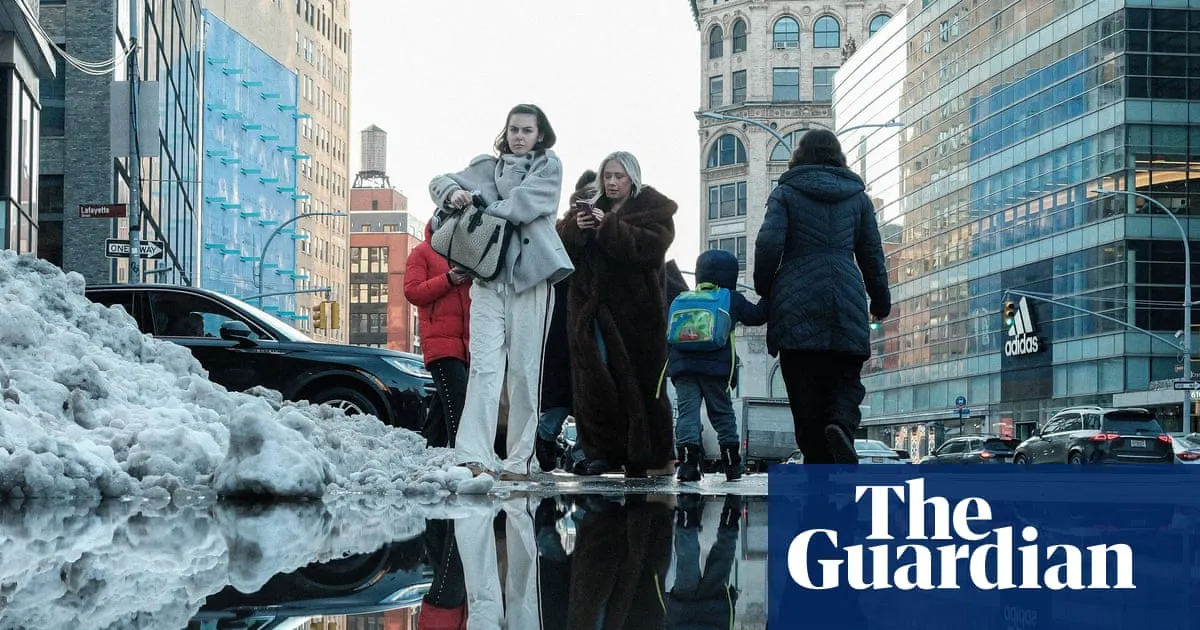
For the millions of people across the United States who have spent the last month digging themselves out of above-average levels of snow and ice, this winter has felt especially long and harsh. But the typical winter is actually getting shorter in 80% of major US cities scrutinized by researchers, according to new data released by Climate Central, an independent climate science and communication group.Researchers found that across 195 US cities, winters are on average nine days shorter today than they were from 1970 to 1997, as the climate crisis progresses.For the purposes of the study, analysts defined winter as the coldest 90 consecutive days of the year during the past period, 1970-1997, and then compared the frequency of winter-like temperatures during the most recent 28-year period, 1998-2025. Across the country, they found that winter-defining temperatures are arriving later and ending earlier than in the 20th century.Cities across the US south-east, north-east, upper midwest and south have experienced the largest average decrease in winter days, according to the research.Juneau and Anchorage in Alaska have seen winters shrink the most, by 62 and 49 days, respectively. Approximately 15% of the 295 cities analyzed saw winters lengthen, particularly along the California coast and in the Ohio Valley.Ironically, the new data coincides with one of the most brutal winters in recent memory, including this week’s historic nor’easter blizzard, which meteorologists have said is the strongest storm in a decade. More than 2ft (61cm) of snow was recorded in parts of the north-eastern US, with more than 3ft (91cm) falling in Rhode Island – surpassing totals from the north-east’s historic blizzard of 1978.“A shorter winter doesn’t mean no winter,” Mathew Barlow, professor of climate science at the University of Massachusetts Lowell, said on Friday. “Another important piece of [research] is that we expect greater precipitation intensity as the climate warms.”The storm caused power outages for hundreds of thousands of people and forced public officials to implement temporary travel bans in New York, Massachusetts, New Jersey, Connecticut and Delaware, among other states.Many climate change deniers have used the recent storms to try to prove that the planet is not heating, driven by human-caused emissions. In January, Donald Trump, who has repeatedly questioned and mocked established climate science, posted about the storms hitting the US in late January: “Record Cold Wave expected to hit 40 States. Rarely seen anything like it before. Could the Environmental Insurrectionists please explain – WHATEVER HAPPENED TO GLOBAL WARMING???”However, January’s storm was likely caused by the stretching of the polar vortex, a vast circular ribbon of planetary wind. Research published last year found that the stretching of the polar vortex in this way is contributing to extreme weather in the US and that global heating, counterintuitively, could be playing a role in accelerating this process.While speaking of Trump’s “ridiculous” argument against global warming, Barlow said: “If you wait for the cold day and you say: ‘Oh, it’s cold’ and you ignore all the other warm days, that’s not an honest attempt at assessing the data in any way, shape or form.”Previous Guardian reporting acknowledged that a single winter storm in one region of one country tells us very little about longer-term, global climate trends. The world is not only undeniably heating up, but in countries like the US, winters are warming at a faster rate than other seasons.Even with evidence of the devastating impacts of global warming in plain sight, Trump has made dismantling environmental protections a key priority of his second administration. On 12 February, Trump’s Environmental Protection Agency (EPA) revoked a core scientific determination, known as the endangerment finding, that gives the government the ability to regulate climate-heating pollution.Since 2009, this policy has allowed the EPA to limit heat-trapping pollution from vehicles, power plants and other industrial sources. More than a dozen health and environmental justice non-profits have sued the EPA over the move.Warmer, shorter winters have significant consequences for both humans and the environment, including reduced water supply, decreased summer crop yields and worsening allergy seasons.“These are not just impacts that you see when you look out the window or affect if you are able to drive into work,” Barlow said. “These are also pretty substantial changes to ecosystems, the health of our natural community and our water resources.”Shorter winters are also creating challenges for local economies. The multibillion-dollar winter recreation industry faces challenges from rising temperatures and reduced snow and ice cover. In certain parts of Colorado, ski resort visits are down 20% this year amid severe snow drought.“It’s important to keep in mind that extreme events, even extreme cold events, are still going to occur, even if they’re occurring less frequently,” said Barlow. “As winter gets warmer, we sort of lose the practice and lose the resources in place to deal with these extreme events. When we do still get substantial snow, there are just fewer people to plow.”
SRCThe Guardian - World News
LANGEN
LEANCenter-Left
WORDS813
ENT9
FRI · 2026-02-27 · 19:18 GMTBRIEF NSR-2026-0227-19922
NSR-2026-0227-19922News Report·EN·Environmental
Winter getting shorter in 80% of major US cities, new data shows
A recent study by Climate Central reveals that winters are shortening in 80% of major US cities. Analyzing data from 195 cities, researchers compared the period of 1970-1997 to 1998-2025, defining winter as the coldest 90 consecutive days.
Sara Braun in New YorkThe Guardian - World NewsFiled 2026-02-27 · 19:18 GMTLean · Center-LeftRead · 4 min
The Guardian - World NewsFIG 01
Reading time
4min
Word count
813words
Sources cited
1cited
Entities identified
9entities
Quality score
100%
§ 01
Briefing Summary
AI-generatedNEWSAR · AI
A recent study by Climate Central reveals that winters are shortening in 80% of major US cities. Analyzing data from 195 cities, researchers compared the period of 1970-1997 to 1998-2025, defining winter as the coldest 90 consecutive days. The study found that winter-defining temperatures are arriving later and ending earlier, resulting in an average decrease of nine winter days across the country. The Southeast, Northeast, upper Midwest, and South regions have experienced the most significant reduction in winter days, with Alaska seeing the largest decrease. Despite this trend, some areas, particularly along the California coast and in the Ohio Valley, have seen winters lengthen. This data coincides with a particularly harsh winter in the Northeast, highlighting that shorter winters do not eliminate the possibility of intense winter storms.
Confidence 0.90Sources 1Claims 5Entities 9
§ 02
Article analysis
Model · rule-basedFraming
Environmental
Political Strategy
Tone
Measured
AI-assessed
CalmNeutralAlarmist
Factuality
0.80 / 1.00
Factual
LowHigh
Sources cited
1
Limited
FewMany
§ 03
Key claims
5 extracted01
Approximately 15% of the 295 cities analyzed saw winters lengthen.
statisticResearchers
Confidence
1.00
02
A shorter winter doesn’t mean no winter.
quoteMathew Barlow, professor of climate science at the University of Massachusetts Lowell
Confidence
1.00
03
Juneau and Anchorage in Alaska have seen winters shrink the most, by 62 and 49 days, respectively.
statisticResearchers
Confidence
1.00
04
Winters are on average nine days shorter today than they were from 1970 to 1997.
statisticResearchers
Confidence
1.00
05
The typical winter is getting shorter in 80% of major US cities.
statisticClimate Central
Confidence
1.00
§ 04
Full report
4 min read · 813 words§ 05
Entities
9 identifiedKey playerOppositionContextPositiveNeutralNegative
§ 06
Keywords & salience
8 termsshorter winter
1.00
climate change
0.90
winter temperatures
0.70
snow and ice
0.60
climate crisis
0.60
climate science
0.50
precipitation intensity
0.50
nor'easter blizzard
0.40
§ 07
Topic connections
Interactive graph Network visualization showing 51 related topics
View Full Graph Person Organization Location Event|Click node to navigate|Edge numbers = shared articles