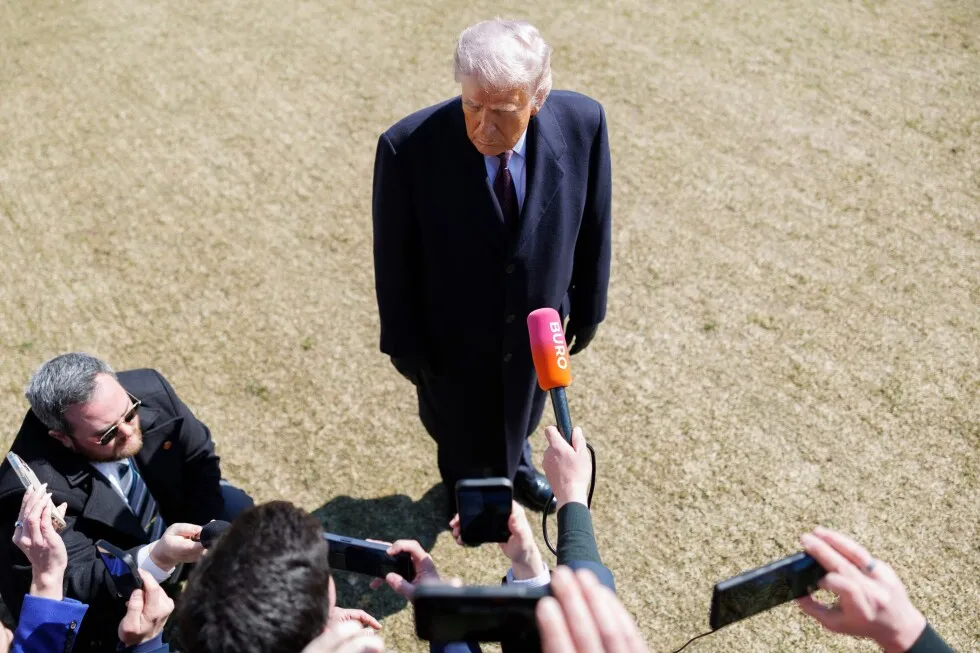
Trump raises the possibility of a ‘friendly takeover of Cuba’ coming out of talks with Havana 1 of 2 | President Donald Trump speaks to reporters before departing on Marine One from the South Lawn of the White House, Friday, Feb. 27, 2026, in Washington. (AP Photo/Tom Brenner) 2 of 2 | President Donald Trump speaks to reporters before departing on Marine One from the South Lawn of the White House, Friday, Feb. 27, 2026, in Washington. (AP Photo/Tom Brenner) 1 of 2 President Donald Trump speaks to reporters before departing on Marine One from the South Lawn of the White House, Friday, Feb. 27, 2026, in Washington. (AP Photo/Tom Brenner) Add AP News on Google Add AP News as your preferred source to see more of our stories on Google. 2 of 2 President Donald Trump speaks to reporters before departing on Marine One from the South Lawn of the White House, Friday, Feb. 27, 2026, in Washington. (AP Photo/Tom Brenner) Add AP News on Google Add AP News as your preferred source to see more of our stories on Google. Updated [hour]:[minute] [AMPM] [timezone], [monthFull] [day], [year] Washington (AP) — President Donald Trump said Friday that the U.S. is in talks with Havana and raised the possibility of a “friendly takeover of Cuba” without offering any details on what he meant.Speaking to reporters outside the White House as he left for a trip to Texas, Trump said Secretary of State Marco Rubio was in discussions with Cuban leaders “at a very high level.” “The Cuban government is talking with us,” the president said. “They have no money. They have no anything right now. But they’re talking to us, and maybe we’ll have a friendly takeover of Cuba.”He added: “We could very well end up having a friendly takeover of Cuba.”Trump didn’t clarify his comments but seemed to indicate that the situation with Cuba, a communist-run island that has been among Washington’s bitterest adversaries for decades, was coming to a critical point. The White House did not respond to requests for more information Friday. The president also said that Cuba “is, to put it mildly, a failed nation” and “they want our help.”His remarks came two days after the Cuban government reported that a Florida-registered speedboat carrying 10 armed Cubans from the U.S. opened fire on soldiers off the island’s north coast. Four of the armed Cubans were killed, and six were injured in responding gunfire, according to Cuba’s government. One Cuban official also was injured. Cuba has been on Trump’s mind since at least early January, after U.S. forces ousted one of Havana’s closest allies, Venezuela’s socialist President Nicolás Maduro. Trump suggested in the aftermath of that raid that military action in Cuba might not be necessary because the island’s economy was weak enough — particularly in the absence of oil shipments from Venezuela that stopped after Maduro was taken into custody — to soon collapse on its own. “We’ve had a lot of years of dealing with Cuba. I’ve been hearing about Cuba since I’m a little boy. But they’re in big trouble,” he said Friday. Then, noting the exile community from the island living in the U.S., Trump said there could be something coming that “I think (is) very positive for the people that were expelled, or worse, from Cuba and live here.” He did not elaborate.The U.S. has maintained a strict trade embargo on Cuba since 1962, the year after a failed, CIA-sponsored invasion of the island at the Bay of Pigs. Trump nonetheless indicated earlier this month that talks with Cuban officials were underway.Cuba’s government confirmed earlier this week that it was communicating with U.S. officials following the shooting of the American boat. Rubio has said the U.S. Department of Homeland Security and Coast Guard are investigating what happened. An executive order that Trump signed in late January pledged to impose tariffs on countries providing oil to Cuba, threatening to further cripple a country already plagued by a deepening energy crisis, though U.S. authorities have since indicated that oil from Venezuela can be sold to Cuban interests in some cases. Carlos Fernández de Cossío, Cuba’s deputy foreign minister, posted, then later deleted on Friday that “the US maintains its fuel embargo against Cuba in full force, and its impact as a form of collective punishment is unwavering.” “Nothing announced in recent days changes this reality,” he wrote on X before the post was removed. “The possibility of conditional sales to the private sector already existed and does not alleviate the impact on the Cuban population.”Meanwhile, 40-plus U.S. civil society organizations sent a letter to Congress on Friday asking that it “press the Trump administration to reverse its aggressive policy towards Cuba” and saying that efforts to cut oil shipments to the Caribbean island would spark a humanitarian collapse.Signees included the Alliance of Baptists, ActionAid USA and the Presbyterian Church.“Policies that deliberately impose hunger and mass hardship on millions of civilians constitute a form of collective punishment, and as such are a grave violation of international humanitarian law,” the letter reads.Associated Press writer Dánica Coto contributed from San José, Costa Rica. Weissert covers the White House for The Associated Press. He is based in Washington.
SRCAssociated Press (AP)
LANGEN
LEANCenter
WORDS870
ENT8
FRI · 2026-02-27 · 20:23 GMTBRIEF NSR-2026-0227-19926
NSR-2026-0227-19926News Report·EN·Diplomatic
Trump raises the possibility of a ‘friendly takeover of Cuba’ coming out of talks with Havana
In February 2026, President Donald Trump stated that the U.S. is in talks with Cuba, suggesting a possible "friendly takeover" of the island nation.
By
WILL WEISSERTAssociated Press (AP)Filed 2026-02-27 · 20:23 GMTLean · CenterRead · 4 min
Associated Press (AP)FIG 01
Reading time
4min
Word count
870words
Sources cited
2cited
Entities identified
8entities
Quality score
100%
§ 01
Briefing Summary
AI-generatedNEWSAR · AI
In February 2026, President Donald Trump stated that the U.S. is in talks with Cuba, suggesting a possible "friendly takeover" of the island nation. Speaking to reporters in Washington, D.C., Trump mentioned that Secretary of State Marco Rubio is engaged in high-level discussions with Cuban leaders. Trump characterized Cuba as a "failed nation" seeking U.S. assistance, citing their current economic struggles. These remarks followed a recent incident where a boat carrying armed Cubans from the U.S. allegedly opened fire on Cuban soldiers off the island's coast, resulting in casualties on both sides. The White House did not provide further clarification on the President's comments.
Confidence 0.90Sources 2Claims 5Entities 8
§ 02
Article analysis
Model · rule-basedFraming
Diplomatic
Economic Impact
Tone
Mixed Tone
AI-assessed
CalmNeutralAlarmist
Factuality
0.70 / 1.00
Factual
LowHigh
Sources cited
2
Limited
FewMany
§ 03
Key claims
5 extracted01
Cuba “is, to put it mildly, a failed nation” and “they want our help.”
quotePresident Donald Trump
Confidence
1.00
02
Secretary of State Marco Rubio was in discussions with Cuban leaders “at a very high level.”
quotePresident Donald Trump
Confidence
1.00
03
Trump raised the possibility of a “friendly takeover of Cuba”.
quotePresident Donald Trump
Confidence
1.00
04
President Donald Trump said the U.S. is in talks with Havana.
quotePresident Donald Trump
Confidence
1.00
05
A Florida-registered speedboat carrying 10 armed Cubans from the U.S. opened fire on soldiers off the island’s north coast.
factualCuba’s government
Confidence
0.80
§ 04
Full report
4 min read · 870 words§ 05
Entities
8 identifiedKey playerOppositionContextPositiveNeutralNegative
§ 06
Keywords & salience
8 termscuba
1.00
friendly takeover
0.90
donald trump
0.80
havana
0.70
u.s. relations
0.60
cuban government
0.50
marco rubio
0.50
failed nation
0.40
§ 07
Topic connections
Interactive graph Network visualization showing 51 related topics
View Full Graph Person Organization Location Event|Click node to navigate|Edge numbers = shared articles