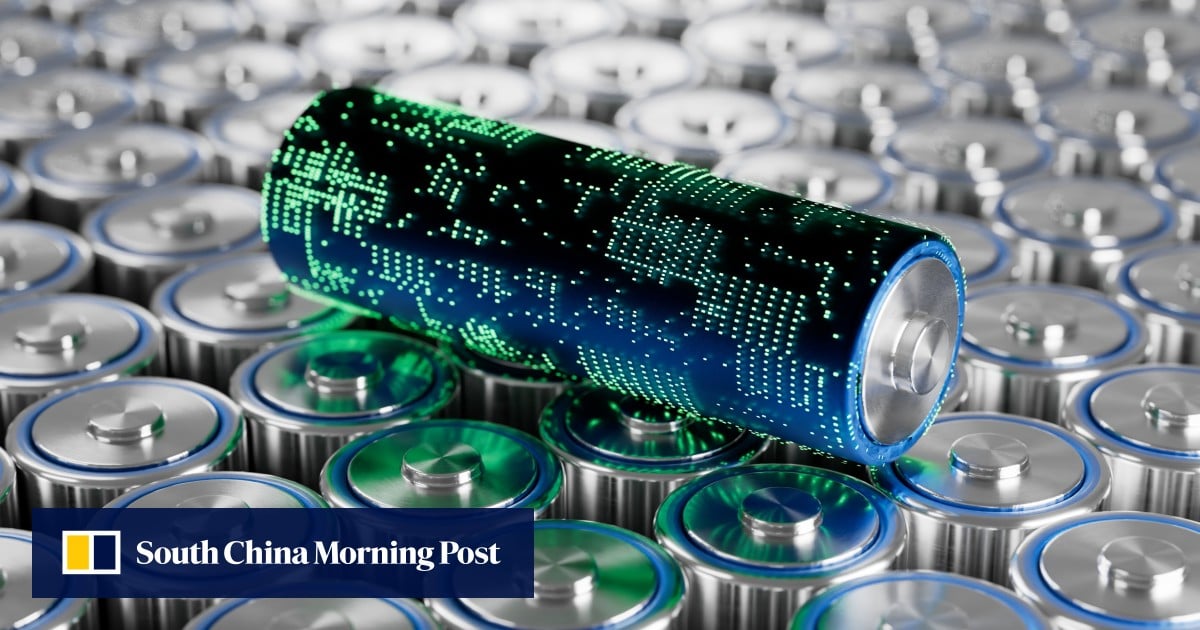
Chinese scientists have developed a flexible and safe organic lithium-ion battery that could be suitable for use in wearable electronics and in extreme conditions.The breakthrough stems from an innovative organic cathode material that enables efficient and stable performance across an extreme temperature range, from far below freezing to as hot as 80 degrees Celsius (176 degrees Fahrenheit).Conventional lithium-ion batteries typically use inorganic minerals such as lithium cobalt oxide or lithium iron phosphate as cathode materials. Their production costs depend on available mineral resources, and they pose safety risks when colliding or overheating.Flexible organic materials’ resistance to bending makes them promising candidates for wearable devices. Photo: HandoutTo address these challenges, researchers have explored using flexible organic materials as an alternative. These materials are inherently stable, reducing the risk of combustion or explosion, and they are easier to synthesise and recycle.Their resistance to bending also makes them promising candidates for wearable devices.However, organic materials generally suffer from low electrical conductivity, often requiring large amounts of conductive additives. Small organic molecules also tend to dissolve in the electrolyte, leading to shorter battery life.According to a report published by the China-science-daily" class="entity-link entity-organization" data-entity-id="17557" data-entity-type="organization">China Science Daily last week, Chinese researchers have taken a crucial step towards bringing organic batteries from the laboratory into practical use.The research was led by Xu Yunhua from Tianjin University and Huang Fei from China-university-of-technology" class="entity-link entity-organization" data-entity-id="37969" data-entity-type="organization">South China University of Technology. Their findings were published in Nature on February 18.
SRCSouth China Morning Post
LANGEN
LEANCenter-Right
WORDS235
ENT5
SUN · 2026-03-01 · 06:00 GMTBRIEF NSR-2026-0301-20248
NSR-2026-0301-20248News Report·EN·Technology
Why Chinese team’s flexible organic battery could change the face of wearables
Chinese scientists from Tianjin University and South China University of Technology, led by Xu Yunhua and Huang Fei, have developed a flexible and safe organic lithium-ion battery. This battery utilizes an innovative organic cathode material, offering stable performance in extreme temperatures ranging from below freezing to 80 degrees Celsius.
Zhang TongSouth China Morning PostFiled 2026-03-01 · 06:00 GMTLean · Center-RightRead · 1 min
South China Morning PostFIG 01
Reading time
1min
Word count
235words
Sources cited
4cited
Entities identified
5entities
Quality score
100%
§ 01
Briefing Summary
AI-generatedNEWSAR · AI
Chinese scientists from Tianjin University and South China University of Technology, led by Xu Yunhua and Huang Fei, have developed a flexible and safe organic lithium-ion battery. This battery utilizes an innovative organic cathode material, offering stable performance in extreme temperatures ranging from below freezing to 80 degrees Celsius. The organic material addresses limitations of conventional lithium-ion batteries, such as reliance on mineral resources and safety risks associated with overheating. Organic materials are also more flexible, making them suitable for wearable devices. The new battery design overcomes challenges of low conductivity and electrolyte dissolution typically associated with organic materials, representing a step towards practical application of organic batteries. The findings were published in Nature on February 18.
Confidence 0.90Sources 4Claims 5Entities 5
§ 02
Article analysis
Model · rule-basedFraming
Technology
Economic Impact
Tone
Measured
AI-assessed
CalmNeutralAlarmist
Factuality
0.80 / 1.00
Factual
LowHigh
Sources cited
4
Well sourced
FewMany
§ 03
Key claims
5 extracted01
Findings were published in Nature on February 18.
factual
Confidence
1.00
02
The research was led by Xu Yunhua from Tianjin University and Huang Fei from South China University of Technology.
factual
Confidence
1.00
03
Conventional lithium-ion batteries use inorganic minerals as cathode materials.
factual
Confidence
1.00
04
The battery can operate across an extreme temperature range, from below freezing to 80 degrees Celsius.
factual
Confidence
1.00
05
Chinese scientists have developed a flexible and safe organic lithium-ion battery.
factual
Confidence
1.00
§ 04
Full report
1 min read · 235 words§ 05
Entities
5 identifiedKey playerOppositionContextPositiveNeutralNegative
Organizations4
Locations1
§ 06
Keywords & salience
9 termsflexible organic battery
1.00
wearable electronics
0.80
lithium-ion battery
0.70
organic cathode material
0.70
flexible materials
0.60
extreme temperature
0.60
electrical conductivity
0.50
battery life
0.40
recycling
0.40
§ 07
Topic connections
Interactive graph Network visualization showing 51 related topics
View Full Graph Person Organization Location Event|Click node to navigate|Edge numbers = shared articles