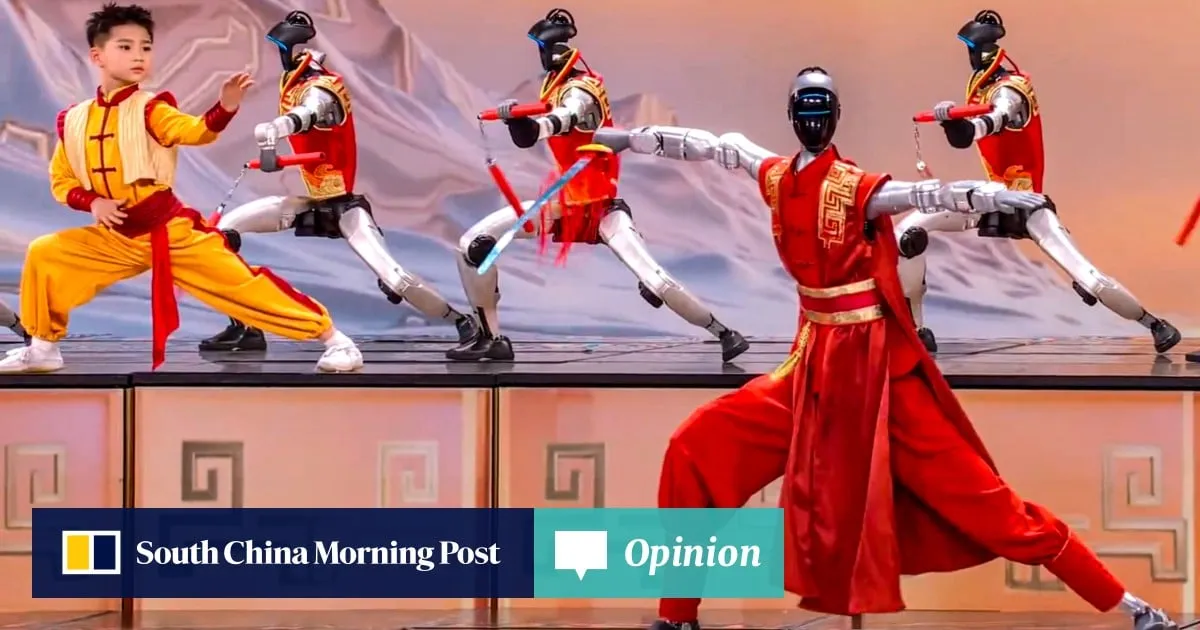
On the eve of the Chinese New Year, the Spring Festival Gala, one of the world’s most-watched television broadcasts, delivered more than just festive entertainment. It served as a high-definition manifesto of China’s “embodied AI” supremacy. International observers, from Reuters to El Pais, watched as humanoid robots from start-ups such as Unitree performed complex martial arts, backflips and synchronised dances.As Beijing-based tech analyst Poe Zhao noted, these humanoids represent the synthesis of China’s three-fold advantage: cutting-edge artificial intelligence (AI), a peerless hardware supply chain and an unshakeable national will. Even Tesla founder Elon Musk recently conceded that his greatest rivals are Chinese, stating that people outside China underestimate them. The Spring Festival Gala proved him right.The sheer velocity of improvement – from simple rhythmic movement in 2025 to full acrobatic stunts in 2026 – suggests an evolutionary slope that the West is no longer climbing.The American establishment has comforted itself with the belief that AI is the domain of large language models, silicon chips and venture capital. But the gala highlighted how we are moving from a world where finance constrains reality to a world where physical reality constrains finance.The “brain” of AI might be a chip, but its “body” requires more electricity, more rare earths, steel and a power grid that doesn’t groan under the weight of a summer heatwave. While the US optimised its economy for advertising algorithms and financial engineering, China has built the “base layer” for the 21st century.The statistics are staggering. China’s power grid capacity has expanded since 2021 by an amount surpassing the entire existing US grid.
SRCSouth China Morning Post
LANGEN
LEANCenter-Right
WORDS263
ENT9
TUE · 2026-03-03 · 08:30 GMTBRIEF NSR-2026-0303-20926
NSR-2026-0303-20926Analysis·EN·Economic Impact
How the US ceded the robotics economy to China
On the eve of the Chinese New Year, the Spring Festival Gala, one of the world’s most-watched television broadcasts, delivered more than just festive entertainment. It served as a high-definition manifesto of China’s “embodied AI” supremacy. International observers, from Reuters to El Pais, watched
Jianlu BiSouth China Morning PostFiled 2026-03-03 · 08:30 GMTLean · Center-RightRead · 2 min
South China Morning PostFIG 01
Reading time
2min
Word count
263words
Sources cited
2cited
Entities identified
9entities
Quality score
75%
§ 02
Article analysis
Model · rule-basedFraming
Economic Impact
Technology
Tone
Mixed Tone
AI-assessed
CalmNeutralAlarmist
Factuality
0.60 / 1.00
Mixed
LowHigh
Sources cited
2
Limited
FewMany
§ 03
Key claims
5 extracted01
Elon Musk recently conceded that his greatest rivals are Chinese.
quoteElon Musk
Confidence
1.00
02
Humanoid robots from start-ups such as Unitree performed complex martial arts, backflips and synchronised dances at the Spring Festival Gala.
factualnull
Confidence
1.00
03
These humanoids represent the synthesis of China’s three-fold advantage: cutting-edge AI, a peerless hardware supply chain and an unshakeable national will.
quotePoe Zhao
Confidence
0.90
04
China’s power grid capacity has expanded since 2021 by an amount surpassing the entire existing US grid.
statisticnull
Confidence
0.80
05
The West is no longer climbing the evolutionary slope of robotics improvement.
predictionnull
Confidence
0.60
§ 04
Full report
2 min read · 263 words§ 05
Entities
9 identifiedKey playerOppositionContextPositiveNeutralNegative
People1
§ 06
Keywords & salience
10 termschina
1.00
robotics
0.90
artificial intelligence
0.80
embodied ai
0.80
united states
0.70
hardware supply chain
0.70
economic competition
0.60
power grid
0.60
manufacturing
0.60
technology
0.50
§ 07
Topic connections
Interactive graph Network visualization showing 51 related topics
View Full Graph Person Organization Location Event|Click node to navigate|Edge numbers = shared articles