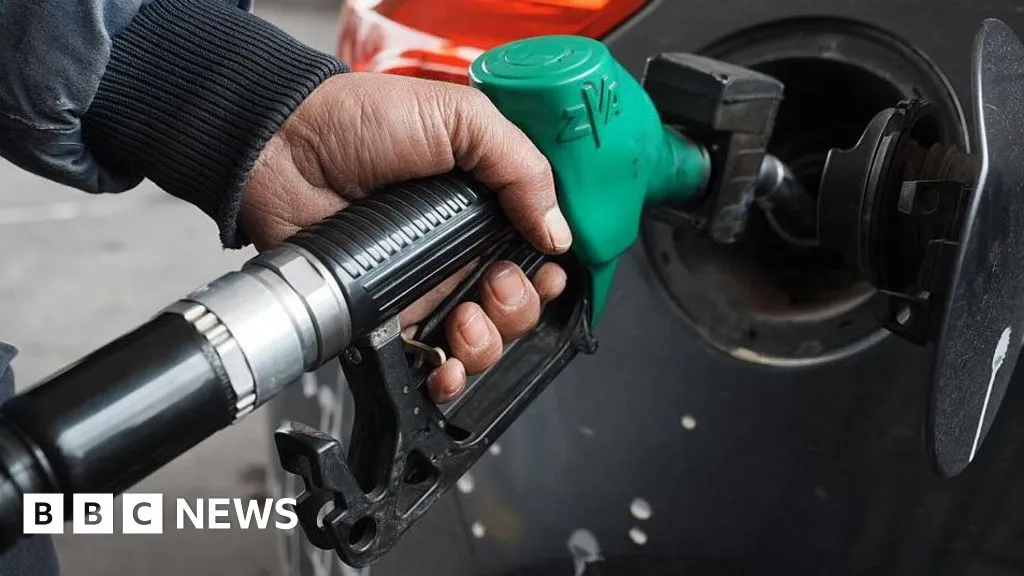
14 minutes agoOsmond ChiaandNick Edser,Business reportersGetty ImagesGas prices rose at the fastest pace for more than three years and stock markets tumbled after an Iranian official said his country would "set fire to anyone who tries to pass through" the key Strait of Hormuz shipping route. In the UK, the FTSE 100 index fell by 2.6% while stocks markets in France and Germany tumbled. Investors are weighing the impact of the conflict on the financial markets and what it could mean for inflation and whether central banks will cut interest rates.Gas prices rose to about 150p a therm on Tuesday, to the highest level for more than three years.Higher gas prices could put pressure on household energy bills, although any impact would not be seen in the UK until July because a price cap has been put in place until then. At the same time, rising oil prices can affect the economy by making things such as transport and food more expensive.If inflation - the pace of price rises - picks up, then this may make central banks less likely to cut interest rates in the months ahead.The price of gas leapt on Monday after QatarEnergy, one of the world's biggest exporters, halted production following "military attacks" on its facilities.Meanwhile, the UK's FTSE 100 dropped 2.5% in Tuesday trading. Germany's Dax fell by 3.2% while in France, the Cac 40 slid by 2.6%. Ebrahim Jabbari, an adviser to the commander-in-chief of Iran's Islamic Revolutionary Guard Corps (IRGC), told state TV that ships "should not come to this region. They will certainly face a serious response from us".Shipping through the Strait of Hormuz is crucial to the global economy, with about 20% of the world's oil and gas passing through the waterway. But they have come to a halt after several vessels were attacked in recent days.As well as pushing up prices on global energy markets, the conflict has triggered a rise in how much it costs to transport oil.Hiring a supertanker to move oil from the Middle East to China reached an all-time high on Monday of more than $400,000 (£298,300) almost double the cost last week, according to data from the London Stock Exchange Group.Sanne Manders, president of logistics technology platform Flexport, told the BBC the Strait of Hormuz is "effectively closed".It is partly down to carriers not willing to take the risk, but also due to "insurance companies not being willing to insure this risk anymore", he told the Today programme.He added that carriers were likely to start raising rates "for any shipping in the world" in anticipation of higher fuel prices.Crude oil prices could pass $100 a barrel if the disruption to shipments is prolonged, Srinivaasan Balakrishnan from risk research firm Avellon Intelligence said.He predicted that if it held at that level US petrol prices could rise by up to 25 cents a gallon.He is scheduled to meet Treasury Secretary Scott Bessent and Energy Secretary Chris Wright on Tuesday to discuss the issue.Secretary of State Marco Rubio said Washington would announce plans to deal with rising energy prices."We knew that going in would be a factor," Rubio said. "Starting tomorrow you will see us rolling out those phases to try to mitigate against that."The UK is also likely to see higher fuel prices if the cost of oil remains high, according to Alasdair Locke, chairman of Motor Fuel Group, the UK's largest independent forecourt operator."With the price of oil going up, that is inevitably going to feed through in due course to higher prices at the pump," he said."It will depend on how long and how high those prices go as to how high the price of fuel will be."In Asia, Japan's Nikkei closed 3.3% lower, with shares in export‑reliant firms like Toyota, Panasonic and Sony among the hardest hit.Hong Kong's Hang Seng and the Shanghai Composite in mainland China were also down.The Kospi in South Korea, which was shut for a public holiday on Monday, fell by more than 7%.Seoul's export-driven economy is especially vulnerable to geopolitical events, with shares of leading firms Hyundai, Samsung and chip company SK Hynix falling by 10%.
SRCBBC News - World
LANGEN
LEANCenter
WORDS687
ENT8
TUE · 2026-03-03 · 10:39 GMTBRIEF NSR-2026-0303-20927
NSR-2026-0303-20927News Report·EN·Economic Impact
Gas and oil prices soar and shares tumble as crucial shipping lane threatened
Iranian official threatens to "set fire" to any ships passing through the Strait of Hormuz.
BBC News - WorldFiled 2026-03-03 · 10:39 GMTLean · CenterRead · 3 min
BBC News - WorldFIG 01
Reading time
3min
Word count
687words
Sources cited
6cited
Entities identified
8entities
Quality score
50%
§ 02
Article analysis
Model · rule-basedFraming
Economic Impact
Conflict
Tone
Mixed Tone
AI-assessed
CalmNeutralAlarmist
Factuality
0.80 / 1.00
Factual
LowHigh
Sources cited
6
Well sourced
FewMany
§ 03
Key claims
6 extracted01
Shipping through the Strait of Hormuz is crucial to the global economy, with about 20% of the world's oil and gas passing through the waterway.
factual
Confidence
1.00
02
Ships should not come to this region. They will certainly face a serious response from us.
quoteEbrahim Jabbari, an adviser to the commander-in-chief of Iran's Islamic Revolutionary Guard Corps (IRGC)
Confidence
1.00
03
The FTSE 100 index fell by 2.6%.
statistic
Confidence
1.00
04
Gas prices rose at the fastest pace for more than three years.
factual
Confidence
1.00
05
The Strait of Hormuz is effectively closed.
quoteSanne Manders, president of logistics technology platform Flexport
Confidence
0.80
06
Crude oil prices could pass $100 a barrel if the disruption to shipments is prolonged.
predictionSrinivaasan Balakrishnan from risk research firm Avellon Intelligence
Confidence
0.70
§ 04
Full report
3 min read · 687 words§ 05
Entities
8 identifiedKey playerOppositionContextPositiveNeutralNegative
People1
Organizations3